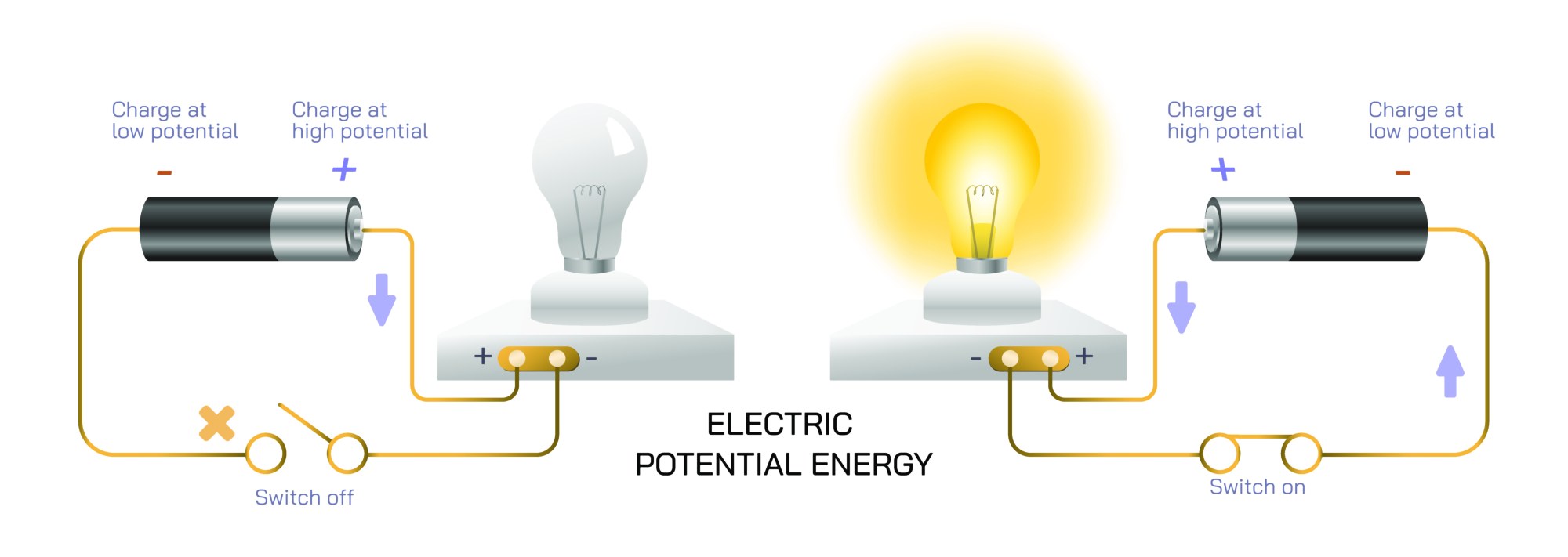
Electric Potential Energy — Meaning, Behavior, and Visual Representation
Electric potential energy describes the stored influence that appears when charges occupy positions within a field region. This type of energy arises from the way charges interact through their natural tendency to attract or repel. When a charge is moved or held at a certain point in this region, the surrounding environment gains or releases a specific amount of stored effect. This stored effect is what allows many electrical systems to function, shaping behavior in circuits, devices, and natural atmospheric events. Even though the idea appears in physics study material, it is also a popular concept for Adobe design work, especially in educational vectors, diagrams, and conceptual art pieces.
To understand this idea, it is helpful to picture a single charge placed inside a field region created by another charge. The position of the smaller charge determines how much stored influence exists. When the smaller charge stays close, the stored influence becomes strong because the interaction between the two points grows intense. When the smaller charge remains farther away, the influence weakens. The difference between these positions creates a change in energy, and that change defines the potential stored at each location. This makes electric potential energy a positional form of energy, meaning it depends heavily on placement rather than movement.
Electric potential energy is important because it forms the base of many electrical processes. When a charge moves from one point to another, the stored influence changes, and that change can perform work. Lights, motors, sensors, communication devices, and countless digital systems rely on this effect within circuits. Even in natural settings such as lightning, large charge regions gather stored influence until the environment forces a sudden release. This makes the concept both practical and deeply connected to daily life. The entire idea revolves around how different positions in a field create distinct energy levels.
When creating Adobe artwork or instructional graphics, designers often show this idea using circles, arrows, and field lines. These design elements help students visualize invisible forces clearly. A central charge is placed at the center, surrounded by expanding field curves. A second charge is shown at various distances to represent different levels of stored influence. Designers may also use color gradients to show intensity, with bright areas close to the center and softer areas outward. This makes the concept more accessible and easier to recall.
In classroom material, electric potential energy helps learners explain why charges move in certain ways. A charge placed in a high influence zone naturally tends to shift toward a region with lower influence if free to move. This shift releases stored energy into the environment. By contrast, holding a charge still within a strong influence zone requires effort. This effort creates additional stored energy in the system. These ideas guide students in understanding more advanced topics such as circuits, electrical fields, and energy transfer.
The concept also plays a role in large scale systems. In atmospheric layers, stored influence between cloud surfaces and land surfaces can grow until the environment breaks down and releases a massive burst of charge. Inside certain natural materials, slight differences in charge positions create stable patterns that support biological and chemical activity. In devices, controlled placement of charge allows for stable data storage, signal transfer, and sensor functions.
Electric potential energy also provides a foundation for visual storytelling in Adobe creative projects. Designers working on educational content often represent this concept with clean vector art, showing clear placement of charges, smooth field curves, and simplified shapes that demonstrate where energy exists. These visuals help transform an invisible idea into an understandable scene. When applied in animations, slight movement of a charge across the field region can show how energy changes calmly and smoothly.
When studied deeply, the concept reveals how nature relies on invisible influences to shape the structure of physical systems. The stored effect between charges gives rise to movement, stability, and communication between particles. This idea supports a wide range of fields including electronics, atmospheric study, chemical bonding, and material science. The more clearly the concept is visualized, the easier it becomes to understand how energy sits quietly in certain positions, ready to be released under the right conditions.
Overall, electric potential energy is a versatile and essential concept. It explains how charges store influence, how energy shifts through positions, and how natural and artificial systems use that stored effect to perform meaningful work. Whether studied in a classroom or illustrated through Adobe graphics, the concept remains a key pillar of understanding electrical behavior and visualizing the framework of field interactions in a clear and meaningful way.