Pendulum — Oscillation Patterns, Restoring Influence, and Rhythmic Motion Across Physical Systems
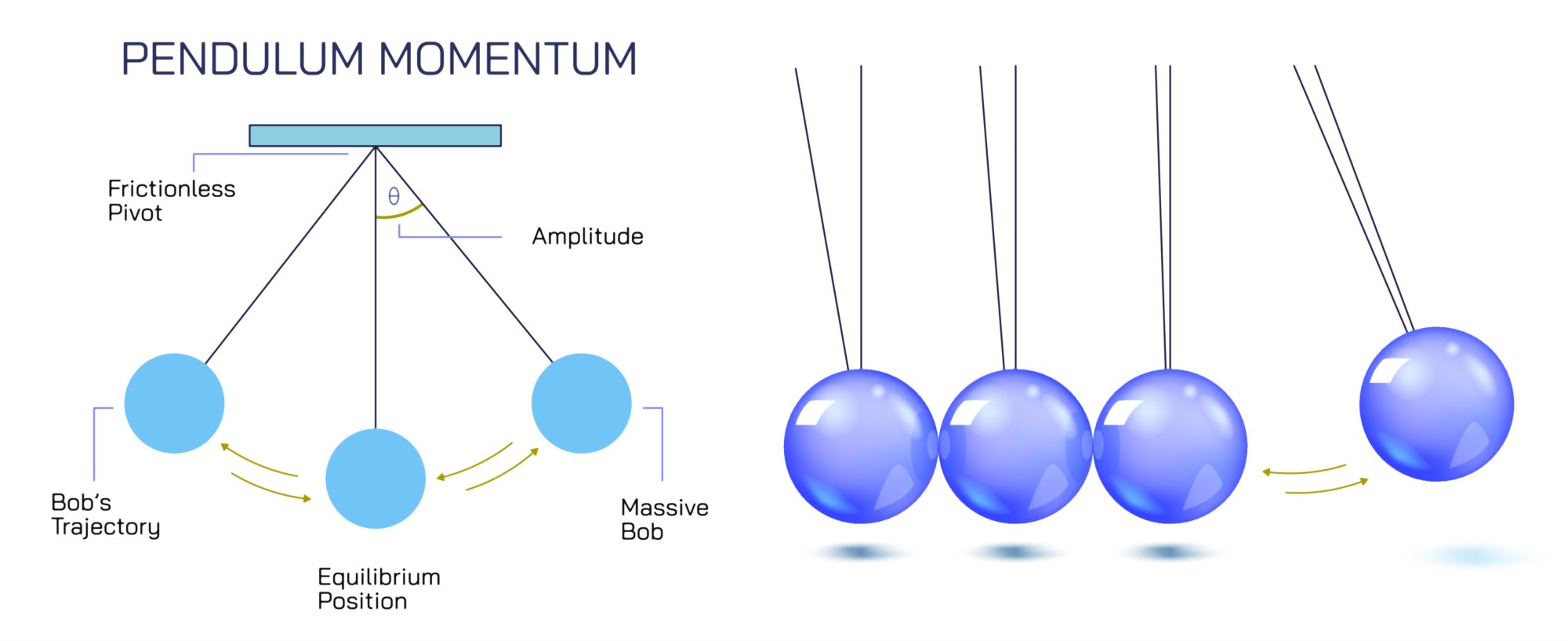
A pendulum demonstrates a repeating swing created through the interaction between gravity and suspended mass. When shifted from its resting position, it experiences a restoring effect that guides it back toward the central line. Instead of stopping there, momentum carries it across to the opposite side, creating a continuous sequence of arcs. This back-and-forth behavior forms a predictable pattern called a period, shaped by the suspended length and the influence acting on it. Even simple adjustments to length can noticeably change the time required to complete one full oscillation.
As the pendulum moves, energy alternates between elevated potential and directed kinetic form. At the highest arc, speed is minimal while positional energy is greatest. As it descends, that stored energy transforms into motion, reaching peak speed at the lowest point. This exchange repeats steadily, creating the familiar rhythm observed in mechanical clocks, laboratory instruments, and numerous natural systems. Although friction and air resistance slowly reduce the amplitude over time, the underlying sequence remains consistent until external forces fully dissipate stored energy.
The pendulum has long served as a foundation for understanding periodic behavior across various scientific areas. It offers insight into how consistent timing emerges from simple interactions, how restoring influences shape repeating cycles, and how external disturbances alter steady sequences. Its principles extend into modern engineering, signal processing, and even structural assessment, where rhythmic sway can reveal underlying conditions. By studying its patterns, observers gain a clear demonstration of fundamental physical relationships that continue to inform broader research and technological development.