Detailed Overview of the Lever Rule and Its Role in Phase Composition and Material Balance
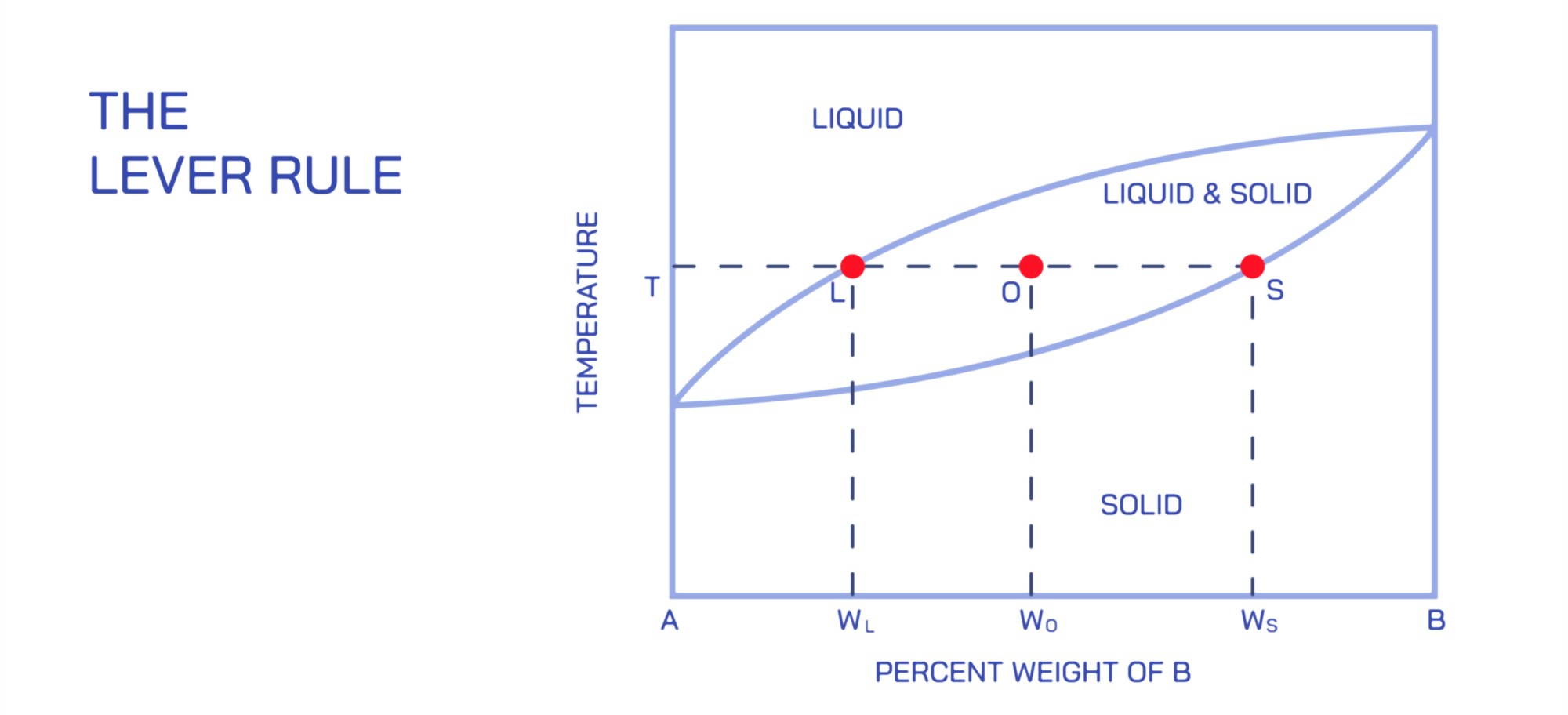
The lever rule is a core principle used to determine the relative amounts of different phases present in a system at equilibrium. It is widely applied in materials science, chemistry, metallurgy, and other fields where mixtures and phase behavior must be analyzed with precision. The rule helps calculate the proportion of two coexisting regions by treating the phase diagram like a balanced scale, allowing accurate prediction of how mixtures distribute under specific conditions.
The rule is most often applied within a two-phase field of a diagram where two distinct regions coexist. A horizontal connector, often referred to as a tie line, is drawn across the two-phase area to link the boundaries that represent each phase. The composition of the overall mixture lies somewhere along this line. By comparing the lengths of the segments on either side of the mixture point, the rule calculates the relative amounts of each phase. The longer segment corresponds to the smaller fraction, and the shorter segment corresponds to the larger fraction, much like the arms of a physical lever balancing a load.
This approach allows scientists and engineers to understand how a mixture behaves when heated, cooled, or altered. In alloy systems, for example, the rule predicts how much of one metallic phase will form compared to another. This is crucial for controlling hardness, strength, melting characteristics, and microstructure. In chemical systems, it provides insight into solubility, crystallization, and equilibrium distributions. Because these predictions can be made directly from the diagram, the rule offers a powerful, visual method for analyzing system behavior.
The strength of the lever rule lies in its simplicity and universal applicability. It does not require complex calculations or advanced measurement tools, only accurate reading of a phase diagram and understanding of composition markers. Its usefulness extends into laboratory analysis, industrial design, and academic studies, making it one of the fundamental tools for learning how materials behave under changing physical conditions.
Overall, the lever rule helps connect theoretical diagram interpretation with real-world phase behavior. Its ability to simplify complex mixtures into clear, measurable ratios makes it essential for research, teaching, and practical application across various scientific domains.