The Tunnel Effect and Its Role in Microscopic Energy Motion
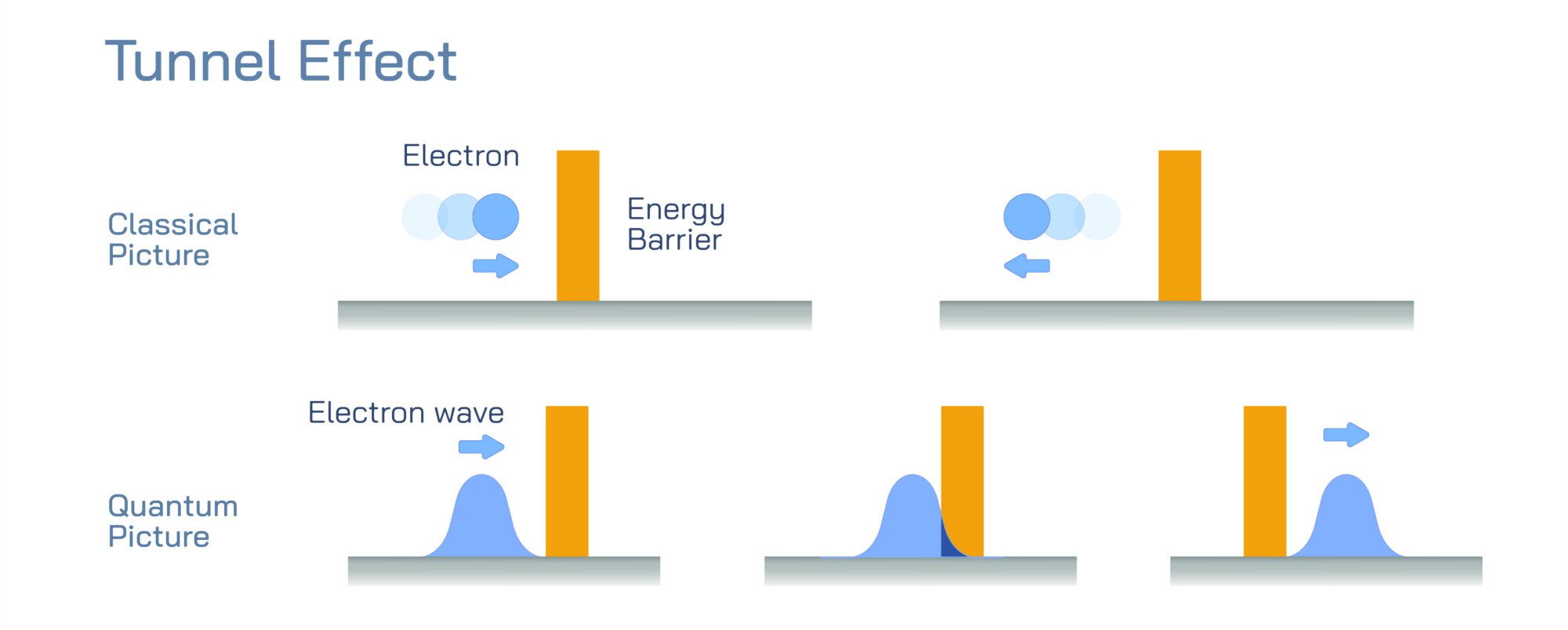
The tunnel effect describes a remarkable event observed in very small domains where waves associated with tiny particles move through slim energy blocks even when classic motion rules say such travel should not occur. This idea began forming when studies revealed that extremely small units of matter show patterns that differ from large-scale behavior. In these zones, waves linked to matter spread in space with gentle decay rather than stopping sharply at borders. Because of this softness, a narrow block can be crossed if the wave tail maintains a small but nonzero value on the far side. This passage is not a jump in the strict sense but a natural extension of the wave tail into a new region, registering as movement through the block.
Inside that very small realm, a block is not solid in the everyday sense. Instead, it is a region requiring a certain level of drive for a unit to stay in free motion. If the wave’s spread dips into that region with enough softness, part of it leaks through, giving rise to a small chance of finding the unit beyond the block. When that chance is not zero, repeated events reveal clear movement across. This outcome shapes many micro-scale events, including the passage of small units inside star cores and the behavior of advanced electronic tools in modern systems. In these applications, extremely thin blocks guide flow, allowing controlled travel of tiny units in both research and practical tools.
The process works by shaping a wave that interacts with the block edge. Before reaching the block, the wave has a steady form with a distinct rising and falling pattern. Upon touching the block, the form changes shape due to sudden change in allowed motion. The front part decays inside the block, yet the decay is not instant. If the block is thin enough, the remaining tail on the far side re-forms into a new spread. This new spread continues moving, giving the appearance that the unit has crossed the block. The passage strength depends on block width, profile, and wave drive. Narrow blocks with smooth edges show stronger passage. Wider blocks weaken the spread significantly, reducing motion likelihood.
Another major factor shaping this passage is energy flow. When the wave has higher internal drive, it reshapes less dramatically at the block’s start. More drive gives a stronger tail inside the block, raising crossing chance. Yet even with lower drive, some passage may still occur if the block is thin. This sensitivity makes the event useful for devices that rely on fine control of tiny movement. In some systems, narrow regions act as gates, using this effect to regulate subtle flow. Such gates form the basis for certain tiny switches in advanced circuits. These switches maintain stable forms because the passage chance shifts predictably with block shape.
Beyond tools and circuits, the tunnel effect explains certain natural events. Inside dense star cores, small units must combine despite repelling forces. Under normal conditions such units cannot approach closely. However, the wave nature of matter in that environment allows small leakage through the repelling zone, enabling fusion. This passage becomes critical in maintaining large-scale heat release from these stars. Without this effect, such fusion would require far greater conditions. The presence of wave spread softens block boundaries, permitting slow but steady combination processes.
In measurement systems, the tunnel effect shapes highly sensitive tools used in material study. When a very fine tip is placed near a surface, a slim block forms between them. As the gap changes, the passage chance shifts. By monitoring that shift, the device builds detailed surface maps at extremely small scales. Such tools help study surface forms, structural defects, and material reactions. They rely on precise control of block shape, gap width, and wave motion.
Through all these examples, the tunnel effect shows how micro-scale behavior differs dramatically from patterns of large objects. In the world we observe daily, a block stops movement unless a unit has enough push to climb over it. But in the micro realm, the wave form grants a distinct softness allowing limited reach into regions of higher demand. This softness is neither magic nor violation of motion rules; it follows directly from the spread of waves associated with tiny units. As research advances, this effect continues shaping new ideas, tools, and explanations for hidden processes in matter.