Raoult’s Law — Principles, Applications, and Colligative Properties
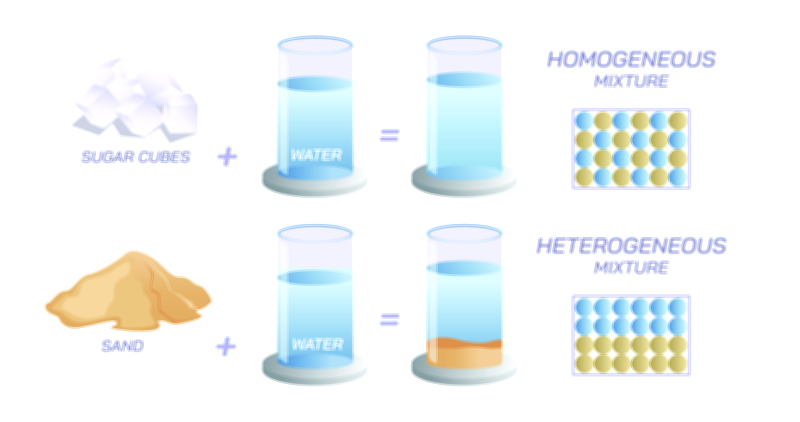
Raoult’s Law is a fundamental principle in solution chemistry that describes how the presence of a solute affects the vapor pressure of a solvent in an ideal solution. It states that the partial vapor pressure of a component in a solution is directly proportional to its mole fraction. In simpler terms, adding a non-volatile solute to a solvent lowers the solvent’s vapor pressure in proportion to the amount of solute present. This relationship is essential for understanding the behavior of solutions and predicting colligative properties.
The law applies primarily to ideal solutions, where intermolecular interactions between solute and solvent are similar to those in the pure components. In such solutions, the decrease in vapor pressure is due to the reduction of solvent molecules at the surface available to escape into the vapor phase. This phenomenon explains why solutions have lower vapor pressure compared to pure solvents, which is critical in chemical analysis, industrial processes, and laboratory experiments.
Raoult’s Law is also the foundation for understanding colligative properties, which depend on the number of solute particles rather than their chemical nature. These properties include boiling point elevation, freezing point depression, and osmotic pressure. By using Raoult’s Law, chemists can calculate the effect of solute addition on these properties, which has practical applications in designing antifreeze solutions, determining molar masses, and controlling osmotic balance in biological and industrial systems.
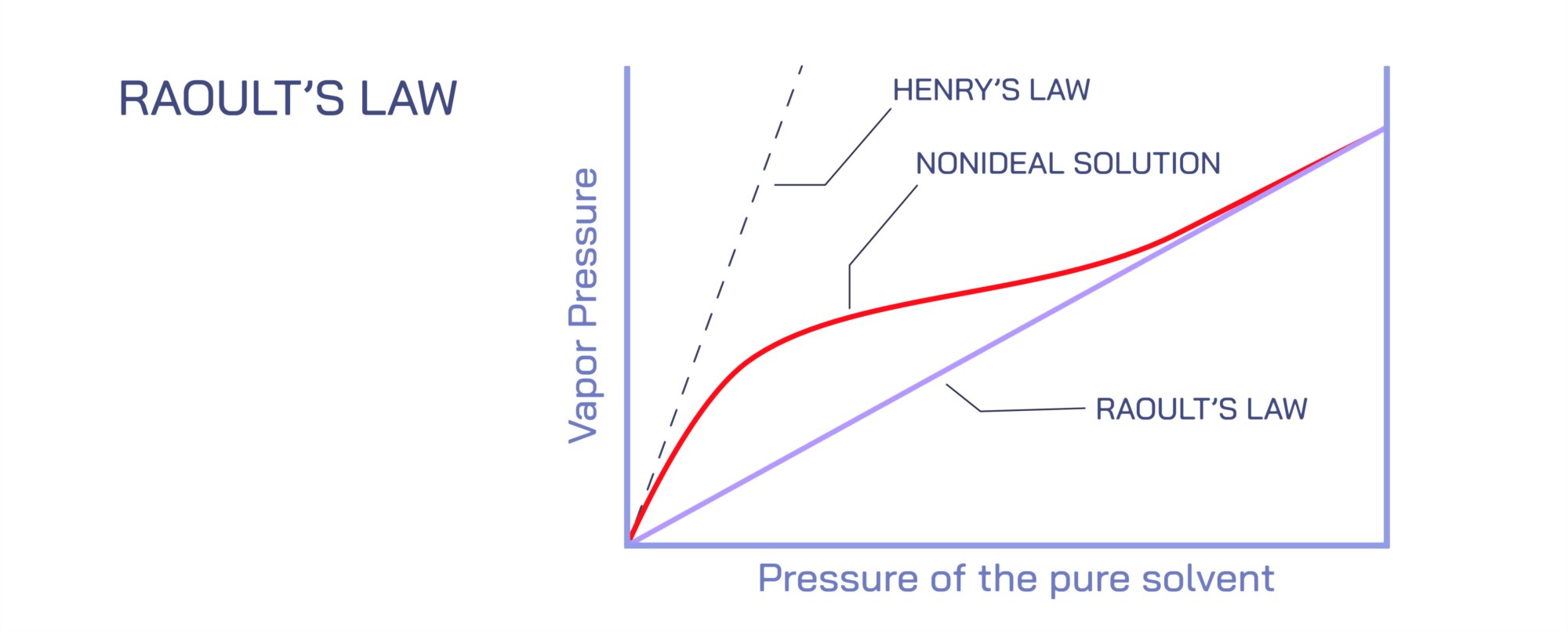
The law has significant applications in various scientific and industrial fields. In pharmaceuticals, it helps in formulation of solutions and suspensions. In food processing, it is used to understand freezing point depression for preserving food. In chemical engineering, Raoult’s Law is used in distillation, evaporation, and separation processes to predict solvent behavior and design efficient systems. Despite its accuracy for ideal solutions, deviations occur in real solutions due to strong solute-solvent interactions, which require activity coefficients for precise calculations.
In conclusion, Raoult’s Law provides a crucial understanding of how solute concentration affects the vapor pressure of solvents, forming the basis of colligative properties. It enables chemists and engineers to predict solution behavior, calculate freezing and boiling point changes, and design applications in pharmaceuticals, food, and chemical industries. Mastery of Raoult’s Law is fundamental for students and professionals working with solutions, chemical equilibria, and thermodynamic processes.