Gay-Lussac’s Law — Relationship Between Gas Pressure and Temperature Explained
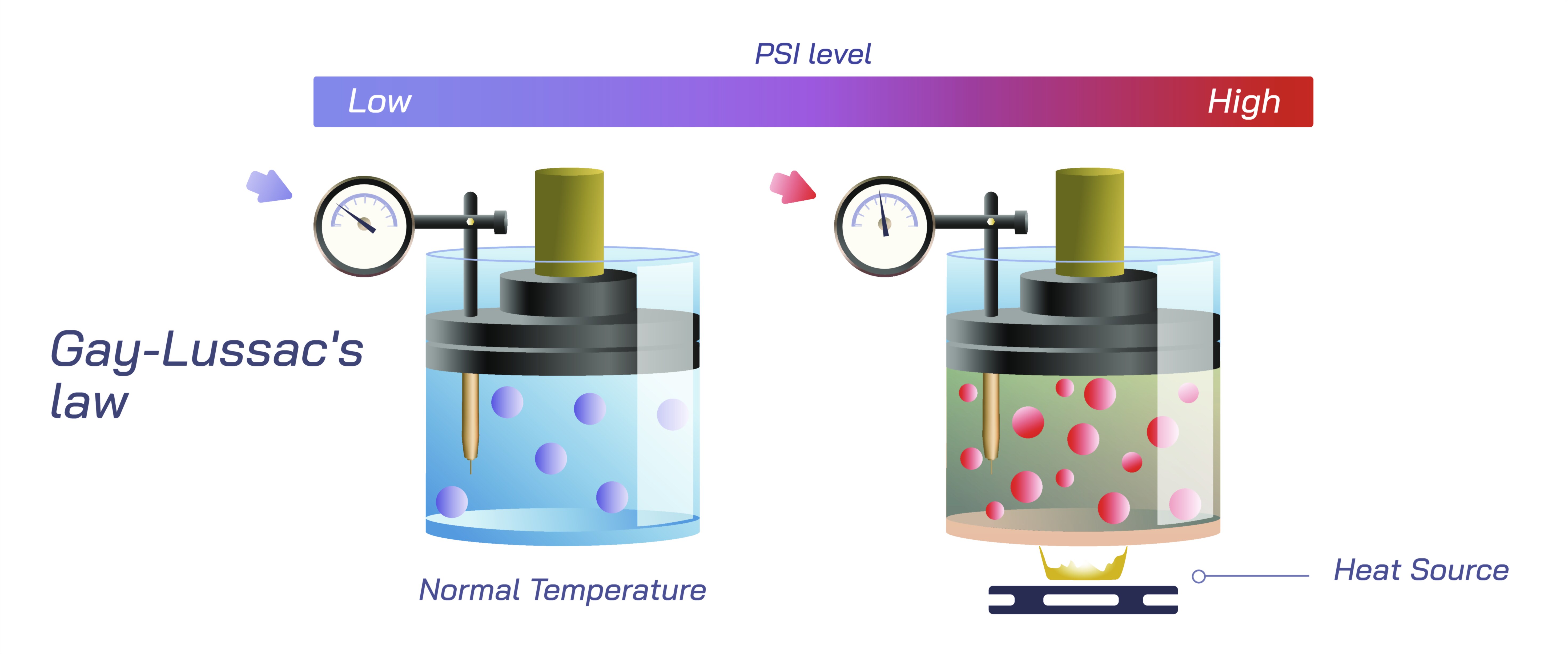
Gay-Lussac’s Law describes a beautifully simple yet profoundly important relationship in gas behavior: when the temperature of a fixed amount of gas in a sealed container increases, its pressure increases; when the temperature decreases, its pressure decreases. While this statement appears straightforward, its deeper meaning unfolds only through a conceptual understanding of how gas molecules move, collide, and exert force within a confined space. Gases consist of countless tiny particles—atoms or molecules—that move continuously and randomly. Their motion is influenced by temperature, which reflects the internal kinetic energy of the gas. The higher the temperature, the faster the gas particles move. When a gas is trapped inside a rigid container of constant volume, the faster-moving particles collide with the walls more frequently and with greater force. These collisions produce what we experience as pressure. Gay-Lussac’s Law reveals that pressure and temperature rise and fall together because both depend on the same molecular mechanism: the kinetic activity of gas particles. By understanding this relationship in purely conceptual terms, without formulas or algebraic treatment, we uncover the physical logic behind why pressure changes when the temperature of a confined gas changes.
Gay-Lussac’s Law becomes especially intuitive when we imagine specific real-world situations in which gas is sealed and its volume remains unchanged. A familiar example is the pressure inside a sealed aerosol can. At room temperature, the gas inside exerts a certain amount of pressure on the container. If the can is heated, the temperature of the gas rises, and the microscopic particles begin to move faster. Even though the container does not expand to provide more space, the gas continues to accelerate as heat is added. Because there is nowhere for the gas to expand, the only possible outcome is that collisions with the container walls become more frequent and much more forceful, causing the pressure to rise sharply. If heated beyond safe limits, this increase in pressure can become so extreme that the container bursts. The same mechanism explains why sealed glass bottles filled with liquid and gas mixture may explode when heated or why a tire left in the sun shows noticeably higher pressure readings than the same tire checked on a cold morning. In every one of these cases, the gas amount remains the same, the volume remains the same, but changes in temperature drive corresponding changes in pressure.
To see the reverse effect, imagine rapidly cooling a sealed container that holds gas. As temperature drops, the kinetic energy of the particles decreases, and their motion slows. Collisions with the container walls become less frequent and less forceful, reducing the pressure inside the container. This explains why car tires appear underinflated during winter even though no gas has leaked out. It also explains why a deodorant can removed from a refrigerator may sound empty when shaken, even though the gas is still inside—it simply exerts less pressure and therefore makes less noise. In industrial settings, cylinders filled with compressed gas stored outdoors exhibit lower pressures during cold weather and higher pressures during hot weather. The seasonal pressure shift does not indicate a change in the amount of gas; it is merely a reflection of how temperature influences molecular motion and therefore internal pressure through the relationship described by Gay-Lussac’s Law.
Understanding the deeper meaning of Gay-Lussac’s Law reinforces the essential role of confinement. If the container can change its size, the relationship becomes more complex because the volume may expand or contract in response to pressure. But when the container is rigid and its volume cannot change, the coupling between temperature and pressure becomes direct and unavoidable. This is why the law applies to metal cylinders, aerosol cans, gas tanks, pressure vessels, and laboratory flasks connected to rigid walls. The inability of gas to expand forces the energy from heating to manifest in increased pressure instead of increased volume. In this sense, the law can be seen as nature’s way of balancing energy: if gas molecules gain energy through heating but cannot use it to occupy more space, they exert that energy in the only manner available—through harder collisions that escalate pressure.
Gay-Lussac’s Law also sheds light on why temperature control is critical in high-pressure systems. Thousands of industries rely on stored gases—oxygen for welding, nitrogen for purging, propane for heating, carbon dioxide for carbonation, hydrogen for fuel systems, and countless specialty gases for research and manufacturing. The pressure inside these cylinders is not constant throughout the day but fluctuates with ambient temperature. On a cold morning, a reading on a pressure gauge might indicate a low amount of gas even though the cylinder is full; later in the day, as temperature rises, pressure climbs. Without proper understanding of Gay-Lussac’s Law, such fluctuations could be mistaken for leaks or supply failure. Professionals who work with compressed gases are trained specifically to account for temperature-driven pressure variation rather than assuming that lower pressure always means gas depletion. This demonstrates how a scientific principle translates into real operational knowledge that improves safety and efficiency.
The law also plays a subtle but essential role in many everyday situations. When an LPG cylinder sits beside a working stove, the surrounding heat increases the gas temperature inside the cylinder slightly, increasing pressure and helping vaporize more liquid into gaseous form for smooth combustion. The same principle applies when a scuba diver descends into cold water: the compressed air tank becomes cold rapidly, reducing internal pressure, which is why divers check their tanks before and after entering the water. Even in sports, such as basketball and football, ball inflation depends on temperature because the air trapped inside cannot change volume significantly; balls expand or soften depending on whether the temperature rises or falls. Each example traces back to the relationship between molecular motion and pressure in a confined space.
Perhaps the most fascinating aspect of Gay-Lussac’s Law is that it reveals the fundamental role of thermal energy in the behavior of gases. Temperature is not merely a number on a thermometer; it is a direct measure of the energy gas particles carry. When that energy rises, pressure rises because molecules interact with the boundaries that confine them more intensely. When energy falls, pressure falls because the gas becomes calmer and exerts less force. This understanding unites microscopic physics with macroscopic observations, linking what happens at the molecular level to events visible on the human scale. Gay-Lussac’s Law connects the invisible world of thermal motion to the tangible world of bursting containers, expanding tires, industrial safety protocols, and physical changes that we witness daily without always realizing the deeper mechanism behind them.
Through this conceptual lens, Gay-Lussac’s Law becomes much more than a simple rule about temperature and pressure. It becomes a window into the living dynamics of gas particles, their restless movement, and the physical reality of thermal energy. It explains why gas systems must always be handled with respect for temperature variations, why pressure gauges shift with weather, why storage of compressed gases requires heat safety, and why heating or cooling sealed containers can be dangerous. It blends intuition and physics into one cohesive narrative: pressure increases when temperature increases because both are manifestations of the same underlying kinetic energy of gas molecules in confinement. Gay-Lussac’s Law shows that the physical world is deeply interconnected and that even ordinary objects like aerosol cans, tires, gas cylinders, and fuel tanks obey elegant and universal principles that govern the movement of particles and the forces they create.