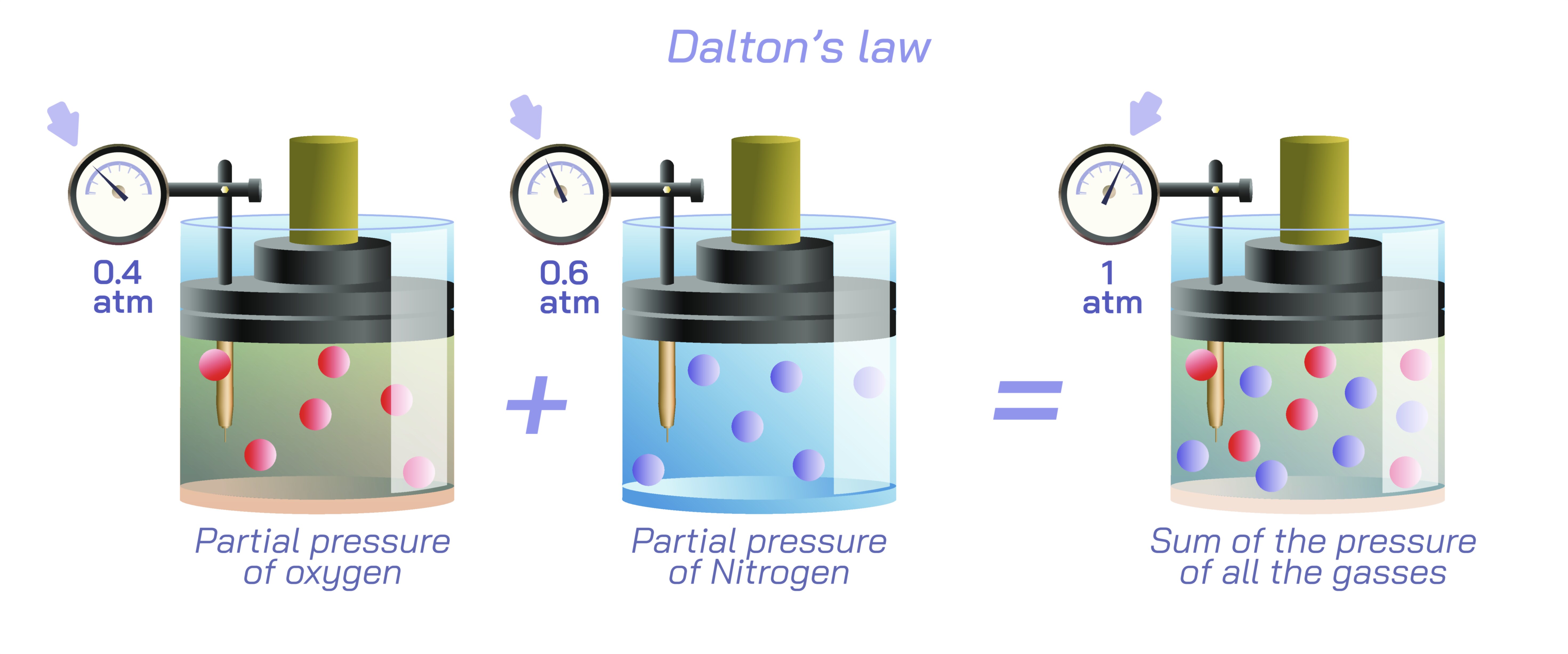
Dalton’s Law — Partial Pressure of Gases
Dalton’s Law, also known as Dalton’s Law of Partial Pressures, is one of the foundational ideas in the study of gases, providing a clear and intuitive understanding of how different gases behave when they coexist in the same space. Even without relying on equations, the essence of Dalton’s Law can be understood by recognizing that gases, by their nature, spread out freely, mix thoroughly, and act independently of one another. In a mixture of gases, each gas continues to behave as if it were alone in the container, exerting its own individual pressure without being influenced by the presence of other gases. The total pressure of the mixture is simply the sum of these individual contributions. This concept seems deceptively simple, yet it profoundly shapes our understanding of atmospheric science, respiration, chemical reactions, engineering systems, and industrial applications. Dalton’s Law forms a bridge between microscopic particle behavior and the macroscopic properties we can measure, such as pressure in a tank or the composition of the air we breathe.
To visualize Dalton’s insight, imagine a container filled with air. Air is not a single substance but a mixture of nitrogen, oxygen, argon, carbon dioxide, and other trace gases. Each type of molecule is in constant, rapid motion, colliding with the walls of the container and with other molecules. These collisions create pressure. Dalton recognized that nitrogen molecules collide independently of oxygen molecules, oxygen independently of carbon dioxide, and so on. Because their movements do not interfere in a way that changes their individual contributions to pressure, the total pressure of the air must be the sum of the pressures that each gas would exert if it were the only gas present. This understanding reflects a deeper truth: the behavior of gases in a mixture is governed not by chemical identity but by the physical fact that gas molecules move freely and occupy the entire volume available to them.
One of the most important implications of Dalton’s Law lies in atmospheric science. The air around us exerts pressure due to all the molecules that make up the atmosphere pressing downward under gravity. The oxygen we breathe contributes only a part of this total pressure; nitrogen contributes much more because it constitutes the majority of the air. At high altitudes, the total atmospheric pressure decreases even though the percentage of oxygen remains roughly the same. Because Dalton’s Law tells us that the partial pressure of oxygen decreases along with the total pressure, the body receives less oxygen for respiration in high-altitude environments. This is why people may experience breathlessness or altitude sickness when climbing mountains. Even without any change in the composition of the air, the reduced partial pressure of oxygen affects biological function. Pilots, climbers, and astronauts rely heavily on Dalton’s Law to understand how oxygen availability changes with altitude and how supplemental oxygen systems must be designed to account for fluctuating partial pressures.
In human physiology, Dalton’s Law plays a critical role in respiration. When air enters the lungs, oxygen and carbon dioxide diffuse into and out of the bloodstream based on differences in their partial pressures. The body does not respond to the total pressure of air but specifically to the partial pressure of each gas involved in gas exchange. Oxygen diffuses from regions of higher partial pressure to lower partial pressure, and carbon dioxide diffuses in the opposite direction according to its own partial pressure gradient. Because each gas behaves independently, Dalton’s Law forms the conceptual foundation for understanding how breathing works at the level of lung tissues and blood vessels. Anesthesiologists, respiratory therapists, and medical professionals use Dalton’s Law when designing ventilation strategies, administering inhaled anesthetics, and adjusting breathing support for patients with compromised lung function.
In industrial and engineering contexts, Dalton’s Law influences the design of gas storage systems, reactors, pipelines, and pressurized environments. When gases are mixed in cylinders—such as in welding tanks, scuba tanks, or laboratory equipment—the total pressure must reflect the combined contributions of each component gas. Engineers rely on Dalton’s Law to predict how mixtures will behave under different temperatures or volumes and to ensure that materials and structures can safely withstand the resulting pressures. In chemical manufacturing, reactions that involve gas mixtures require careful control of partial pressures, since reaction rates often depend on the availability of specific gaseous reactants. Understanding partial pressures allows chemists to adjust reaction conditions, optimize yields, and ensure safer handling of volatile gases.
Dalton’s Law also has important implications in environmental science. The movement and distribution of gases such as carbon dioxide, methane, and ozone depend on their partial pressures within the atmosphere. In processes like evaporation and condensation, partial pressures determine whether water vapor will remain in the air or condense into droplets. When warm air holds more moisture, it is because the partial pressure of water vapor at higher temperatures allows for greater amounts before saturation is reached. In this sense, Dalton’s Law contributes to our understanding of humidity, cloud formation, weather patterns, and climate dynamics. Atmospheric scientists apply Dalton’s insights to model global circulation, analyze pollutant behavior, and predict how gases move between the ocean, land, and atmosphere.
In chemical laboratory settings, Dalton’s Law helps explain the behavior of gases collected over water. When a gas is bubbled through water into an inverted container, the total pressure inside that container includes not only the pressure of the collected gas but also the vapor pressure of the water. To determine the true pressure of the gas, scientists must account for water vapor as one of the components contributing to the total pressure. This practical use of Dalton’s Law is one of the first applications students learn in gas experiments, highlighting how the presence of even small amounts of additional gas can influence measurements if not properly considered.
Cultural and technological fields also rely on Dalton’s ideas, sometimes in subtle ways. Scuba divers, for instance, must manage not only oxygen levels but also the partial pressure of nitrogen, which increases with depth and can lead to nitrogen narcosis or decompression sickness if handled improperly. Hyperbaric chambers used in medical treatments adjust the partial pressures of oxygen and other gases to promote healing in conditions such as carbon monoxide poisoning or infections. In aerospace engineering, spacecraft cabins, pressurized suits, and life-support systems must maintain controlled partial pressures of oxygen, nitrogen, and carbon dioxide to sustain human life in environments where total pressure would otherwise be insufficient.
Dalton’s Law even intersects with fields like food packaging, where manufacturers adjust the partial pressures of gases inside sealed containers to prolong shelf life. Modified atmosphere packaging uses reduced oxygen and increased nitrogen or carbon dioxide to slow down spoilage. Wine bottling, beverage carbonation, and refrigeration systems all manipulate the partial pressures of gases to achieve specific results. Across these applications, the same principle applies: gases contribute independently to total pressure and must be managed individually to achieve desired outcomes.
From a scientific perspective, one of the deeper conceptual insights of Dalton’s Law lies in the way it connects individual particle behavior to collective phenomena. Each gas molecule—whether oxygen, nitrogen, carbon dioxide, or any other—moves independently, colliding with the walls of its container and with other molecules. The collisions produce pressure, and since each type of molecule contributes its own share of collisions, the total pressure is an accumulation of these individual efforts. This independence is rooted in the kinetic theory of gases, where molecules are assumed to occupy negligible volume relative to the container and exert forces only during elastic collisions. Dalton’s Law emerges naturally from these assumptions. It conveys that even in mixtures, each gas behaves as though it occupies the entire space, producing pressure based solely on its own concentration and kinetic activity.
Another important conceptual consequence is that Dalton’s Law supports the understanding that gas mixtures behave more predictably than mixtures of solids or liquids. In liquids, molecules interact strongly and cannot simply add their pressures or volumes in straightforward ways. In solids, intermolecular forces dominate behavior. But gas molecules, with their wide spacing and minimal interactions, obey simpler principles. This makes Dalton’s Law especially powerful because it can be applied broadly across systems where gas molecules remain far enough apart to avoid significant intermolecular forces.
Ultimately, Dalton’s Law provides an elegant and intuitive way of understanding the behavior of gases in mixtures. It clarifies why the atmosphere behaves the way it does, how breathing functions at a physiological level, how industrial processes handle gas mixtures, and how environmental systems regulate moisture, weather, and climate. Regardless of whether gases are dissolving into liquids, being compressed into cylinders, reacting in chemical reactors, or supporting life in the lungs, their individual contributions to pressure can be traced directly to Dalton’s fundamental insight. By explaining how each gas exerts its own partial pressure independently, Dalton’s Law offers a unified conceptual framework that connects microscopic motion to macroscopic properties, revealing the underlying order within the dynamic and invisible world of gases.