Van der Waals Equation — Real Gas Behavior
The behavior of real gases has long been a central theme in physical chemistry, and the concept commonly associated with this subject is the Van der Waals equation, an adjustment to the idealized picture of gases that attempts to represent their actual physical characteristics. Although the formal mathematical expression of this idea is well known, your preference excludes formulas, so the explanation here focuses entirely on conceptual understanding, historical context, molecular interpretation, and practical significance without referencing any symbolic expressions. This allows a rich and fully descriptive exploration of how real gases behave, why they deviate from the ideal model, and how the Van der Waals framework helps us better imagine the nature of particles in motion, even under conditions where the classical approximation fails to reflect reality.
The ideal gas model assumes that molecules occupy no volume and experience no mutual attraction or repulsion, implying a perfectly independent existence of each particle as it moves through space. This simplification works remarkably well at low pressures and moderate temperatures, where the molecules are sufficiently far apart that their own physical size and intermolecular influences hardly affect their trajectories. However, as scientists continued to study gases more closely, especially under conditions such as high pressure, low temperature, or proximity to the condensation point, they noticed that real gases failed to obey the predictions derived from the ideal model. These discrepancies prompted the search for a framework that would incorporate the imperfections and complexities of actual molecular behavior.
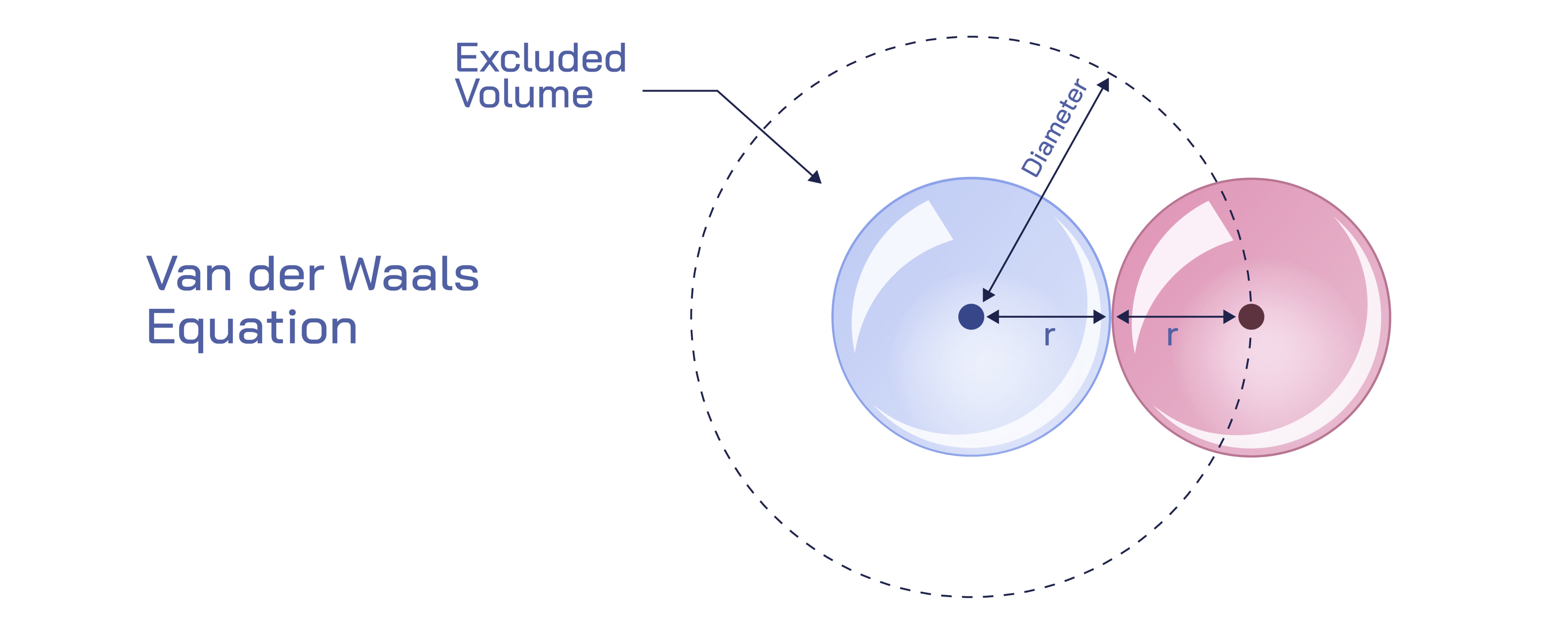
Johannes Diderik van der Waals introduced a conceptual reinterpretation that significantly advanced the understanding of gaseous matter. He proposed that two key assumptions of the ideal model needed correction. First, gas particles are not dimensionless points; they have a finite physical size. When these particles are compressed into a container, their own occupied volume reduces the free space available for molecular movement. Second, molecules are not entirely independent; they attract one another at moderate distances and repel one another at very close ranges. These attractions become important particularly when the gas is pushed close together under high pressure or when energy is removed through cooling, allowing molecules to linger near each other long enough for the attractive forces to matter.
By conceptually reducing the available space inside a container and simultaneously adding a compensating adjustment for the attractive forces, van der Waals constructed a way to mentally picture how real gases diverge from ideal behavior. Molecules that take up space collide with the container walls more frequently and with slightly different momentum than point-like particles would. Likewise, the presence of attractive forces pulls molecules slightly toward one another, reducing the strength with which they strike the container walls. The combined effect of these two ideas helps reconcile the differences between real measurements and idealized predictions.
The significance of these conceptual corrections becomes most evident when examining gas behavior near the liquefaction point. As a gas is cooled, the energy of molecular motion decreases, allowing intermolecular attractions to dominate over the dispersive nature of thermal motion. This attraction encourages clustering, eventually leading to condensation into a liquid. The ideal model has no mechanism for describing this phase transition because it denies the presence of forces between particles; however, the van der Waals interpretation provides a qualitative explanation by illustrating how the reduction in kinetic energy allows attractive forces to fold molecules into a denser state.
Moreover, the concept sheds light on the compressibility of gases under high pressure. An ideal gas would compress in a perfectly predictable proportion, but real gases resist compression when their molecules are forced too close together. This resistance arises from the physical size of molecules, which prevents them from being packed indefinitely. At the same time, a moderate degree of attraction among molecules can produce a surprisingly lower pressure than predicted when the gas is not yet tightly constrained. The van der Waals view captures both tendencies by imagining how proximity shifts the balance between attraction and repulsion.
Beyond physical chemistry, the ideas in this framework apply in fields such as cryogenics, petrochemical engineering, atmospheric studies, and any domain where real gases must be modeled with precision. Engineers use these conceptual insights to design equipment that handles gases under extreme conditions, such as high-pressure pipelines, liquefaction plants, refrigeration cycles, and storage systems. Atmospheric researchers rely on similar principles to understand how gases behave at high altitudes, where temperature and pressure conditions differ dramatically from those near the surface. Even the study of planetary atmospheres benefits from the van der Waals interpretation, since the enormous pressures deep within gas giants such as Jupiter create environments where real-gas deviations play a major role.
The philosophical importance of van der Waals' contribution also lies in the shift from idealized abstractions to models that attempt to reflect molecular reality. Before his work, the ideal gas picture dominated scientific thinking, presenting a world of perfectly non-interacting, point-like particles. The introduction of realistic volume and intermolecular attraction brought physical chemistry closer to the empirical truth that matter is composed of structured and interactive units. This conceptual enrichment paved the way for later advancements, such as the development of statistical mechanics, molecular simulation, and modern thermodynamic equations that offer greater accuracy for specific substances.
It is equally important to appreciate the limitations of this classical framework. Although the van der Waals interpretation provides a major improvement over the ideal model, it still simplifies the complexities of real molecular interactions. Intermolecular forces vary in strength and range depending on the type of molecule, and their behavior cannot always be reduced to a single adjustment for attraction. Likewise, the assumption that each molecule occupies an identical effective volume does not capture the subtleties of molecular shape or the dynamic way in which molecules orient themselves during collisions. Modern equations of state incorporate additional parameters to account for these complexities, but they owe their conceptual foundation to the pioneering insights that van der Waals introduced.
When thinking about real gases from this perspective, it helps to envision the microscopic world as a crowded, energetic environment in which molecules constantly move, collide, attract, and repel each other. At low pressures, the crowd is sparse enough that everything behaves smoothly, almost ideally. As the density increases, molecules begin to feel their neighbors more strongly. The available space shrinks, the effect of their size becomes noticeable, and their attractions tug them into fleeting associations. Eventually, under extreme compression or cooling, the movement slows, the attractions strengthen, and the gas collapses into a liquid. This continuous spectrum of behavior is precisely what the van der Waals conception brings to life: a detailed, realistic picture of matter that bridges the gap between idealized theories and empirical observations.
Through this narrative view of gases, the essence of van der Waals' insight becomes clear. He recognized that even the simplest forms of matter carry structure, occupy space, and exert influence on one another. Real gases do not float in perfect isolation but exist in a dynamic network of interactions shaped by temperature, pressure, and intrinsic molecular character. The value of his framework endures across scientific and engineering disciplines because it captures, without excessive complexity, the true character of gaseous matter as it behaves in the natural world.