Comprehensive Overview of Four-Sided Figures and Their Distinct Geometry Traits
Four-sided figures form a major section of plane geometry, helping learners understand how line arrangement, angle alignment, and structural balance shape mathematical reasoning. Each category carries unique design traits defined by its sides, interior measures, and symmetry profile. These forms often appear in real constructions, diagrams, coordinate systems, and technical drawings, making their recognition essential for academic and practical tasks.
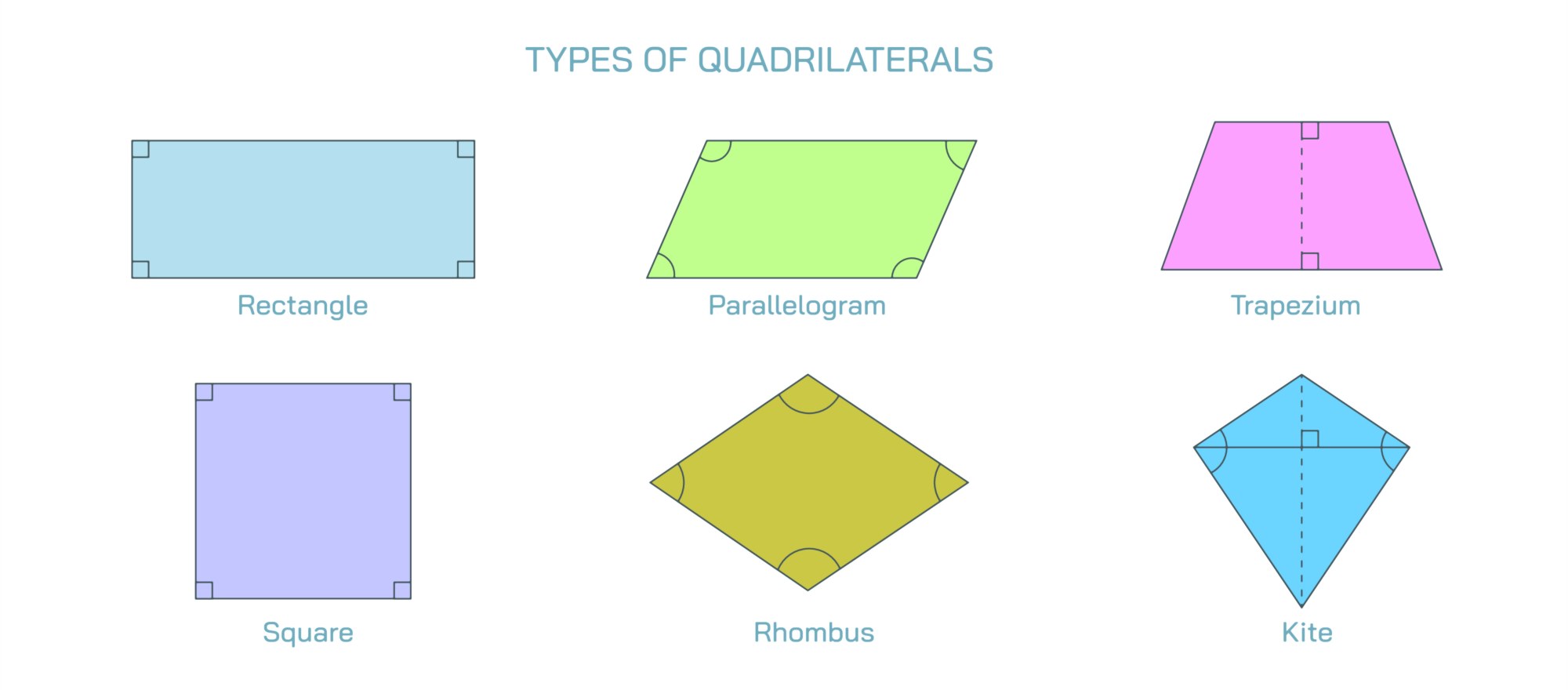
A square combines equal edges with right angles, offering maximum balance and uniformity. Its layout supports many engineering and architectural applications due to its even proportions and rotational consistency. Meanwhile, a rectangle extends this principle with matched opposite edges while maintaining strict right angles. The result is a versatile form widely used for layouts, room plans, screens, and data tables.
A rhombus introduces another structural idea: all edges share equal length but angles shift from ninety degrees. This produces a tilted, diamond-like form often used in artistic grids, lattice patterns, and tiling systems. Unlike the rhombus, a parallelogram emphasizes parallelism, where opposite pairs follow identical directions and equal measures. This form reveals how planar forces and directional vectors behave, making it valuable in physics and mechanical studies.
Next, the trapezium (or trapezoid in some regions) includes only one set of parallel edges, creating a structure ideal for studying gradient changes, cross-sections, and slanted layouts. Its ability to vary widely in proportion makes it a flexible teaching tool. Lastly, the kite captures attention with two equal adjacent pairs, forming a sharp central angle and strong bilateral symmetry. This layout appears in aerodynamics, art, and ornamentation.
Across these categories, learners discover how slight shifts in edge measure or angle placement alter the entire figure. Studying these distinctions deepens conceptual clarity, strengthens visualization ability, and prepares students for advanced geometric reasoning, including coordinate proofs, construction tasks, and spatial analysis.