Types of Angles in Geometry – Understanding Angle Classification, Measurement Relationships, Spatial Orientation, Line Intersections, and the Importance of Angles in Mathematical Reasoning and Real-World Applications
Angles form the foundation of geometry because they describe how two rays or line segments meet at a single point, called the vertex, to create a measure of rotation or separation between their directions. Although an angle seems like a simple figure, its classification reveals essential information about the size of rotation, the spatial arrangement of lines, and the relationships formed when figures join, intersect, or move through space. Studying the different types of angles helps learners not only understand the structure of geometric shapes but also develop reasoning skills that apply to architecture, engineering, physics, art, computer graphics, and navigation. From the smallest turn that barely opens between two rays to the sweeping turn that stretches beyond a full circle, each type of angle has a specific role in describing shape, position, symmetry, and motion. Recognizing these variations deepens mathematical intuition and provides a language for analyzing patterns in both theoretical and real-world contexts.
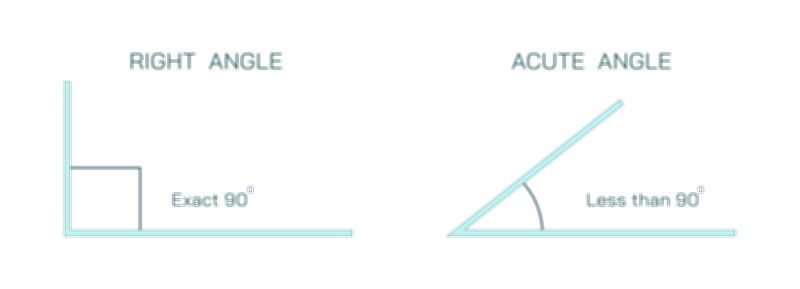
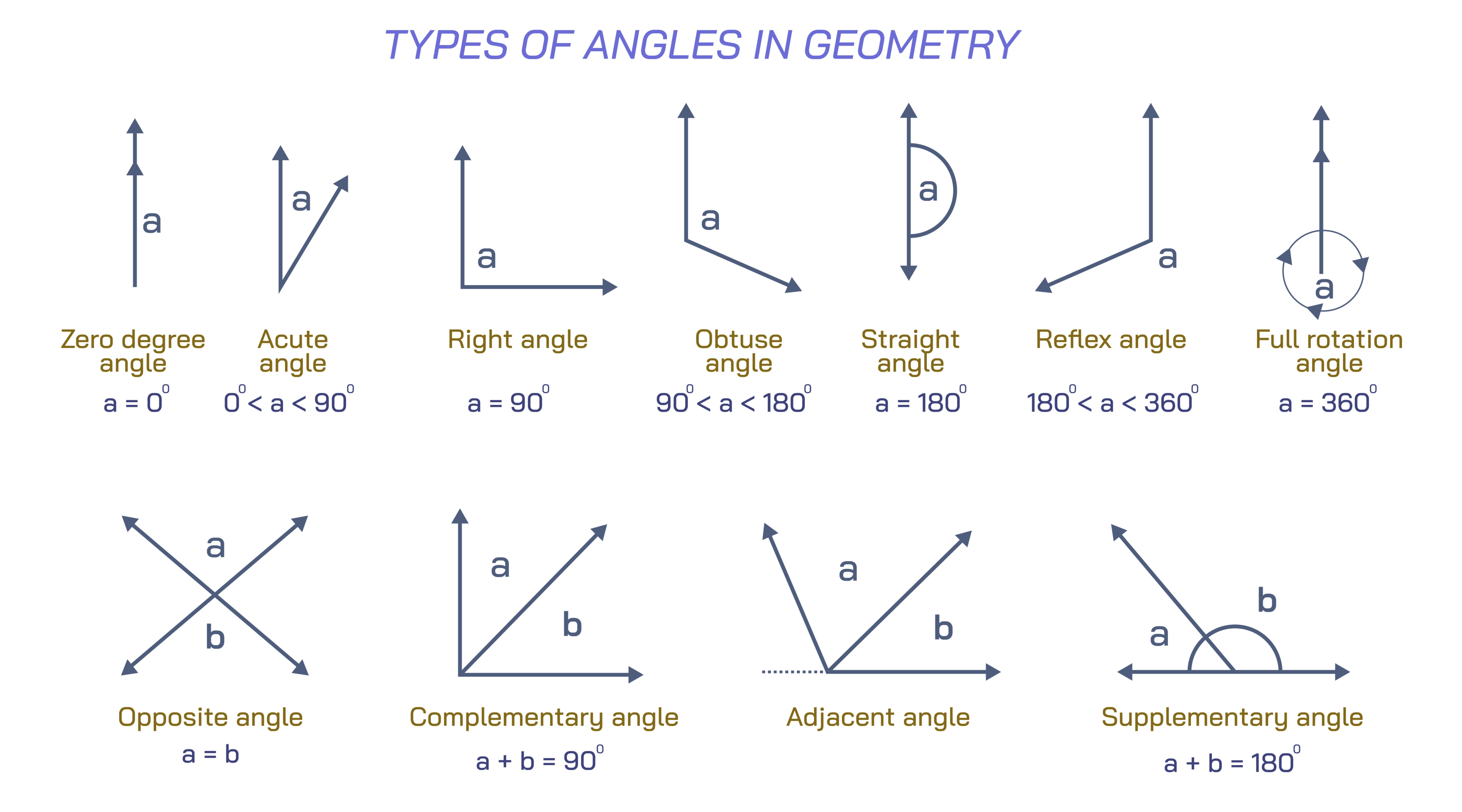
A natural starting point for classifying angles focuses on their magnitude, measured in degrees, which quantifies the rotation between one side of the angle and the other. The simplest and smallest of these classifications is the acute angle, which measures less than 90 degrees. Acute angles appear in sharp corners of geometric figures and in everyday structures like the pointed tip of a triangle, the slope of roof rafters, or the stretched legs of a folding ladder. Although acute angles are smaller in measure, they play vast roles in trigonometry, where they serve as the central focus of right-triangle relationships. In contrast to acute angles, a right angle measures exactly 90 degrees and forms the classic square corner associated with rectangles, floor tiling patterns, door frames, and most architectural layouts. The right angle serves as the benchmark against which other angles are defined, representing a perfect quarter-turn, and is essential for constructing perpendicular lines. When the measure of an angle exceeds 90 degrees but remains less than 180 degrees, it becomes an obtuse angle, visually appearing wide or stretched. Chairs that recline, hands of a clock at 9:00, and the opening of a book lying slightly back all create obtuse angle shapes. These three basic size-based types—acute, right, and obtuse—form the groundwork for understanding the full spectrum of angular measurement.
Another important classification arises when ray positions extend further, leading to the straight angle, which measures exactly 180 degrees. A straight angle looks like a flat line because the two sides of the angle lie in opposite directions, forming a continuous straight path from one ray to the other. Beyond this measure lies the reflex angle, which measures greater than 180 degrees but less than 360 degrees. Reflex angles wrap around past a straight opening and appear in spinning mechanisms, star-shaped geometric constructions, and rotational turning beyond a straight line. Finally, a complete turn from one ray around to the exact starting ray measures 360 degrees, called a full angle or complete angle. This type of angle may appear abstract on paper, yet it represents a full rotational cycle in real life: a wheel spinning one complete revolution, a dancer turning once on a stage, or a compass rotating around a central pivot. Through these classifications, learners can describe every possible angular measure between 0° and 360°, reinforcing that geometry is not only about shapes in frozen form but also about direction and motion.
Beyond measure, angles can also be classified based on their positional relationships when lines intersect. When two angles share a vertex and lie across from each other at the intersection of two straight lines, they are vertically opposite angles, or vertical angles. These angles are always equal because the intersecting lines open symmetrically on either side, and they serve as fundamental building blocks in geometric proofs. When two angles lie side by side and share a common arm, forming a pair that together totals 180 degrees, they are called adjacent supplementary angles or a linear pair. This relationship highlights how angle pairs express balance: the collapsing of two angles into a straight angle regardless of their individual measures. Supplementary relationships become the basis for understanding polygon interior angles and parallels intersected by transversals. Similarly, complementary angles add to 90 degrees, demonstrating how different angular quantities cooperate to form the right-angle standard that underlies perpendicularity.
Parallel lines introduce even deeper ways angles can relate. When a transversal cuts across two parallel lines, eight angles form predictable relationships because of geometric symmetry. Angles in the same relative position at each intersection are corresponding angles, and they are always equal when the lines are parallel. Alternate interior angles and alternate exterior angles also hold equality under parallel conditions, while interior angles on the same side of the transversal remain supplementary. These relationships are not limited to textbook diagrams; they guide the design of rail tracks, machine gears, road intersections, and even the rendering of perspective in art and computer-graphic modeling. Angle classifications in parallel line systems teach learners that geometry is built upon consistency, symmetry, and invariance—concepts central to scientific thinking.
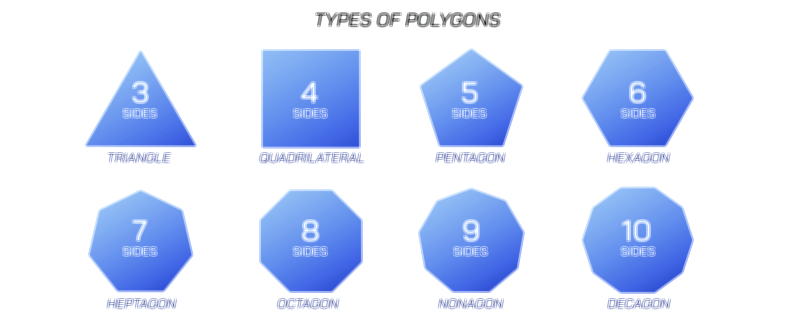
In polygonal geometry, angle types expand to describe how shapes form. A triangle contains three interior angles that together sum to 180 degrees, and the type of triangle depends on those angles: an acute triangle consists entirely of acute angles, a right triangle has one right angle, and an obtuse triangle has one obtuse angle. Quadrilaterals and higher polygons follow similar rules: rectangles require four right angles, parallelograms contain pairs of equal opposite angles, and regular polygons contain equal interior angles determined by their number of sides. Through these rules, the classification of individual angles evolves into a language for describing entire shapes. When reflections, rotations, or size changes occur in transformation geometry, angle measures remain preserved, reinforcing that angles represent intrinsic spatial properties independent of scaling or movement.
Modern technology brings angle concepts into the digital world. Computer-aided design software uses angular precision to guide the construction of buildings, circuits, engines, and bridges. GPS navigation relies on angles and triangulation to calculate position. Virtual and augmented-reality environments build their dimensional experiences through angular relationships of camera views and projection lines. Even pixel orientation in display systems uses angles to determine how light enters and exits optical layers for the clearest visibility. In human-centred disciplines like kinesiology and sports science, joint angles describe posture, motion, and biomechanics, while in astronomy, celestial longitude and angular separation define the positions of stars and planets across the sky. Whether analyzing galaxies or designing furniture, angles remain the language through which directions, rotations, distances, and structure are quantified.
Educationally, learning the classifications of angles is more than memorizing names; it builds the foundational reasoning needed for higher problem solving. Angles teach proportional thinking, introduce students to the logic of equality and proportional relationships, and help them understand symmetry, similarity, congruence, and trigonometric ratios. When learners understand angle types intuitively, they gain more confidence identifying relationships, proving statements, and constructing geometric arguments. Angles also form a conceptual bridge from elementary geometry into calculus, because the rate of change of angles under rotation becomes the backbone of radian measure, periodic functions, and wave behavior.
Ultimately, the study of angles demonstrates the elegance of geometry as a discipline that connects measurement, logic, visual reasoning, and real-world application. From the smallest acute turn to the complete rotation of 360 degrees, and from intersecting line relationships to polygon structure and motion tracking, angles give meaning to how shapes exist and move in space. By understanding the types of angles in geometry, students do not simply learn definitions; they unlock a system of thought that helps them interpret forms, patterns, and spatial relationships throughout mathematics and the world around them.