2D and 3D Coordinate Geometry — Spatial Representation, Points, Axes, and Geometric Interpretation Explained
Coordinate geometry is one of the most important bridges between algebra and spatial reasoning because it provides a systematic way to represent the position of points, shapes, and objects in space using numbers. Instead of describing location vaguely, coordinate geometry assigns values that tell exactly where something is located. Whether on a flat sheet of paper or in the real three-dimensional world, coordinates allow distances, directions, shapes, angles, and movements to be expressed mathematically and visually. The concepts of 2D (two-dimensional) and 3D (three-dimensional) coordinate geometry build the foundation for physics, engineering, architecture, navigation, computer graphics, animation, robotics, and everyday map systems. Understanding how spatial representation works in both 2D and 3D reveals how numbers transform into visual structure and how positions in space become measurable, comparable, and predictable.
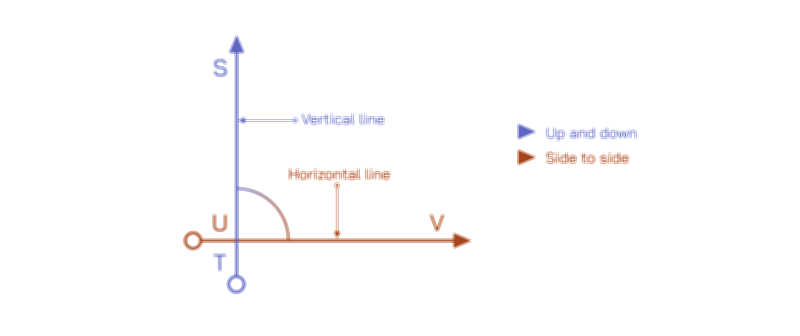
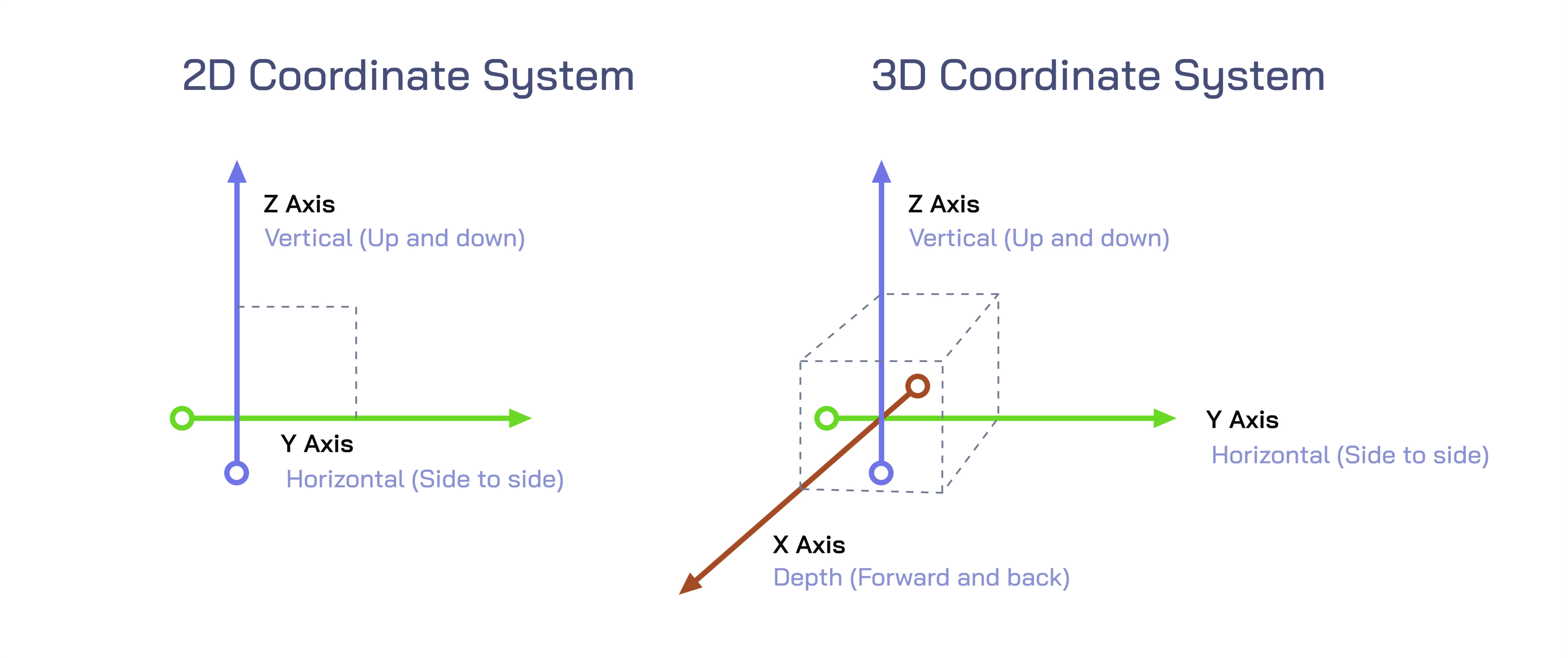
In 2D coordinate geometry, the space considered is flat, having only two directions — horizontal and vertical. This plane is described using two perpendicular lines called axes: the horizontal x-axis and the vertical y-axis. These axes intersect at a special point called the origin, which is assigned the coordinates (0, 0). Every location on the plane can be represented by an ordered pair (x, y). The first number tells how far to move horizontally from the origin, while the second tells how far to move vertically. Positive numbers extend rightward on the x-axis and upward on the y-axis, while negative numbers extend leftward and downward. This simple numerical system allows shapes such as triangles, circles, rectangles, and polygons to be expressed clearly through coordinates of their corner points or boundary paths. Straight lines become visible through coordinate patterns, curves become graphs of equations, and geometric problems like distance, area, and angle relationships can be solved using algebraic interpretation of coordinate positions.
The deeper value of 2D geometry lies not just in locating points but in representing motion and relationships. A moving object on a screen or graph traces changing (x, y) values across time, revealing its path as a curve or straight line. Temperature trends, financial growth patterns, waveforms, and statistical charts all rely on this same coordinate idea: one dimension expresses the input variable and the other expresses the output. Even though these graphs aren’t physical motion across space, the coordinate system provides a way to visualize patterns and change in a flat representation. Thus, 2D coordinate geometry becomes a universal descriptive language for both real spaces (maps, floor plans, drawings, printed images) and abstract data displays.
While 2D geometry describes flat surfaces, real life takes place in three dimensions, where objects do not just have length and width but also height or depth. 3D coordinate geometry expands representation by adding a third perpendicular dimension known as the z-axis. This axis comes out of the plane of the page (or screen interface) and represents depth. With three axes — x, y, and z — the coordinate space becomes three-dimensional, and every point is expressed as an ordered triple (x, y, z). The origin becomes the point (0, 0, 0), the reference for all other positions. Positive and negative directions extend outward along each axis, forming a full geometric space in which objects can be located, moved, or transformed using numerical values. Just as in 2D geometry, the power of the system lies in linking numbers to spatial interpretation: a change in the x-value moves a point left or right; a change in the y-value moves a point forward or backward; a change in the z-value moves a point upward or downward.
3D coordinate geometry allows mathematicians, scientists, and engineers to understand physical space precisely. Every solid object has spatial boundaries that can be expressed using coordinates. Surfaces, planes, spheres, cubes, cylinders, and all 3D shapes take definable mathematical form through relationships between x, y, and z. The distance between two points, the angle between two lines, or the intersection of planes can be determined using algebraic techniques applied to coordinate values. This ability to describe 3D shapes numerically becomes essential in computer modeling, structural engineering, automotive design, spacecraft trajectory calculation, GPS navigation, and virtual animation environments, where digital representation of real-world objects depends on accurate coordinate positioning.
One of the most meaningful differences between 2D and 3D coordinate geometry lies in how spatial complexity increases with the third dimension. In 2D, a line intersects another line at a point unless parallel; in 3D, two lines might cross, run parallel, or never meet because they might run in different planes. A triangle drawn in 2D always lies flat, but in 3D it might fold into an irregular spatial form. Motion in 2D takes place along a surface, while motion in 3D involves full volumetric movement. The third axis turns flat geometry into realistic space, where perspective, depth, shadows, and physical interaction occur. This explains why visual systems in games, movies, simulations, scientific visualization, and architectural modeling rely heavily on 3D coordinates to make artificial environments behave like real ones.
Despite appearing complex, 3D geometry is built on the same logical foundation as 2D geometry — a coordinate system that transforms space into numbers and numbers into space. A 3D object is simply a collection of points whose coordinates obey geometric relationships. A surface becomes a set of infinite points satisfying an equation. A path traced by a moving object becomes a curve defined by changes in x, y, and z across time. Through this framework, shapes can be visualized, rotated, scaled, reflected, or translated mathematically. Robots use 3D coordinate systems to calculate movement paths. Cameras in animation software use 3D coordinates to simulate viewpoints and angles. Airplanes, satellites, and ships rely on three-dimensional navigation systems to adjust their positions relative to the Earth. All these applications exist because coordinates make space calculable and predictable.
It is also meaningful to recognize how 2D and 3D coordinate geometry connect rather than operate separately. A 2D slice of a 3D object reveals its cross-section. A map of a city (2D) represents the ground, while the buildings rising above it exist in 3D. Technical drawings use several 2D projections to communicate 3D shapes. Scientific graphs take variables from higher dimensions and represent them on 2D pages through coordinate projection. Many advanced mathematical systems, including 4-dimensional and n-dimensional coordinate spaces used in data science and physics, build on the same geometric principles established first in 2D and expanded into 3D. In this way, learning spatial representation through simple coordinate systems lays the groundwork for the understanding of complex multi-variable structures.
Ultimately, the conceptual strength of both 2D and 3D coordinate geometry lies not simply in plotting locations, but in turning space, structure, and motion into precise language. Coordinates give a formal method to describe where objects are, how far apart they are, whether shapes are congruent or similar, how they move, how they transform, and how they relate to one another. Without coordinates, geometry would rely only on intuition and drawing; with coordinates, space becomes measurable, analyzable, and computable. Whether interpreting a graph, navigating a map, designing a skyscraper, animating a 3D model, or programming a robot, coordinate geometry provides the underlying structure that connects mathematical ideas to spatial reality.
Thus, 2D and 3D coordinate geometry together explain how humans understand and control space. The 2D system organizes information on a plane and forms the foundation for graphing and geometric analysis. The 3D system mirrors physical reality and allows complex shapes, designs, and movements to be modeled accurately. Both reflect the same deep idea: numbers can describe space, and space can be understood through numbers — a principle that unifies mathematics with the physical world in a powerful and lasting way.