Acute and Right Angle Showing Types of Angles with Geometry Lines and Mathematical Diagram Concept
In geometry, angles form the foundation of how shapes, lines, symmetry, and spatial relationships are understood, and visual diagrams play an essential role in helping learners grasp their properties at a glance. When comparing acute angles and right angles, a clear illustration showing how each angle is formed by two intersecting lines provides a simple yet powerful way to decode a key concept in mathematics: the size of the opening between lines determines the type of angle. Even though these angles appear in nearly every geometric figure—from basic triangles to complex engineering designs—their differences become intuitive only when the precise visual features are examined alongside their mathematical definitions.
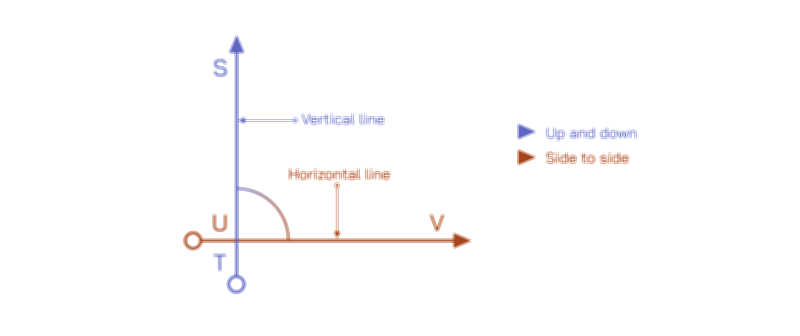
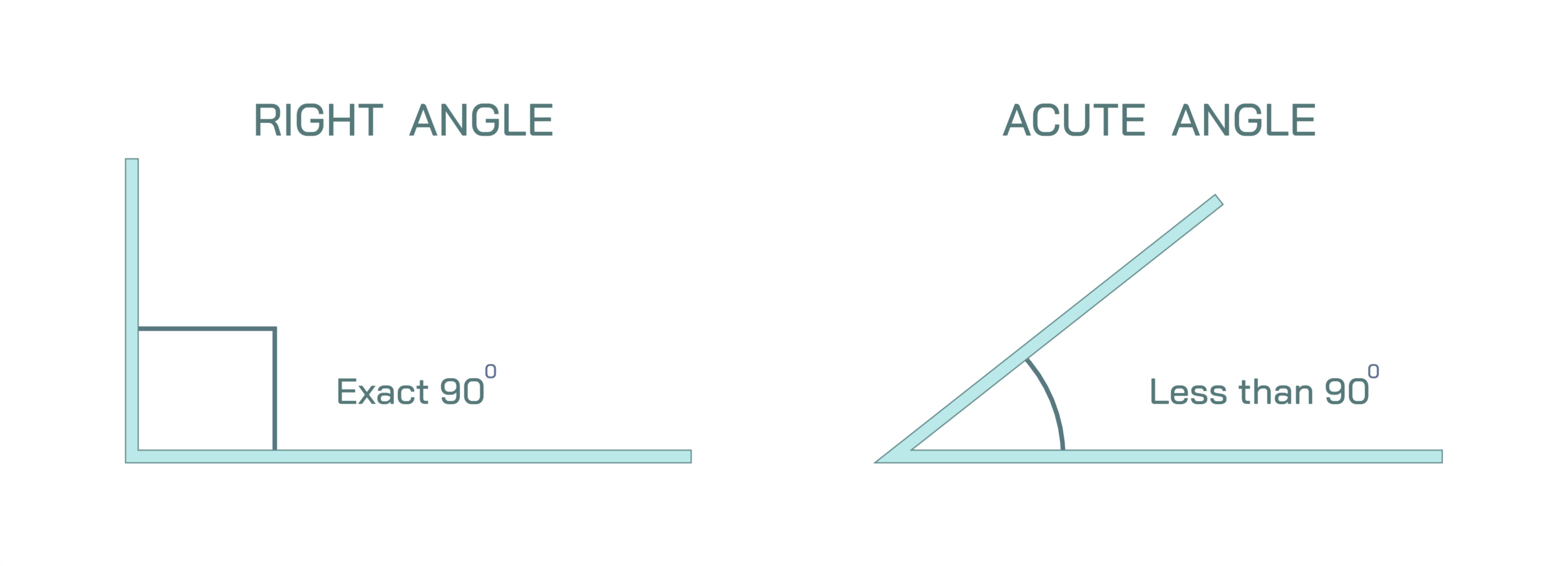
A right angle is widely recognized as one of the most important angles in mathematics. It is formed when two lines or rays meet to create a perfect quarter-turn, producing an angle that measures exactly 90 degrees. This angle is neither smaller nor larger than that value; it sits at the precise boundary between acute and obtuse angles. In diagrams, right angles are easily identifiable because they are marked with a small square in the corner, symbolizing the perpendicular joining of lines. Right angles appear naturally in the corners of rectangles, squares, grids, architectural layouts, and countless real-world structures where stability and alignment are essential. At the conceptual level, the right angle is a benchmark—used not only to classify angles but also to validate geometric constructions, establish perpendicular relationships, and define coordinate planes.
In contrast, an acute angle is narrower and sharper in appearance, formed when two lines intersect to create an opening that measures less than 90 degrees. The acute angle can vary widely in size, from one that is barely open to one that approaches—but does not reach—the right angle. The common thread among all acute angles is that they are smaller than a quarter-turn. In diagrams, the acute angle is depicted without the square marking found in right angles, allowing the viewer to notice the visually tighter gap between the rays. Acute angles appear prominently in triangles (including all three internal angles of an equilateral triangle), star-shaped patterns, and in dynamic structures that require tension, rotation, or directionality. Their sharpness often conveys visual energy—an expression of motion or tilt compared to the balanced stillness of right angles.
When the two types of angles are placed side by side in a geometric illustration, the comparison becomes unmistakable. The opening of a right angle displays the bold perpendicular posture of vertical and horizontal lines, while the opening of an acute angle has a distinctly smaller—and sometimes more dramatic—incline between its rays. This visual “degree gap” serves as an intuitive interpretation of angle measurement long before numerical tools such as protractors are introduced. In educational diagrams, right and acute angles often share a vertex but diverge in the width of their openings, showing that angle types are defined by magnitude rather than orientation.
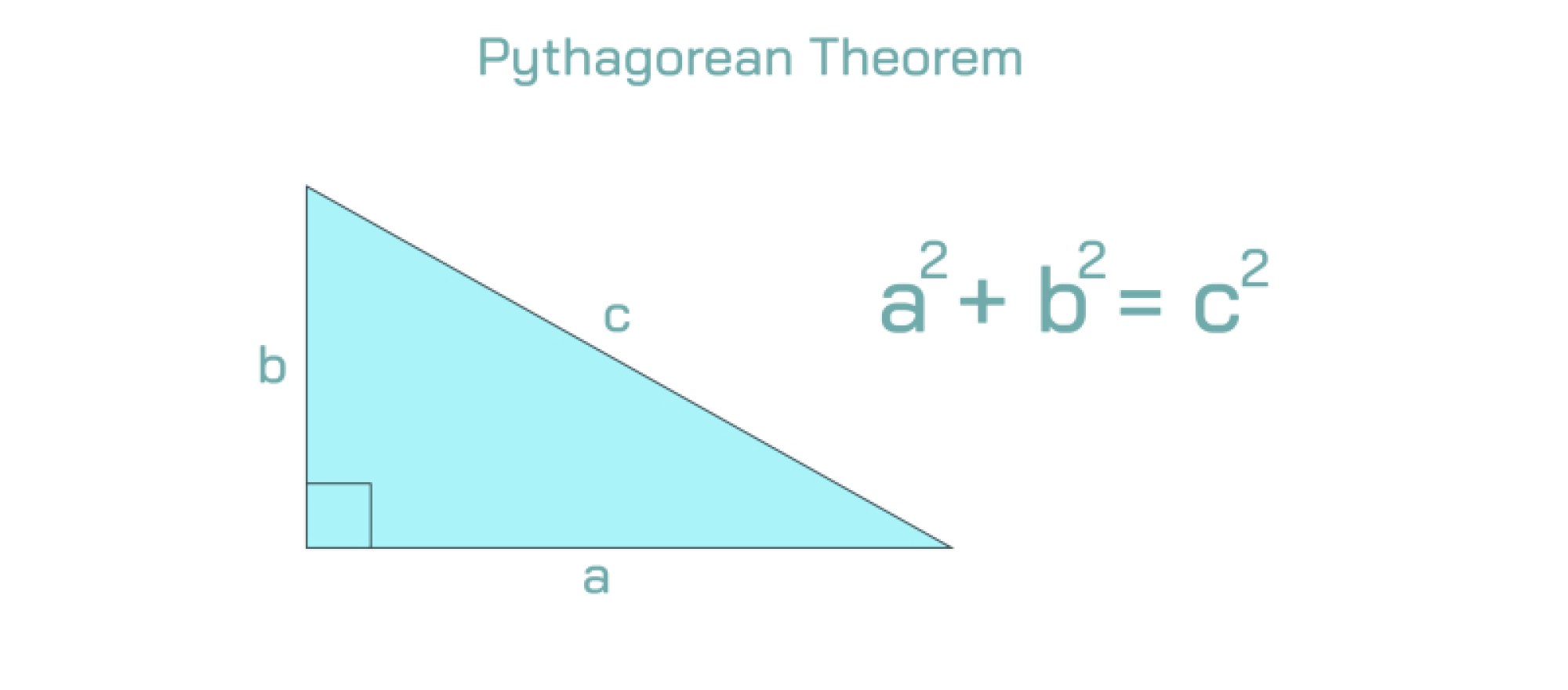
Understanding the difference between these angles is not only a matter of academic classification but also a building block for higher mathematical reasoning. In trigonometry, the distinction establishes which functions apply to triangles—right triangles require a 90-degree angle and become the basis for sine, cosine, and tangent relationships. Acute angles provide the complementary pairings within those triangles, shaping the proportional connections between sides. In coordinate geometry, the right angle becomes the backbone of the Cartesian plane, where the x- and y-axes form perpendicular lines. Acute angles help describe slopes, rotations, and directional change.
Outside mathematics, these angle types are embedded in everyday observation. The edges of a standard sheet of paper form right angles, while the hands of a clock form acute angles at specific times. The angle of a tree branch splitting from its trunk or the pitch of a roof demonstrates acute geometry in nature and design. When learners can recognize these forms visually through illustrations, they begin to notice geometric structure in architecture, objects, body movement, and the natural world.
A complete visual depiction of acute and right angles includes:
Two rays sharing one vertex, demonstrating each angle shape
A square marker on the right angle to indicate 90 degrees
A smaller opening for the acute angle without the square marking
Bold angle arc lines drawn inside the opening to highlight the measurement area
Labels distinguishing < 90° for the acute angle and = 90° for the right angle
This helps communicate that the classification of angles depends on measurement rather than the direction in which the rays point.
By placing acute and right angles together in one geometric diagram, the viewer gains a visual guide to the mathematical concept that underlies shapes, symmetry, measurement, and design. The acute angle shows the sharp, narrow opening that signifies values less than 90 degrees, while the right angle represents the perfectly perpendicular landmark used throughout geometry. Through this pairing, geometry transforms from abstract measurement into a recognizable visual language—one that gives form to both the precision of mathematics and the structure of the world around us.