𝐓𝐲𝐩𝐞𝐬 𝐨𝐟 𝐒𝐡𝐚𝐩𝐞𝐬 𝐍𝐚𝐦𝐞𝐬 𝐢𝐧 𝟐𝐃 𝐚𝐧𝐝 𝟑𝐃 𝐆𝐞𝐨𝐦𝐞𝐭𝐫𝐲
Two-dimensional and three-dimensional shapes form the core of geometry and help us understand the structure, design, and measurement of objects in both mathematics and real-world applications. Shapes are everywhere—whether in nature, architecture, art, physics, engineering, or daily life—and each shape has its own properties, structure, edges, curves, and boundaries that define how it occupies space. Two-dimensional shapes exist on a flat surface with only length and width, while three-dimensional shapes extend further into space with height or depth as an additional dimension. Even though these classifications sound simple, they represent the visual and mathematical language through which the world is interpreted and constructed. The study of 2D and 3D shapes enables us to analyse size, symmetry, angles, surfaces, vertices, and edges, and also plays a major role in geometry-based problem solving, technical drawing, graphic design, architecture, interior modelling, product manufacturing, and scientific visualization. Without understanding shapes, ideas about space, distance, area, and volume would remain incomplete, and many engineering mechanisms that depend on geometry would not be possible.
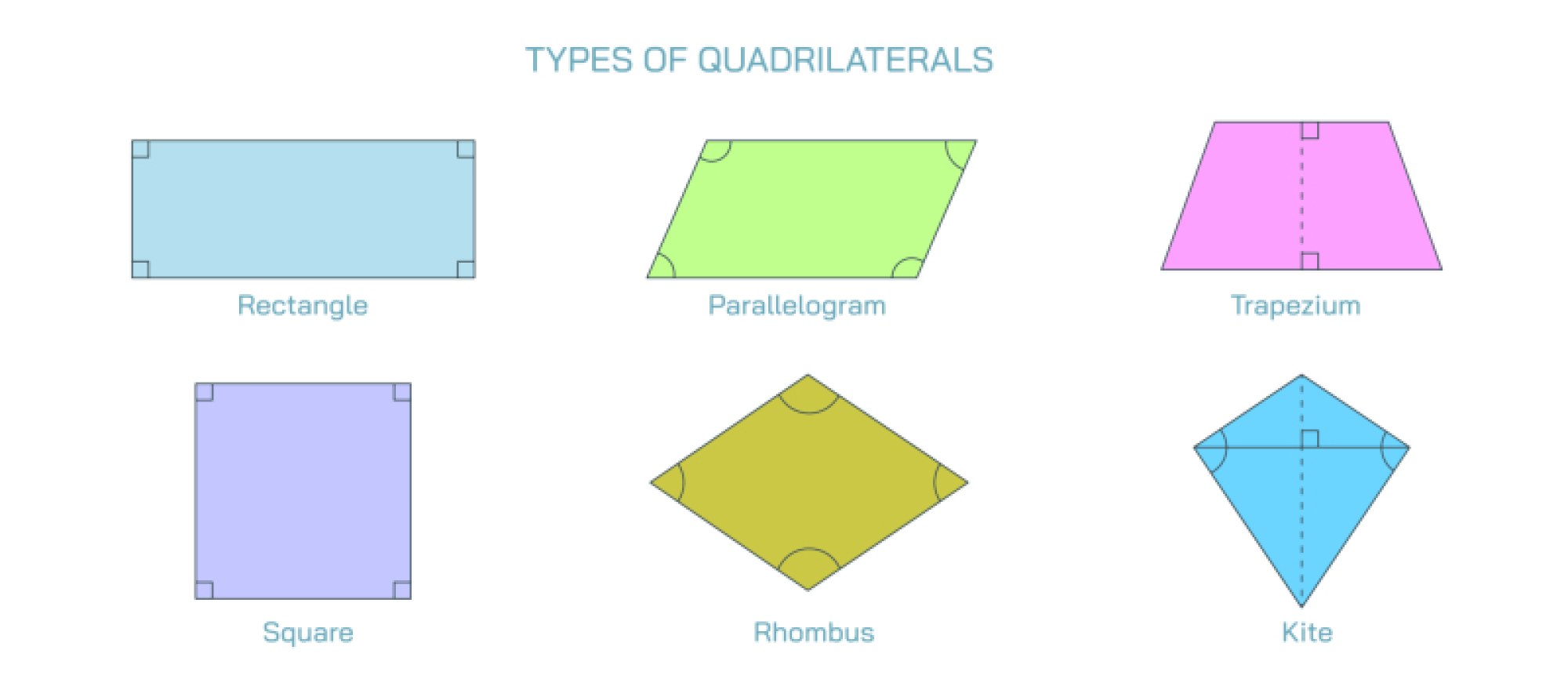
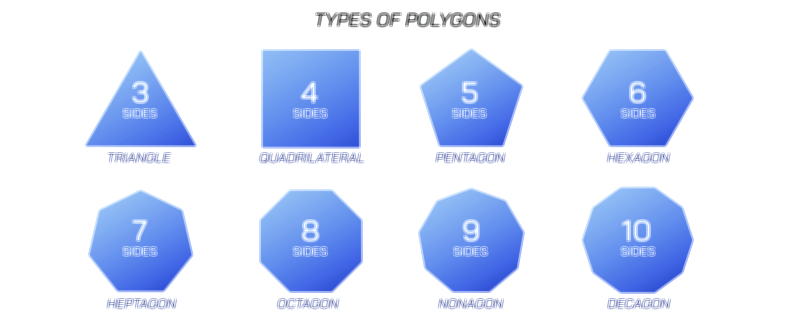
Two-dimensional shapes are known as plane shapes because they lie on a flat surface and can be drawn on paper without any thickness. The most familiar 2D shapes include triangles, squares, rectangles, circles, and polygons. Each of these shapes has unique features that make them different from one another. A triangle has three sides and three angles, and it appears in many variations such as equilateral, isosceles, and scalene depending on its side lengths. A square has four equal sides and four equal angles, while a rectangle has four right angles but only opposite sides equal. A circle stands apart because it has no straight sides or vertices and is defined by a single curved boundary where every point is at the same distance from the centre. Other basic polygons include pentagons, hexagons, heptagons, octagons, nonagons, and decagons, where the number of sides increases gradually. Shapes like ovals, rhombuses, trapeziums, parallelograms, kites, and stars enrich the diversity of 2D geometry and illustrate how different side and angle combinations form unique structures. Even though they are flat, 2D shapes form the foundation of much more complex structures because they make up the surfaces and nets of 3D objects.
Three-dimensional shapes, also called solid shapes, have length, width, and height. Instead of only boundaries, they possess volume and occupy physical space. Cubes, cuboids, spheres, cylinders, cones, and pyramids are the most common examples of 3D shapes. A cube has six square faces, all identical, while a cuboid has six faces that are rectangular. A sphere has no edges or vertices and is defined by a completely smooth curved surface where every point is at equal distance from the centre. Cylinders combine two flat circular faces with a curved surface, and cones have a circular base that narrows to a single point. Pyramids vary depending on the shape of their base—such as triangular, square, or pentagonal pyramids—and they meet at a common apex. More advanced forms like prisms, torus shapes, hemispheres, tetrahedrons, and polyhedrons show the depth and diversity within 3D geometry. These solids are essential in architecture, engineering models, packaging, manufacturing, robotics, and virtual 3D animation because they realistically represent objects that exist in physical space.
Understanding the relationship between 2D and 3D shapes is important because two-dimensional shapes act as the blueprint for three-dimensional structures. For example, the net of a cube is formed by six connected squares, and the net of a cylinder includes a rectangle and two circles. The net of a pyramid includes a polygon base and triangular lateral faces. These transformations from 2D nets to 3D solids help students and professionals visualize how flat shapes fold into real-world objects. This spatial thinking is vital in architectural drafting, origami design, computer-aided design (CAD), construction planning, product packaging, and scientific simulation. In reverse, slicing a 3D object produces 2D cross-sections. Cutting a cylinder can produce a circle or rectangle, while slicing a cone can produce a circle, triangle, or parabola depending on the angle of the slice. Therefore, 2D and 3D geometry is deeply interconnected and learning one reinforces understanding of the other.
The names of shapes also help describe real-world objects more clearly. A wheel resembles a circle, a book looks like a cuboid, a dice cube resembles a perfect cube, a lampshade can resemble a cylinder or a cone, and a football resembles a sphere. Honeycomb cells naturally form hexagons, while architectural roof structures may follow triangular or trapezoidal shapes. This practical connection is why shape recognition is a fundamental part of early learning in mathematics and remains important through advanced geometry and applied sciences. Shapes embody not only mathematical logic but also aesthetics and design principles, influencing fashion, product architecture, patterns, and even human perception of balance and harmony.
Learning the correct names of shapes is useful for communication, teaching, drafting, mapping, and STEM education. When shapes are understood, concepts such as symmetry, tessellation, angles, area, perimeter, surface area, and volume become much easier to interpret. Children who learn shapes early often develop stronger visualization skills, which later support problem solving in subjects ranging from geometry to machine design. In higher education and professional fields, shape theory plays a major role in modelling physical systems, developing artificial intelligence in computer vision, creating structural frameworks for buildings and bridges, and designing medical imaging technologies.
The world around us is built on shapes, both flat and solid, simple and complex. The study of 2D and 3D geometry strengthens observation, calculation, visual thinking, and creativity. When we recognize and understand the names and properties of shapes, we gain a deeper appreciation of how the physical world is structured. From children's toys to scientific instruments, from the screen icons we interact with to the vehicles we travel in, shapes are silently present everywhere. The more we become familiar with them, the more capable and confident we become in analysing patterns and building new ideas. Through this awareness, geometry transforms from an abstract subject into a clear, practical, and visually meaningful part of daily life.