Fibonacci Sequence Vector Illustration Showing Golden Ratio Pattern and Number Progression in Mathematics
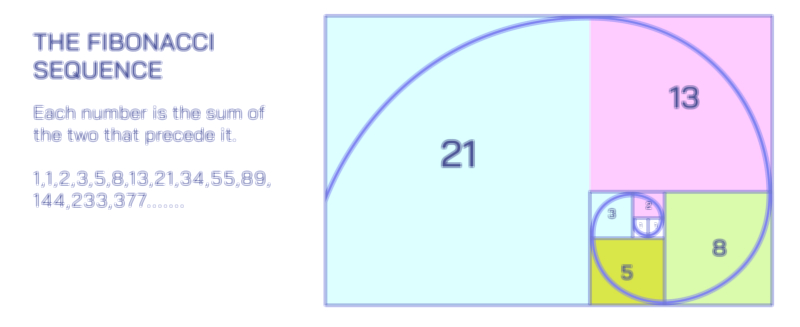
1. In mathematical notation, the sequence progresses as 0, 1, 1, 2, 3, 5, 8, 13, 21, 34, and so forth, continuing indefinitely. A vector illustration of the Fibonacci sequence typically demonstrates both the numerical progression and the geometric representation of the Golden Ratio, connecting abstract numbers with visual patterns observable in the natural world, architecture, and art. This type of illustration allows learners to comprehend the sequence as both a simple arithmetic series and a manifestation of proportional harmony across various domains.
In a vector illustration, the number progression is often displayed as a series of labeled blocks, spirals, or linear arrangements. Each block corresponds to a Fibonacci number, and the illustration may use color coding or scaling to emphasize the increasing size of numbers. The visual representation helps viewers understand the recursive nature of the sequence: every number after the first two arises naturally from the sum of its immediate predecessors. This recursive property is central to understanding how the sequence expands and why it exhibits patterns that appear repeatedly in nature, such as in the arrangement of leaves, seeds, and flower petals. By visualizing the sequence numerically, learners can trace the addition process and internalize the underlying mathematical principle.
618. As the sequence progresses, the ratio of consecutive Fibonacci numbers (F_n+1 / F_n) approaches φ, a value considered aesthetically pleasing and harmonious in design, architecture, and art. Vector diagrams often overlay spirals or rectangular boxes whose dimensions correspond to Fibonacci numbers, creating the characteristic logarithmic spiral that embodies the Golden Ratio. Each square in the diagram represents a Fibonacci number in width and height, and connecting arcs illustrate the spiral pattern, showing how mathematics translates into geometric form. This dual representation emphasizes both numerical progression and proportional growth.
The vector illustration may also incorporate natural examples to contextualize the Fibonacci sequence. For instance, a spiral pattern can mimic the arrangement of sunflower seeds, the shell of a nautilus, or the spiral arms of galaxies. By showing these real-world analogues alongside the numerical sequence, the illustration highlights the universality of the Fibonacci pattern. Arrows and labels may link specific Fibonacci numbers to observable quantities, such as petal counts in flowers or leaf arrangements in plants, reinforcing the connection between abstract numbers and tangible patterns. This approach illustrates how mathematics can describe growth, symmetry, and efficiency in natural systems.
In addition to the spiral representation, vector diagrams often include linear or tabular layouts that show how each number is derived from the sum of its predecessors. These visualizations may use arrows connecting pairs of numbers to the resulting number, emphasizing the additive rule that defines the sequence. Such diagrams can also highlight ratios between consecutive numbers, illustrating the convergence to the Golden Ratio over successive iterations. This feature demonstrates the predictive power of the sequence and its relation to exponential growth and proportionality.
Vector illustrations may also incorporate Fibonacci-related geometrical shapes, such as rectangles, pentagons, or triangles, whose dimensions align with Fibonacci numbers. These shapes can be arranged to show tiling patterns, nested shapes, or spirals, further emphasizing the aesthetic and structural applications of the sequence. By combining numerical, geometric, and visual elements, the illustration conveys the multifaceted nature of the Fibonacci sequence as both a mathematical tool and a model for natural and artistic phenomena.
Another common element in such illustrations is the exponential growth aspect of the sequence. Fibonacci numbers increase rapidly, and vector diagrams often visually represent this by scaling blocks or rectangles according to size, making the growth trend immediately apparent. Color gradients or proportional sizing can highlight this expansion, showing how each new term builds upon the previous ones. This visual scaling reinforces the recursive property of the sequence while providing an intuitive sense of numerical magnitude and growth patterns.
In educational contexts, vector illustrations may annotate the sequence to show applications in problem-solving, modeling, and prediction. For instance, the sequence can model population growth in idealized scenarios, branching patterns in trees, or financial modeling for compounding growth. Arrows and labels in the diagram may indicate these real-world analogues, helping viewers connect the mathematical concept to practical situations. By showing both the abstract sequence and its tangible manifestations, the illustration bridges theoretical mathematics and observable reality.
The Fibonacci sequence vector illustration can also emphasize symmetry and balance, key aspects of the Golden Ratio. Spirals derived from the sequence often exhibit self-similarity and proportional consistency, characteristics associated with aesthetic harmony. In the illustration, arcs and curves may be overlaid on rectangular blocks or grids, visually reinforcing how the Golden Ratio emerges naturally from the Fibonacci progression. This visual relationship highlights why the sequence is frequently used in art, architecture, design, and nature, providing an intuitive understanding of its mathematical elegance.
Ultimately, a vector illustration of the Fibonacci sequence integrates numerical progression, geometric representation, and proportional analysis, offering a comprehensive view of how this simple additive series manifests in both abstract mathematics and the observable world. By combining labeled numbers, proportional blocks, spirals, and examples from nature and art, the diagram enables viewers to understand the sequence’s recursive logic, its convergence to the Golden Ratio, and its aesthetic and structural significance. The illustration transforms the abstract pattern of 0, 1, 1, 2, 3, 5, 8… into a tangible and visually compelling framework, demonstrating the enduring influence of Fibonacci numbers across mathematics, science, and human perception.