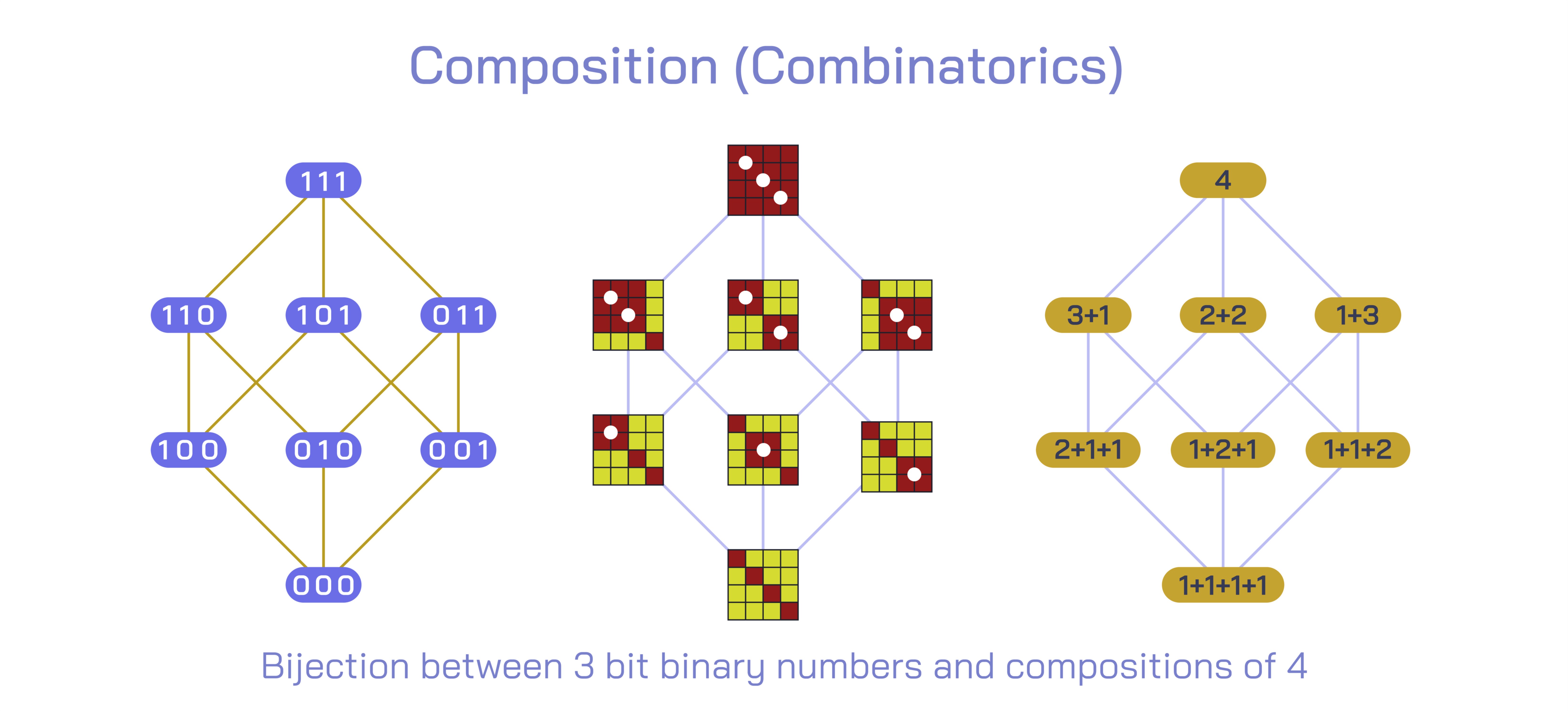
Composition in Combinatorics — Mathematical Arrangement Concept
Composition in combinatorics represents one of the most elegant conceptual tools used to understand how a whole can be broken down into ordered parts. Although at first glance the idea of “composition” may seem like a simple partitioning of a number or quantity, its meaning in combinatorics reaches far beyond basic division. It captures the essence of how arrangements arise, how order influences outcomes, how structures are formed from smaller pieces, and how constraints shape the possible configurations of a system. What makes compositions especially powerful is that they reflect a fundamental idea across mathematics: the whole can be represented in infinitely many structured ways depending on rules, context, sequence, and the inclusion or exclusion of certain allowed elements. Even without formulas or symbolic expressions, the conceptual foundation of combinatorial composition reveals rich patterns that influence probability theory, algorithm design, graph theory, discrete structures, number theory, and even areas outside mathematics such as linguistics, computer science, biology, and information encoding. Understanding composition means understanding how systems arrange themselves when both value and order matter.
At its core, a composition describes the ways a given quantity can be expressed as a sum of smaller, strictly ordered parts. Unlike typical partitions where the order of parts does not matter, compositions treat each ordering as a unique and meaningful arrangement. This distinction immediately expands the number of possible outcomes and highlights how sensitive structures become when sequence plays a role. For example, in many real-world systems, the arrangement of steps, components, or stages matters more than the total. In music, a set of notes played in one sequence produces an entirely different effect than the same notes rearranged. In linguistics, the meaning of a sentence changes completely when its components shift order. In algorithms, the sequence of operations determines whether a process succeeds or fails. Composition in combinatorics captures this deep principle: ordering transforms structure.
Because compositions emphasize order, they naturally reflect how choices unfold in time or along a logical sequence. When we think about how an event can occur in several steps, each with its own contribution, we are effectively thinking in terms of compositions. If a quantity represents total effort, energy, cost, or length, its composition represents the ways this quantity can be divided across different stages. This conceptual framework helps model processes where each segment depends on the previous one or where an ordered arrangement matters more than the sum itself. In this sense, compositions resemble paths: each choice leads to a distinct direction, and small changes in ordering create fundamentally different outcomes. The idea becomes particularly important in computer science where compositions describe sequences of operations, nested loops, or recursive steps that must follow precise orderings to generate correct results.
Compositions also allow the exploration of constraints, which add depth to combinatorial reasoning. Constraints might require that parts be positive, non-negative, odd, even, or drawn from specific sets. They may allow repetition, forbid certain values, or restrict how large or small any part may be. Each of these constraints narrows the range of possible arrangements and reveals how structures adapt within limitations. These ideas mirror realistic scenarios in engineering, manufacturing, and scheduling, where total resources must be divided into tasks that follow rules or thresholds. For example, designing a machine may involve breaking a required performance output into ordered stages with minimum capabilities. Scheduling problems may require distributing total time across sequential jobs while respecting minimum or maximum durations. Composition models these situations by showing how an ordered division of a total value behaves when limits are imposed.
Graph theory provides another rich interpretation of compositions by viewing them as ways to represent paths through nodes, each step contributing a value that leads to a final destination. A composition becomes a journey with checkpoints, where each segment corresponds to a specific decision or movement. This perspective connects compositions to directed graphs, decision trees, and communication pathways where the sequence of steps dictates outcomes. It also mirrors biological systems in which genetic sequences follow strict informational ordering; even if the total genetic content remains the same, rearranging segments alters biological function. Compositional reasoning thus becomes a conceptual lens through which we understand structured sequences in both artificial and natural systems.
In number theory, compositions help illuminate properties of integers by showing not just how they can be decomposed, but how these decompositions reveal patterns, symmetries, and principles of counting. The emphasis on order introduces a layer of structural richness that reveals how integers can stand in for more abstract quantities such as energy levels, frequencies, or discrete events. This interpretative flexibility makes compositions widely applicable in fields that deal with discrete quantities broken into steps—such as digital signal processing, cryptography, or data compression. In these contexts, the arrangement of discrete units determines the meaning of the encoded information, precisely paralleling the structural philosophy of compositions.
One of the profound strengths of the compositional viewpoint is its capacity to unify diverse combinatorial ideas. Sequential arrangements, ordered selections, restricted choices, recursive structures, and stepwise processes all fall under the conceptual umbrella of compositions. They describe not only how many ways something can be broken down but how it behaves when reconstructed in ordered patterns. Problems involving dividing tasks among workers, distributing resources over time, allocating computing power among operations, or designing layered manufacturing processes can all be modeled using compositional thinking. This universality demonstrates how compositions act as a bridge between discrete mathematics and practical engineering, linking theoretical concepts with real-world applications.
In probability and statistics, compositions play a crucial role in analyzing distributions of events. Many scenarios require understanding the number of ways a total outcome can be achieved through sequential sub-events. Whether modeling random walks, analyzing sequences of successes and failures, or studying distributions of identical objects into ordered containers, compositions define the structural foundation. Because they preserve the sequence of outcomes, they allow analysts to capture directional behavior, path dependence, and time-specific arrangements—traits essential in fields like economics, queuing theory, and reliability analysis. They illustrate how a total quantity may arise through different ordered contributions, offering deeper insight into the likelihood of certain patterns emerging in a system.
In computer algorithms, compositions embody the foundation of recursive and dynamic processes. When breaking a problem into smaller subproblems, the ordering of those subproblems determines how the solution unfolds. Composition models how each layer depends on the previous layer and how structured breakdowns lead to efficient computation. This perspective appears in memory allocation, string parsing, code optimization, and segmentation tasks in artificial intelligence, where systems analyze sequences, divide them, and rebuild meaning from structured fragments. Even in machine learning and natural language processing, compositionality refers to the principle that meaning arises from the ordered combination of smaller units—an idea that mirrors the combinatorial concept almost perfectly.
Compositions also enrich the study of patterns in art, music, and design. Artists assembling patterns, architects arranging structural elements, or musicians composing ordered note sequences all rely on structured arrangements of smaller components to create cohesive wholes. Although these domains may not express their structures mathematically, the underlying principle remains identical: order produces meaning. This human-centered interpretation illustrates how deeply embedded compositional thinking is in cognition, creativity, and interpretation. Whether arranging colors in a palette, forming rhythmic patterns, or designing structural layers in a building, compositions guide how elements come together in meaningful order.
Beyond these broad applications, compositions sharpen intuition about complexity. They remind us that systems are often more than their totals; they are defined by how pieces are arranged, sequenced, and integrated. In engineering, the success of a process may depend not only on the amount of material used but on the ordered stages of assembly. In biological systems, not only the amount of genetic information but its sequence dictates its function. In data structures, not only the number of bits but their arrangement determines stored meaning. In human communication, not only the words chosen but the order in which they are spoken shapes understanding. This philosophical insight parallels the core idea behind combinatorial composition: order is a defining ingredient of structure.
Ultimately, composition in combinatorics provides a conceptual framework for understanding how wholes can be constructed from ordered parts, how constraints shape possible arrangements, and how structure emerges from sequence. It forms a bridge between abstract mathematics and the structured patterns that appear throughout science, technology, and daily life. By emphasizing ordering, composition shows that arrangement is as fundamental as quantity, and that the way parts are sequenced transforms the meaning, behavior, and potential of the whole.