Archimedean Spiral Graph — Mathematical Curve
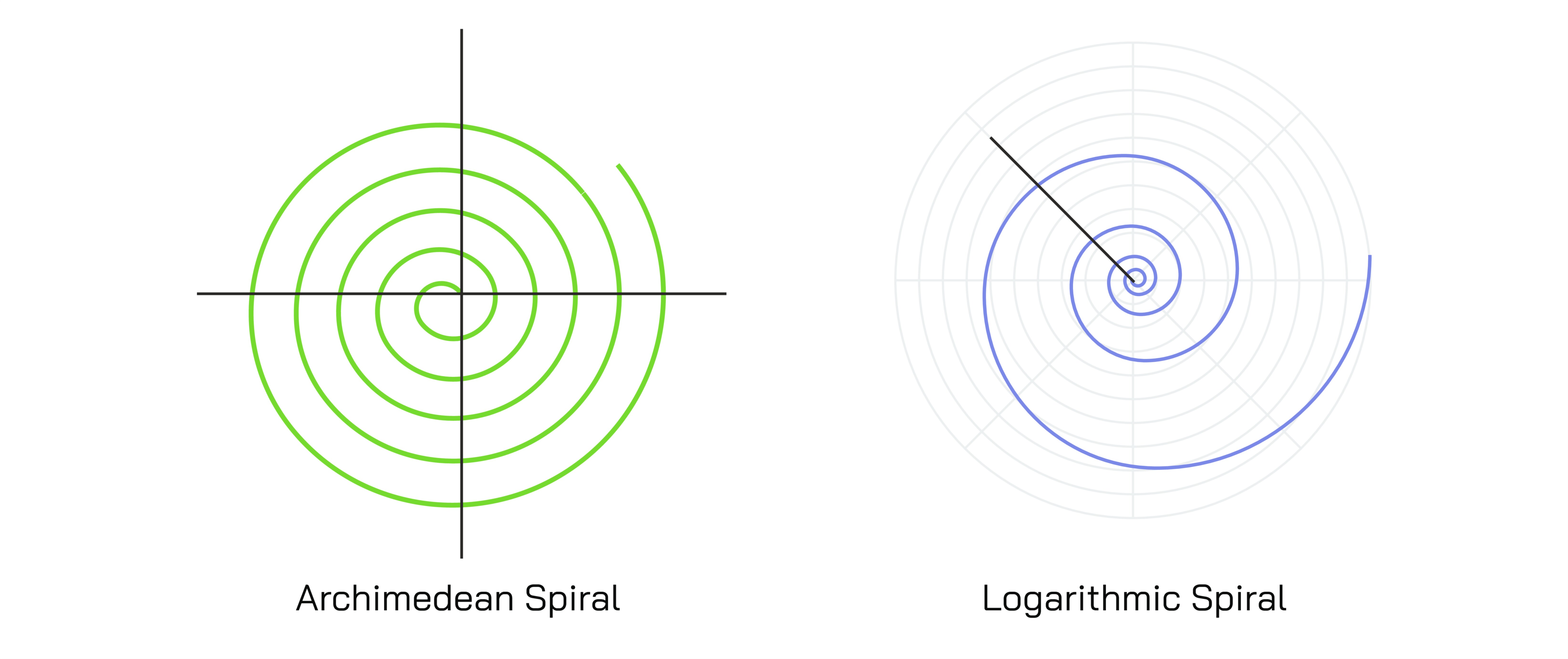
The Archimedean spiral is one of the most captivating and historically significant curves studied in mathematics, distinguished by its elegant outward-winding form that begins at a central point and expands gradually as it revolves. It is named after the ancient Greek scholar Archimedes, who first described this remarkable spiral more than two thousand years ago while exploring the geometrical relationships of curves. Even today, long after its origin in classical geometry, the Archimedean spiral continues to fascinate scientists, designers, and engineers because of its balanced blend of simplicity and complexity. At its core, the spiral is defined by the property that the distance from the center increases in equal increments for equal increases in angular rotation. This characteristic makes the spiral feel rhythmic, predictable, and almost hypnotic when observed, and it sets it apart from many other spiral curves found in mathematics and nature.
Visual Structure and Growth Pattern
What gives the Archimedean spiral its recognizable appearance is the uniform spacing between each turn of the curve. Starting from a central point, the spiral moves outward smoothly while maintaining an evenly increasing radius relative to the angle of rotation. This generates loops that are equally spaced apart from each other, producing a pattern that resembles rings expanding in a controlled and consistent manner. The result is neither too tight nor too explosive in curvature but balanced in a way that feels both dynamic and calm. The beauty of the Archimedean spiral lies in the fact that one can visually sense the constant growth rate even without formulas. Each loop builds naturally upon the previous one, and this behavior makes the curve particularly useful when precision and uniformity are required in mechanical or graphical design. Whether observed on a flat plane or traced by hand, the spiral conveys a strong sense of motion and expansion, creating an impression of steady journey outward from the core.
Historical and Scientific Applications
Throughout history, the Archimedean spiral has played a role in understanding the mathematics of motion and measurement. Archimedes used this curve as a tool for studying the area under curves and for investigating rotational mechanics. The spiral also helped ancient scholars explore the relationship between linear and rotational movement. Beyond historical contributions, the curve has become deeply rooted in modern scientific and technological disciplines. Engineers use it in the design of springs, cams, and spiral pumps where gradual and predictable expansion is crucial for performance. In astronomy, it has been explored as a model for certain orbital patterns and rotating systems. Even radar technology harnesses the Archimedean spiral shape for antennas that need equal coverage across wide angular regions. Because the spiral grows steadily without sudden jumps, it allows energy to distribute consistently across space, which is valuable for many electronic and communication systems.
Presence in Modern Art, Graphics, and Design
The visually appealing pattern of the Archimedean spiral has also found its place in creative fields. Graphic designers frequently rely on this curve when creating dynamic backgrounds, logo elements, abstract artwork, or motion graphics because of its fluid symmetry and sense of expansion. Tattoo artists, illustrators, and animators use the spiral to evoke movement, continuity, and growth in their visuals. In architectural design, spirals inspired by Archimedean geometry are applied to staircases, plaza layouts, and floor patterns due to their smooth and progressive widening. The equal spacing between turns helps maintain harmony and balance, making the spiral a strong tool for both aesthetic appeal and ergonomic structure. The influence of this spiral extends to user interface design and game development as well, where it is used to guide visual flow or spatial arrangement in circular menus, load animations, and layered progress indicators.
Connections to Natural Patterns and Real-World Behavior
Although the Archimedean spiral is defined mathematically rather than biologically, it has many parallels in natural structures. It resembles the pattern of certain shells, plant arrangements, or weather formations where growth occurs steadily outward from a central region. The curve appears in the arrangement of snail shells, the arms of some marine organisms, and even the paths of certain animals that move outward from a starting point while maintaining constant angular change. In nature, this spiral also emerges in physical processes where expansion occurs at a stable rate over time, such as the propagation of waves on water or the spiraling pattern observed in some charged particles under magnetic influence. The predictability and consistency of the Archimedean spiral make it a valuable conceptual model for interpreting natural growth, controlled expansion, and rotational spreading.
Relevance in Education, Visualization, and Mathematical Exploration
The Archimedean spiral serves as a powerful teaching tool for visualizing the relationship between rotation and linear displacement. In mathematics education, graphing this spiral helps students intuitively grasp the idea of incremental radial change tied to angular movement. Graphing software, drawing tools, and digital art platforms frequently feature the spiral as an example of smooth progressive curves. Exploring this shape deepens understanding of coordinate systems, curve plotting, and geometric reasoning. In fields involving simulation and visualization, the spiral can guide the distribution of data points, animated paths, or sampling patterns on circular surfaces. Moreover, studying the Archimedean spiral often leads learners to compare it with other spiral types, such as logarithmic or hyperbolic spirals, encouraging deeper awareness of how different curves express contrasting growth behaviors even though they all share rotational character.
Enduring Significance and Conceptual Impact
What makes the Archimedean spiral enduringly fascinating is its seamless fusion of geometry, structure, and symbolism. It represents gradual progress and balanced development, expanding outward with clarity and purpose. From ancient mathematical manuscripts to modern engineering diagrams, and from scientific laboratories to digital design studios, the influence of this spiral continues to grow. The curve reflects order without rigidity, movement without chaos, and expansion without abrupt change. Even without formulas, graphs of the Archimedean spiral capture a sense of infinite possibility and controlled evolution. It remains a foundational shape not just in mathematical studies but in the broader appreciation of patterns that govern structure, motion, growth, and beauty across the world.