Fibonacci Sequence Vector Illustration Showing Numerical Pattern, Spiral Growth, and Mathematical Progression in Nature and Geometry
The Fibonacci sequence is a renowned mathematical series in which each number is the sum of the two preceding numbers, forming the pattern: 0, 1, 1, 2, 3, 5, 8, 13, 21, and so on. This sequence is widely observed in nature, art, architecture, and geometry, producing patterns that are aesthetically pleasing and mathematically significant. A vector illustration of the Fibonacci sequence typically integrates numerical progression, geometric spiral formation, and natural examples, providing a visually intuitive explanation of how this sequence manifests in both abstract mathematics and tangible structures. By combining labeled numbers, spirals, and real-world representations, such diagrams enable learners to connect numerical patterns with spatial growth and natural occurrences.
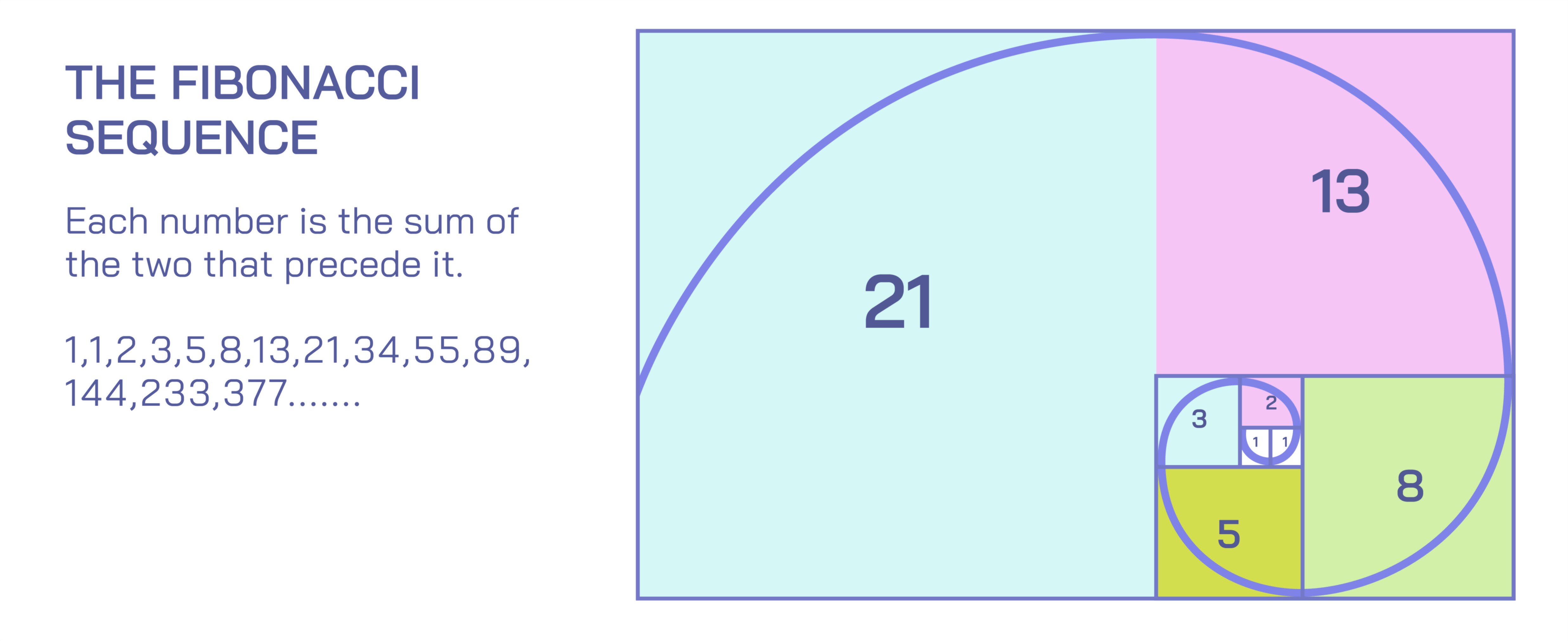
At the core of the illustration is the numerical pattern of the Fibonacci sequence, often displayed as a series of boxes or squares arranged sequentially. Each box is labeled with its corresponding Fibonacci number, starting from 0 or 1, depending on the convention used. The sizes of these boxes typically correspond proportionally to the numbers themselves, providing a visual representation of the increasing magnitude of the sequence. Arrows or connecting lines may indicate the summation rule, demonstrating how each number is derived from the sum of the two preceding numbers. This helps learners internalize the additive property and recursive nature of the sequence.
A key feature of the vector diagram is the Fibonacci spiral, constructed by connecting quarter-circle arcs inside each consecutive square. This spiral visually demonstrates geometric progression, illustrating how the sequence can generate natural growth patterns. Color coding may be used to differentiate segments, highlighting the relationship between sequential Fibonacci numbers and the curvature of the spiral. Labels such as "n=5 → side length 5 units" or "arc connects squares 3 and 5" clarify the connection between the numerical sequence and geometric expansion.
Vector illustrations often include natural examples of the Fibonacci spiral to link mathematics with biology. For instance, sunflower seed arrangements, nautilus shells, pinecones, and pineapples can be overlaid or inset along the spiral path. Arrows and magnified insets demonstrate how the phyllotaxis (leaf arrangement) and seed patterns correspond to Fibonacci numbers, showing efficiency in packing and optimal exposure to sunlight. This connection between mathematical abstraction and natural forms emphasizes the universality and practical significance of the sequence.
In addition, the diagram may illustrate ratios derived from Fibonacci numbers, such as the golden ratio (approximately 1.618), which emerges as consecutive Fibonacci numbers increase. Arrows between successive squares or numbers can indicate the ratio of one number to the next, highlighting convergence toward the golden ratio. Labels may indicate the ratio of width to height of the Fibonacci rectangles, visually linking the sequence to geometric aesthetics and proportional harmony observed in natural and human-made structures.
The vector illustration may also feature step-by-step construction of the Fibonacci spiral, showing how successive squares are added to form the expanding spiral pattern. Arrows indicate the sequence of construction, demonstrating how each new square’s size is determined by the sum of the previous two, reinforcing the additive property. Color gradients may illustrate growth direction, providing a clear and intuitive understanding of the expansion process.
For educational clarity, vector diagrams may include mathematical annotations, highlighting formulas such as F(n) = F(n-1) + F(n-2), alongside visual examples. Magnified insets may show how small Fibonacci numbers (1, 2, 3, 5) scale up into larger numbers, linking arithmetic progression to geometric growth. Arrows connecting numerical sequence, rectangle sizes, and spiral curves help learners see the integrated relationship between number, shape, and spatial expansion.
Additional features often include comparative panels demonstrating Fibonacci patterns in nature versus abstract geometric spirals. For example, a nautilus shell can be placed beside a constructed spiral to show precise correspondence, while sunflowers or pinecones illustrate how the mathematical arrangement results in efficient packing and symmetry. Labels identify the Fibonacci number associated with each radial or spiral segment, visually bridging numerical sequences and biological structures.
By combining numerical sequence, Fibonacci rectangles, spiral construction, natural examples, and golden ratio annotations, a vector illustration of the Fibonacci sequence provides a holistic understanding of this fundamental mathematical principle. Color-coded boxes, connecting arrows, labeled arcs, and comparative nature examples ensure that both theoretical and practical aspects of the sequence are communicated effectively. Learners can visually comprehend the progression from simple addition rules to complex spatial and natural patterns.
Ultimately, a Fibonacci sequence vector illustration demonstrates the interplay between mathematics, geometry, and nature, showing how a simple numerical pattern manifests in spiral growth, aesthetic proportion, and natural efficiency. Through labeled numbers, sequential squares, spiral arcs, natural overlays, and ratio annotations, the diagram transforms abstract arithmetic and geometric concepts into an educational and visually engaging framework, enabling learners to appreciate both the mathematical beauty and practical significance of the Fibonacci sequence.