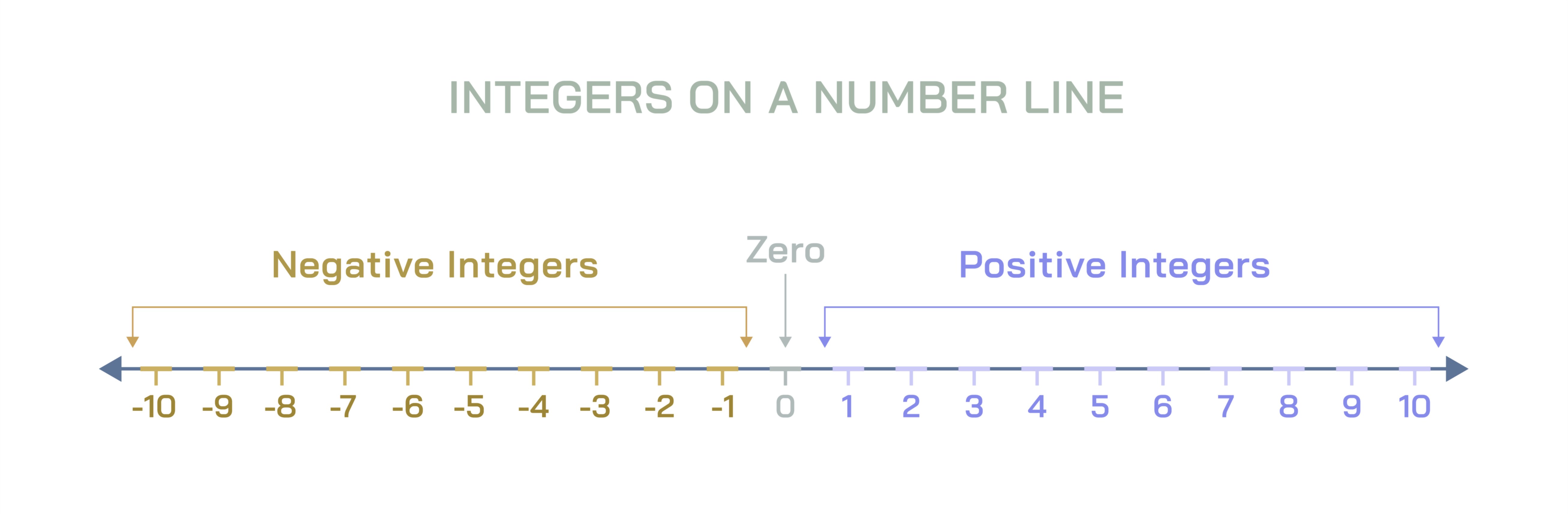
Integers on Number Line Vector Illustration Showing Positive and Negative Integers with Zero at Center for Math Education
The concept of integers is a foundational element in mathematics, representing whole numbers that can be positive, negative, or zero. A number line is a visual tool that helps learners understand integers, their relative positions, magnitude, and operations such as addition and subtraction. A vector illustration of integers on a number line typically integrates positive and negative integers, zero as a central reference point, and evenly spaced markings, providing a clear and educational representation of numerical order and value. By combining labeled ticks, directional arrows, and color coding, such illustrations allow students to intuitively grasp integer relationships and mathematical operations.
At the center of the illustration is the number line, drawn as a horizontal line with zero positioned at the center, serving as the reference point for both positive and negative numbers. Labels are placed above or below the line to indicate integer values, typically ranging from negative to positive numbers (e.g., -10 to +10), depending on the educational context. The spacing between adjacent integers is uniform, emphasizing the concept of equal intervals, which helps learners visualize numerical distances and relationships.
Positive integers are displayed to the right of zero. Each integer is represented by a labeled tick mark, often highlighted with a distinct color such as blue or green to distinguish positive numbers. Arrows may indicate increasing value from left to right, reinforcing the idea that integers grow larger as one moves in the positive direction. Optional insets may illustrate real-life examples of positive quantities, such as bank deposits, temperature above zero, or steps forward, connecting abstract concepts to tangible experiences.
Negative integers are displayed to the left of zero. Each negative integer is represented by a labeled tick mark, typically colored red or another contrasting hue to visually separate them from positive numbers. Arrows pointing left may indicate decreasing value, emphasizing that negative numbers represent quantities less than zero. Magnified insets or icons may illustrate real-life examples of negative quantities, such as bank debt, temperature below zero, or steps backward, helping learners contextualize the concept of negative numbers.
Zero is prominently labeled at the center of the number line. It acts as the neutral reference point, dividing positive and negative integers. Vector illustrations may highlight zero with a larger tick mark, bold labeling, or a central icon, emphasizing its role as the origin or starting point for integer operations. Arrows extending in both directions from zero may indicate the symmetry of positive and negative integers, reinforcing their relational properties.
The number line may also include arithmetic demonstration elements. For example, vector arrows may show addition and subtraction operations, illustrating how moving to the right corresponds to adding positive numbers and moving to the left corresponds to subtracting or adding negative numbers. Color-coded arrows can show direction and magnitude, helping students visualize integer operations spatially. Labels such as “+3” or “-5” can accompany arrows to clarify movement and resulting positions on the number line.
Vector diagrams may include comparative spacing or distance markers to emphasize absolute value concepts. Arrows or dashed lines between integers illustrate the distance from zero or between numbers, reinforcing that absolute value represents the magnitude of a number regardless of sign. Color gradients along the number line can further visualize proximity to zero, aiding in intuitive understanding of numerical relationships.
Additional features may include integer groupings or labeling conventions, such as highlighting even and odd integers with different shapes or colors, or using circles or dots above the number line to visually reinforce the discrete nature of integers. Insets may illustrate integer sequences, showing patterns such as counting by twos, fives, or tens, to enhance understanding of numerical progression and mathematical relationships.
By combining zero-centered number line, positive and negative integers, labeled ticks, directional arrows, distance markers, and arithmetic visualization, a vector illustration provides a comprehensive, visually engaging representation of integers. Color coding, magnified insets, and directional arrows allow learners to quickly differentiate positive and negative values, understand integer magnitude, and perform basic arithmetic operations.
Ultimately, a vector illustration of integers on a number line demonstrates the concept of numerical order, symmetry, and magnitude, linking abstract mathematical ideas to spatial visualization. Through labeled ticks, color-coded positive and negative numbers, central zero, directional arrows, and distance markers, the diagram transforms fundamental integer concepts into an educational, visually intuitive, and engaging tool for mathematics learning.