Essential Vitamins and Minerals Vector Illustration for Bone Strength and Skeletal Health Support
Bone strength is not simply a characteristic inherited through DNA or determined by body size—it is the ongoing result of complex biological exchanges, nutritional balance, physical activity, and hormonal guidance. Even though bones are often imagined as rigid, unchanging frameworks, they are in fact living tissues constantly renewing themselves. Throughout life, tiny sections of bone are broken down and rebuilt through the remodeling cycle, and whether this process strengthens or weakens the skeletal system depends largely on the availability of essential vitamins and minerals that nourish and reinforce the bone matrix. A vector illustration designed to show these nutrients supporting skeletal health becomes a valuable educational tool because it visually connects invisible biochemical processes to the real-world need to maintain stable bone density. By displaying bones alongside their required nutrients—such as calcium, vitamin D, vitamin K, magnesium, phosphorus, zinc, copper, and manganese—the illustration translates abstract nutritional knowledge into a clear explanation of how bones remain strong, resilient, and functional across the lifespan.
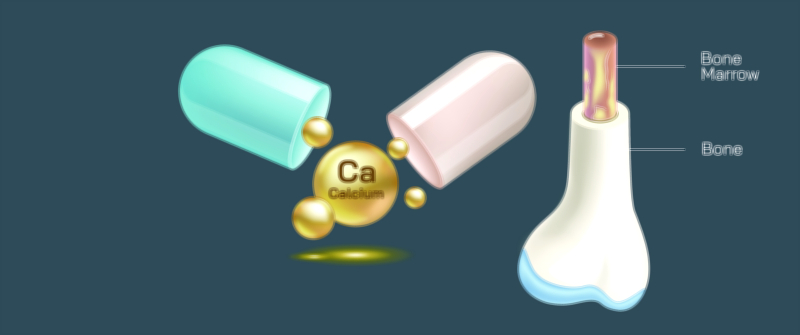
The foundation of skeletal strength lies in the microscopic architecture of bone. A strong bone is built from a dense outer cortical layer and a spongy inner trabecular layer that provides both durability and flexibility under physical load. Within this structure, calcium acts as the primary mineral that hardens and stabilizes the collagen matrix, creating the rigidity needed for weight-bearing tasks. A vector graphic often highlights calcium as the key building block, showing how tightly packed mineral crystals reinforce the bone scaffold. Yet, without proper absorption and regulation, even a calcium-rich diet would not be enough. Vitamin D, frequently positioned in bone-health illustrations alongside sunlight, is necessary for calcium to enter the bloodstream from the digestive system; without it, the body cannot use calcium effectively. A well-designed illustration might show vitamin D activating calcium transport, visually reinforcing their interdependence.
Vitamin K plays another central role in skeletal health by securing calcium into the bone matrix rather than allowing it to circulate unbound. It activates osteocalcin, the protein needed to anchor minerals into the developing bone structure. When vitamin K is insufficient, calcium may not bind properly, weakening structural integrity even if total calcium intake appears adequate. Educational diagrams often depict this “locking” effect to help viewers understand why vitamin K–containing foods—such as leafy greens—are foundational to bone nutrition. Magnesium is also critical; it not only supports vitamin D activation but also contributes to bone mineral composition. When magnesium is low, bone metabolism becomes unstable and the remodeling process falters. A vector illustration might show magnesium surrounding osteoblasts, enhancing the message that this nutrient is essential for the cellular machinery that builds bone.
Phosphorus is another major contributor to the structural matrix because it forms hydroxyapatite crystals with calcium, giving bones their inherent hardness. Bones store the vast majority of the body’s phosphorus, creating mineral balance under healthy conditions. However, this nutrient must remain in proportion to calcium. A nutritional imbalance—such as chronically high dietary phosphorus—can disrupt bone chemistry and trigger calcium withdrawal from bones to maintain blood levels. Visual representations explain this relationship by balancing phosphorus on opposite sides of calcium to show how both minerals depend on one another for proper function.
Beyond these primary nutrients, trace minerals—including zinc, copper, and manganese—contribute to bone strength in subtler but essential ways. Zinc supports collagen synthesis and cell growth; copper helps form cross-links between collagen fibers to prevent structural weakness; manganese aids in cartilage formation and bone matrix development. Though required in smaller amounts, their representation in vector illustrations gives a more complete picture of the cooperative nature of nutrients. Strong bones are not the result of a single vitamin or mineral, but a synchronized equation in which each component plays a role in either mineralization, collagen formation, or metabolism regulation.
Because the body draws calcium from bones when blood calcium levels drop, long-term nutritional shortages create visible structural consequences even when day-to-day symptoms are not apparent. Illustrations that compare a dense, mineralized bone with a porous and weakened one help make this biological exchange easier to grasp. The weakened structure—marked by widening gaps between trabeculae and thinning of the cortical border—represents conditions such as osteopenia or osteoporosis. These structural degenerations evolve silently, which is why visual education is so impactful: it provides a window into what gradual deficiencies produce before pain or fractures occur.
The same template often incorporates lifestyle influences that either support or undermine skeletal health. Physical activity, especially weight-bearing exercise and resistance training, stimulates bone-building cells and ensures minerals are deposited into bone rather than lost. In contrast, prolonged physical inactivity accelerates bone loss, as the body interprets low movement as a sign that strong bone density is unnecessary. Illustrations that juxtapose active and inactive skeletal systems help reinforce these behavioural influences. Sleep, protein intake, hydration, and stress all influence the hormonal pathways behind bone remodeling, and educational graphics frequently place these habits around the bone structure to show that bone strength is supported by whole-body wellness rather than diet alone.
Another important feature of a vector illustration template is its ability to explain bone health across age groups. In childhood and adolescence, bones accumulate density rapidly; during adulthood, remodeling stabilizes bone mass as long as nutrient intake remains balanced; and later in life, hormonal changes—especially estrogen decline during menopause—tilt the balance toward bone loss. Showing these phases visually alongside nutrient icons teaches that supplementation and healthy dietary choices become especially important in midlife and beyond. This view also supports early prevention, making it clear that the most powerful protection against age-related bone loss is built years earlier through consistent nutrition and lifestyle.
Ultimately, a vector illustration of essential vitamins and minerals supporting bone strength and skeletal health is more than a diagram—it is a clinically meaningful communication tool. It enables medical students to understand biochemical interrelationships in visually intuitive ways, helps fitness and nutrition professionals explain bone-health strategies, and empowers patients and the general public to take ownership of long-term skeletal wellbeing. By visually linking nutrients, hormonal influences, exercise, diet, and bone density, the illustration illuminates the truth that strong bones arise from balance and cooperation rather than from a single dietary focus. The human skeleton remains structurally strong not by chance but by nourishment, movement, and awareness—and the vector illustration makes that lifelong connection vividly clear.