Law of Reflection with Incident and Reflected Rays – Vector Representation of Light Interaction, Angle Geometry, Normal Line Orientation, Surface Behavior, and Optical Image Formation in Physics
The Law of Reflection defines how light behaves when it strikes a surface and bounces back into the same medium. Though often introduced in school using simple ray diagrams, the principle carries deep meaning in physics, mathematics, and real-world optical engineering. When represented as a vector process, reflection reveals precise directional relationships between incoming and outgoing light rays. Whether a beam of sunlight hits a still lake or a laser strikes a metal sheet in a laboratory, the same law applies. Reflection is reliable and predictable, and this predictability allows mirrors, telescopes, periscopes, cameras, and optical sensors to work with high precision. The law does not change with wavelength, intensity, or light source — it is consistent across the electromagnetic spectrum.
To understand reflection at a surface, three elements must be defined. The first is the incident ray, which is the vector representing the direction of incoming light before contact with the surface. The second is the reflected ray, which is the vector representing the direction in which the light bounces after striking the surface. The third is the normal line, an imaginary perpendicular drawn at the point of incidence where the ray meets the surface. Without the normal line, it would be impossible to measure angles accurately. In vector-based physics, the normal provides a reference for orientation by indicating the direction perpendicular to the surface.
The Law of Reflection states that the incident ray, the reflected ray, and the normal all lie in a single plane, and the angle of incidence is always equal to the angle of reflection. The angle of incidence is measured between the incident ray vector and the normal. The angle of reflection is measured between the reflected ray vector and the same normal. Because these angles are always equal, reflection is symmetrical. This symmetry is the foundation of mirror optics. When people see their reflection in a mirror, they are observing this symmetry: the light from each point on their face strikes the mirror, reflects with equal angular behavior, and reaches their eyes in an aligned manner, allowing a precise visual representation.
Although the law sounds theoretical, it is visibly demonstrated in a vector-style ray diagram. A straight line indicates a reflecting surface. At the point where the ray hits, a perpendicular line represents the normal. The incident ray approaches at a slanted angle toward the surface. After contact, the reflected ray leaves on the opposite side of the normal at an equal angle. The symmetry of these angular vectors conveys the fundamental truth that reflection is governed by geometry rather than randomness.
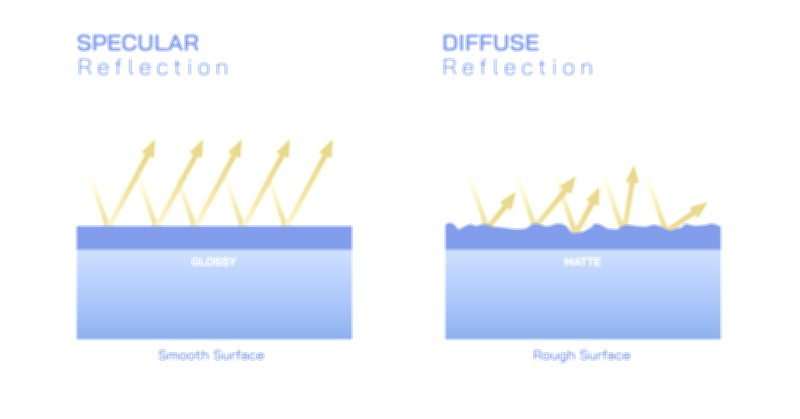
Reflection behaves differently depending on the nature of the surface. On a smooth, polished surface, like a mirror or still water, the microstructure is even. Rays strike and reflect in a coordinated manner, maintaining angle equality and direction. This produces regular reflection, where reflected rays remain grouped and form a sharp image. On a rough or irregular surface, each microscopic projection and depression has a different orientation. At every individual point the law remains true — the angle of incidence equals the angle of reflection — but because each tiny segment has a different tilt, the reflected rays scatter in multiple directions. This is called diffuse reflection, and it prevents image formation but allows objects to be visible from all directions. The world appears bright and detailed not because everything behaves like a mirror, but because diffuse reflection from most surfaces scatters light everywhere, enabling the eyes to detect it.
Reflection also governs image formation. In a plane mirror, reflected rays appear to originate from behind the mirror, although they do not physically pass through it. The image appears upright and equal in size but laterally inverted. Left and right switch because of the geometry of vector reflection — the horizontal directions of incident rays reverse, while vertical directions remain unchanged. In curved mirrors, which obey the same vector law, the surface shape causes rays to converge or diverge. A concave mirror focuses rays inward and can produce magnified or real images depending on distance, whereas a convex mirror spreads rays outward and always produces smaller upright images. These optical behaviors support technologies ranging from telescopes and headlights to makeup mirrors and security domes.
The vector form of reflection becomes even more important in scientific instruments and advanced technology. Laser scanners reflect beams at precisely controlled angles to map distances and read coded patterns. Solar concentrators reflect light toward a focal point to generate heat or electricity. Periscopes redirect light vectors to allow viewing over obstacles. Surveying instruments reflect laser signals from mirrors to measure terrain. In digital medical scopes and industrial sensors, reflections inside lenses and components guide controlled light paths to capture information. None of these would work without the certainty that the path of reflected light is mathematically predictable.
Reflection also helps shape human perception. The sparkle of sunlight on a lake, reflections on glass skyscrapers, the glittering surface of polished floors, and the shimmering patterns on curved car bodies are all consequences of vector reflection. The human brain uses reflected rays to reconstruct the appearance, location, and texture of objects. Reflection links physics with sensory experience, transforming mathematical symmetry into visual reality.
Despite being simple in its statement, the Law of Reflection is foundational because it describes light with absolute reliability: every ray obeys the rule that the angle of incidence equals the angle of reflection, and the normal, incident ray, and reflected ray always lie in the same plane. Whether light hits a mirror, a raindrop, a gemstone, a pair of eyeglasses, or a solar panel, the same law is in operation. This consistency makes reflection a cornerstone of optics and ensures that optical instruments can be engineered with accuracy.
In essence, reflection is the interaction that allows light to be controlled, redirected, and interpreted. It enables cameras to capture images, telescopes to explore distant galaxies, and the human eye to detect and identify objects. When viewed through vectors and angles, the Law of Reflection becomes more than a rule — it becomes a window into how light carries information, how images form, and how physics translates into vision. Through reflection, the world is not only illuminated but also understood.