Law of Reflection of Light — Behaviour of Light Rays on Reflective Surfaces
The law of reflection of light describes one of the most predictable and universal responses of light when it meets a reflective surface, enabling the formation of images, the control of optical rays, and the design of countless technologies used in daily life and scientific research. Whether a person looks into a mirror, sees sunlight dancing on a lake, notices the shine on polished metal, watches a projector beam strike a screen, or observes a laser redirected by a mirror, the same fundamental law is operating with absolute precision. Reflection is not a random rebound of light; it follows a strict geometric rule that determines how the direction of a ray will change after striking a surface. This rule forms the foundation of geometric optics and makes it possible to predict image formation, trace ray paths through optical instruments, and explain the visibility of objects. Without the law of reflection, visual perception, mirrors, telescopes, periscopes, cameras, laser engineering, and many scientific devices would not exist in the way humanity depends on them today.
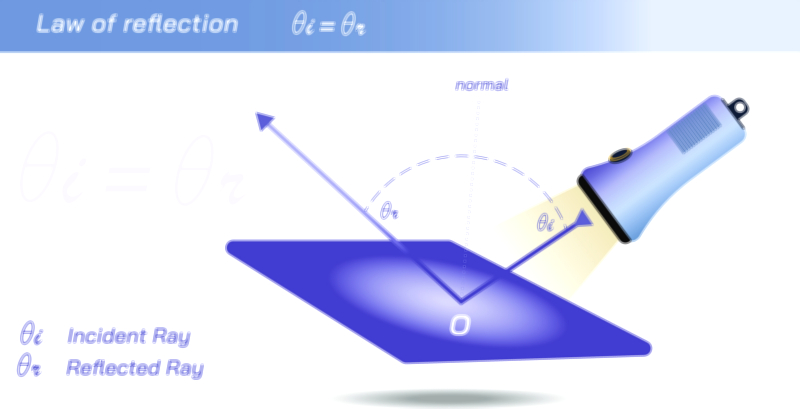
Whenever light meets a reflective surface, three essential elements define its interaction: the incident ray, which is the incoming beam striking the surface; the reflected ray, which is the outgoing beam after bouncing off; and the normal, an imaginary line drawn perpendicular to the surface at the point of incidence. The law of reflection states that the angle of incidence is always equal to the angle of reflection when both angles are measured relative to the normal. In addition, both rays lie in the same plane along with the normal, meaning light never reflects in a direction outside that geometric plane. The remarkable consistency of this law makes reflection highly predictable across all wavelengths of visible and invisible light, across all materials capable of reflecting, and across all intensities of illumination. From faint stars observed through astronomical mirrors to intense laser beams used in manufacturing, the equality of angles ensures that optical systems behave reliably.
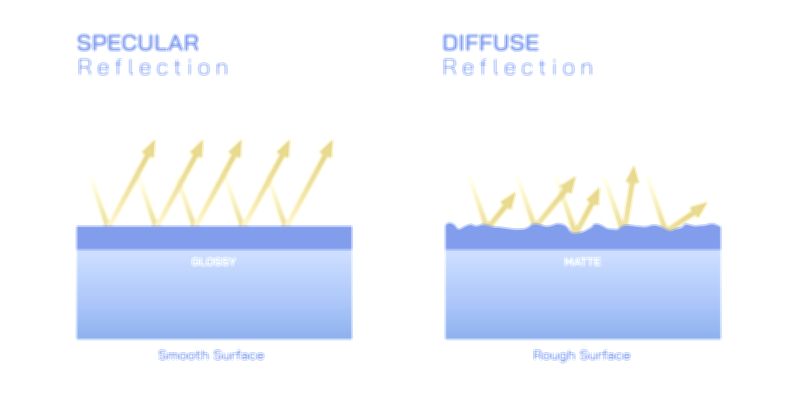
This law governs two major forms of reflection observed in the real world. The first is specular reflection, in which light strikes a smooth surface—such as a glass mirror, polished steel, or calm water—and reflects uniformly, maintaining the angular spacing of rays. Because neighbouring rays remain ordered, they carry visual information back to the observer, forming crisp and clearly defined images. When a person looks into a mirror and sees a sharp reflection of themselves or a scene behind them, they are experiencing specular reflection created by the precision of the law of reflection acting uniformly across the surface. The second form is diffuse reflection, which occurs when light encounters a rough surface with microscopic bumps and irregularities. At each microscopic point, the law of reflection still applies, but the tiny differences in surface angle scatter the rays in many directions. This scattering prevents image formation but makes the surface visible from almost any direction, allowing everyday objects such as clothing, walls, furniture, plants, roads, and skin to appear evenly illuminated. Without diffuse reflection, the world would look like a hall of mirrors, with everything reflecting images instead of showing colour and texture.
The law of reflection holds true even for curved reflective surfaces. In concave mirrors, which curve inward like the inside of a bowl, each point on the surface reflects rays according to the law of reflection, but the geometry causes parallel incoming rays to converge toward a focal point. This property makes concave mirrors valuable for telescopes that collect and focus distant starlight, for shaving mirrors that magnify the face, for solar concentrators that direct sunlight to a single focal area, and for vehicle headlights that form powerful directed beams. In convex mirrors, which bulge outward, the law of reflection operates at every surface point as well, but the geometry causes parallel rays to diverge. This divergence provides a wider field of vision, which is why convex mirrors are used on car side mirrors, in parking lots, and in security systems to monitor broad areas. Even though the reflected paths differ dramatically between concave and convex shapes, both are governed by exactly the same principle: the angle of incidence equals the angle of reflection at every microscopic location on the surface.
Technological applications of reflection depend heavily on the reliability of this optical law. Periscopes in submarines use mirrors positioned at precise angles to reflect light down into observation chambers. Laser cutting machines rely on high-reflectivity mirrors to redirect concentrated beams across complicated work paths. Optical communication systems steer signals through mirrors and photonic pathways to maintain alignment across long distances. Astronomical telescopes, especially those used in space or for deep-sky observations, employ large concave mirrors to gather faint light from galaxies, nebulae, and distant stars and focus it with minimum scattering. Barcode scanners, projectors, medical imaging tools, surveying instruments, and scientific interferometers all function by using mirrors that manipulate light according to the law of reflection. The accuracy of these tools depends on the physicist’s and engineer’s ability to calculate ray behaviour down to fractions of a degree using the rule that the incident and reflected angles are equal.
Reflection also shapes the way humans perceive light in natural environments. Sunlight shining on rippling water creates shifting lines of brightness because each small wave reflects rays in slightly different directions. Jewels and polished stones sparkle because their faceted surfaces reflect light specularly at many orientations. Wet pavement becomes dangerously reflective because a thin film of water smooths the surface, reducing diffuse scattering and turning the road into a partial mirror. Artists and photographers rely on the understanding of reflected light to depict highlights, brightness gradients, and glints that define shape and texture. Designers of theatrical lighting and architectural spaces also use reflection deliberately to brighten areas, soften shadows, or control glare. Every reflection the human eye sees—whether subtle or dramatic—is governed by the same consistent optical behaviour.
Beyond practical visibility and instrument design, the law of reflection reveals profound insights into the nature of light. Reflection demonstrates that light travels in straight lines and interacts with boundaries in predictable ways, forming the basis for geometric optics. It provides evidence for the wave–particle nature of light because, at a microscopic level, reflection occurs when electrons at a surface absorb incoming electromagnetic energy and then re-radiate it in the direction determined by the geometry of incidence. Reflection also underpins advanced fields such as quantum optics, photonics, and gravitational-wave detection, where mirrors reflect photons or laser beams with extreme precision to measure tiny vibrations and distances. The law remains unchanged even in the most sensitive scientific measurements, highlighting the universality of light–matter interaction.
The law of reflection of light rays therefore represents far more than a statement that angles match. It is a universal rule describing how light responds to surfaces, shaping how human beings see the world and how technology uses light for measurement, observation, communication, protection, and innovation. Every mirror-like shimmer on water, every accurate optical telescope, every controlled laser beam, every retroreflective safety sign, and every sharp image formed in glass owes its existence to this rule. Through its simplicity and reliability, the law of reflection stands as a cornerstone of physics, linking everyday visual experience with the deepest understanding of how light interacts with matter.