Law of Reflection of Light Rays — Fundamental Optical Principle Governing the Return Path of Light
The law of reflection of light rays describes one of the most foundational behaviours of light in the study of optics, explaining how a beam of light changes direction when it encounters a reflective surface. Although reflection appears simple on the surface—light hits an object and bounces back—this behaviour follows a precise mathematical law that governs the way light travels, the way images form, and the way mirrors and optical systems operate. Every time a person looks into a mirror, observes sunlight glimmering on a lake, sees a polished metal surface shine, uses a periscope, takes a photograph with a camera, or relies on a telescope to observe distant galaxies, they are witnessing the law of reflection at work. The predictability of reflection makes it possible to design optical instruments, focus light accurately, redirect beams in scientific devices, and explain everyday visual experiences.
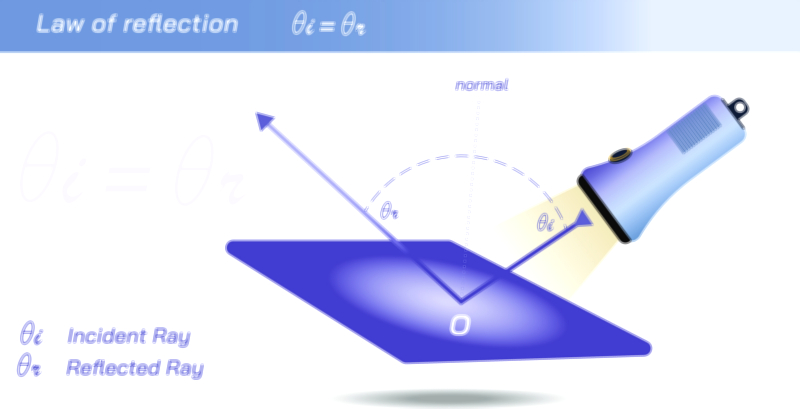
When a light ray meets a reflective surface, three important reference lines can be identified: the incident ray, which is the incoming ray of light striking the surface; the reflected ray, which is the outgoing ray after bouncing off the surface; and the normal, which is an imaginary line drawn perpendicular to the surface at the point where the incident ray meets the reflector. The law of reflection states that the angle of incidence—the angle between the incident ray and the normal—is always equal to the angle of reflection—the angle between the reflected ray and the normal. Both the incident and reflected rays lie in the same plane, a plane defined by the incident ray and the normal. These rules apply universally, regardless of whether the reflected surface is glass, metal, water, polished wood, ceramic, or even a smooth gemstone. The behaviour does not depend on the colour or intensity of the light, nor on the type of light source. The rule is universal because reflection arises from deeper physical interactions between electromagnetic waves and the electrons on the reflecting surface.
This predictable equality of angles allows mirrors to reproduce images with geometric accuracy. When parallel rays strike a flat mirror, they reflect in orderly directions, preserving angular relationships between rays. This consistency allows the brain to interpret the reflected light as if it were coming from behind the mirror, creating a virtual image that appears upright and identical in size to the original object but laterally inverted. The fact that mirrors produce clear and stable images is not a coincidence but a direct consequence of the law of reflection ensuring that each ray maintains its relationship with neighbouring rays.
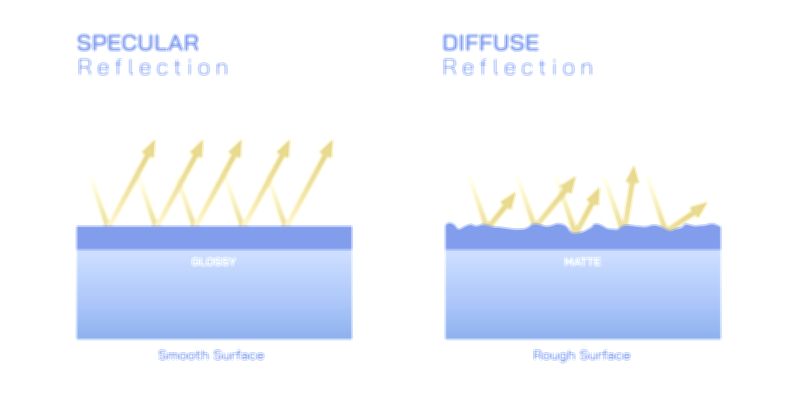
Reflection can occur in two major forms depending on the smoothness of the surface. Specular reflection happens when light encounters a smooth, polished surface, such as a mirror or calm water. In this case, all incident rays reflect at the same angle and remain parallel, resulting in a sharp reflected image. This is what allows us to see ourselves in a bathroom mirror, a car mirror, or the glass windows of a building. Diffuse reflection, on the other hand, happens when light strikes a rough or irregular surface. Each microscopic bump and valley reflects light according to the law of reflection, but because their orientations differ randomly, the reflected rays scatter in many directions. This scattering prevents the formation of a clear image but enables us to see everyday objects from multiple angles. If diffuse reflection did not exist, light would reflect like a mirror from everything, making the world visually chaotic and disorienting. Instead, diffuse reflection provides stable surface visibility while specular reflection allows image formation.
The law of reflection plays a major role in the behaviour of curved mirrors, which either converge or diverge light based on their shape. A concave mirror, which curves inward like the inside of a bowl, reflects rays in such a way that parallel rays converge toward a focal point. This behaviour makes concave mirrors useful in telescopes, flashlights, solar cookers, and headlights, because they concentrate light into a tight beam or onto a single location. A convex mirror, which bulges outward, reflects rays so that they diverge and spread apart. This property provides a widened field of view, making convex mirrors ideal for vehicle side mirrors, security observation points, parking lots, and road intersections. In both cases, curved surfaces follow the law of reflection at every microscopic point along their shape; the different image behaviours emerge from the geometry of the surface, not from a change in optical rules.
Reflection is essential in numerous optical devices that redirect light to produce magnified, reduced, or redirected images. Periscopes use internal mirrors oriented at carefully calculated angles to allow observation from hidden or protected positions. Telescopes rely on large concave mirrors that gather faint light from distant stars and galaxies and reflect it precisely into an eyepiece or detector. Microscopes use reflective surfaces to guide and manipulate light internally, helping illuminate specimens and magnify structures too small for the naked eye. Laser instruments depend on precise mirror orientation to steer beams to specific locations without divergence or distortion. Barcode scanners, optical sensors, stage lighting systems, projection devices, surveying instruments, and many scientific and medical machines rely on mirror-based reflection to control light paths accurately.
Beyond structured equipment, reflection plays a crucial role in everyday visual perception. The reason a polished floor shines, sunlight glitters across rippling water, headlights glare on wet asphalt, and jewelry sparkles under bright light all stem from how the law of reflection interacts with surface smoothness, surface coatings, refractive index, and environmental conditions. When water covers a road, bumps and irregularities become smoother, turning what used to be a diffusely reflecting surface into one that partially reflects specularly, producing dangerous glare. Similarly, gemstones sparkle because their polished angular facets reflect light specularly in different directions based on their geometry. These daily experiences demonstrate how the same rule of reflection produces completely different visual outcomes depending on surface conditions.
Reflection also contributes to safety and visibility engineering. Road signage, safety vests, bicycle reflectors, and runway lights incorporate retroreflective materials that bounce incoming light back in the direction of the light source. Retroreflection involves a combination of internal microstructures that reflect light multiple times internally. Although the geometric path is more complex, the law of reflection at each internal interface ensures that the outgoing beam aligns with the incoming beam, enhancing visibility in low-light environments. This principle has become crucial for nighttime driving, aviation safety, and disaster response.
Scientifically, the law of reflection provides evidence that light travels in straight paths unless acted upon by a reflective surface or refractive medium. This principle underpins geometric optics and provides a stepping stone for more advanced concepts such as light refraction, wave interference, and quantum-light interactions. Although reflection is taught early in physics for its simplicity, it underlies some of the most advanced technologies today. Precision optical computing devices, gravitational-wave detectors, high-power lasers, and space-based telescopes rely on mirrors engineered to atomic smoothness. Even when light behaves as a wave or quantum particle, reflection still obeys the same geometric rule because it stems from the conservation of momentum of photons interacting with matter.
The law of reflection of light rays, therefore, is not merely a classroom formula but a universal description of how electromagnetic waves respond at boundaries. Its influence extends into every corner of visual experience, from the clarity of human sight to the tools that allow scientists to probe the universe. Whether a ray of light meets a polished mirror, a dusty wall, a metal surface, a sparkling diamond, or a retroreflective safety marker, the same law governs its path. With this consistency, reflection becomes a bridge between the natural behaviour of light and the technological capability of humans to capture, manipulate, and make use of it.