Reflection vs Refraction of Light — Interaction of Light with Surfaces and Media
Reflection and refraction represent two of the most fundamental behaviours of light when it encounters different boundaries in the physical world, and together they form the foundation of geometric optics, visual perception, lens design, imaging technology, and many scientific instruments. Although both involve a change in the direction of light, they arise from different physical interactions and lead to different visual and practical outcomes. Reflection occurs when light strikes a surface and bounces back into the same medium, whereas refraction occurs when light passes from one transparent medium into another and changes its direction due to a change in speed. These two processes shape everything from the way mirrors produce images and surfaces shine to the way lenses focus light in eyeglasses, cameras, microscopes, and telescopes. Understanding reflection and refraction is therefore not only essential for physics but also for interpreting the visual world and building optical technologies that rely on the predictable behaviour of light.
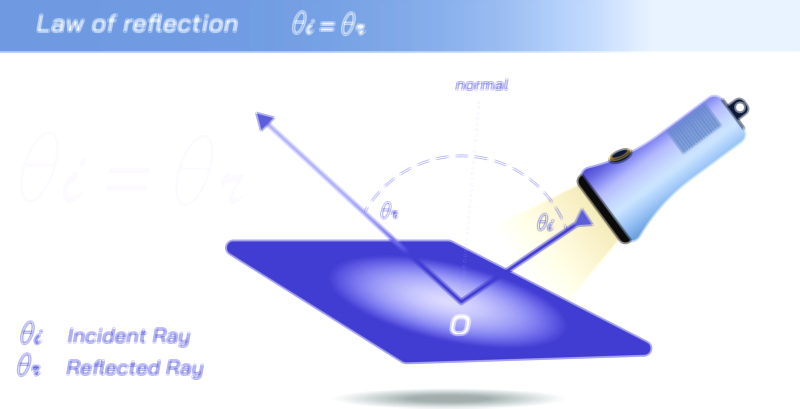
When light encounters a surface that does not allow it to enter—such as polished metal, a mirror, or still water—the incoming ray is reflected. In reflection, the incident ray, reflected ray, and the normal at the point of interaction form a precise geometrical relationship: the angle of incidence always equals the angle of reflection. This equality expresses that the direction of light change is not random but governed by a strict rule. Reflection can take two major forms depending on the smoothness of the surface. Specular reflection occurs when light strikes a smooth and polished surface, causing parallel rays to reflect in a uniform direction and form clear images. This is the principle behind mirrors, camera reflectors, and optical instruments that precisely redirect light. Diffuse reflection, on the other hand, occurs when light encounters a rough surface where microscopic irregularities scatter individual rays in many directions. In this case, each tiny bump still obeys the law of reflection independently, but the scattered pattern diffuses the reflected light so that no clear image forms. Diffuse reflection makes everyday objects such as clothing, wood, concrete, paper, plants, and skin visible from multiple angles, enabling stable perception of the environment rather than mirror-like reflections everywhere.
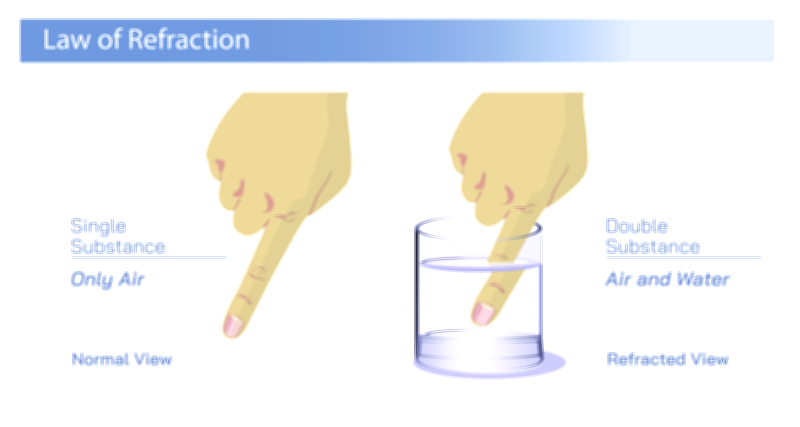
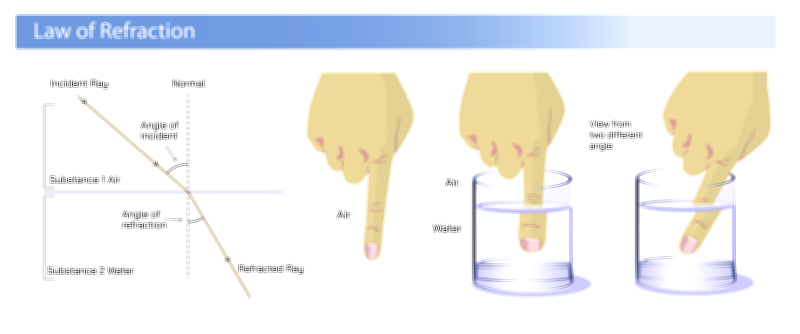
Refraction, by contrast, occurs when light travels from one transparent medium into another—such as from air into water, from water into glass, or from glass into air—and bends because its speed changes. Light slows down when entering a denser optical medium and speeds up when entering a rarer one. This change in speed causes the light ray to change direction at the boundary between media. If a ray of light passes from air into water, it bends toward the normal; if it moves from water back into air, it bends away from the normal. The amount of bending depends on the refractive index of the two media, a property that describes how much a material slows light compared to a vacuum. This bending effect explains why a straw in a glass of water appears bent, why a swimming pool looks shallower than its true depth, and why objects under water appear closer to the surface than they really are. Just as reflection obeys a precise law, refraction follows Snell’s law, which relates the ratio of the sine of the angle of incidence to the sine of the angle of refraction to the refractive indices of the two media. While Snell’s law is mathematical in nature, its observable consequences are familiar and visible in everyday life.
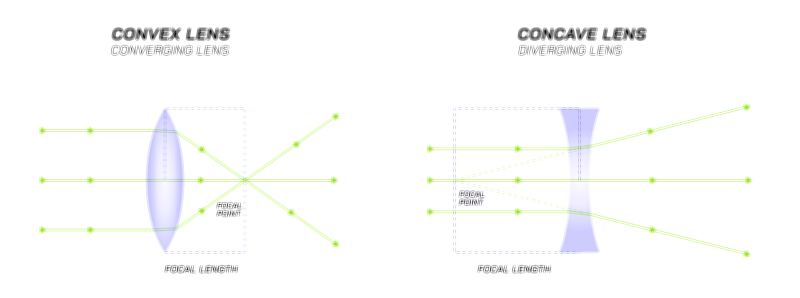
Reflection results in light remaining in the same medium, while refraction transports light into another medium. Because of this fundamental difference, the two processes influence visual appearance differently. Reflection determines how bright or shiny a surface looks; polished metals, mirrors, and calm water surfaces reflect large portions of light, producing visible images and highlights. Materials with low reflectivity and high diffuse scattering appear dull or matte. Refraction, meanwhile, determines how light bends when passing through transparent materials. Lenses rely on refraction to converge or diverge beams of light in controlled ways. A convex lens bends light inward, using refraction to focus parallel rays at a focal point, enabling magnification of distant objects or correction of farsightedness. A concave lens bends light outward, causing parallel rays to spread apart; this design is used for correcting nearsightedness and in devices requiring diverging light. Whether designing glasses, microscopes, telescopes, cameras, VR headsets, or optical sensors, the control of refraction is central to manipulating light in useful ways.
Reflection and refraction frequently work together in natural phenomena, many of which are visually striking. A classic example is the rainbow, which forms because sunlight refracts when entering water droplets, reflects internally off the back surface of the droplet, and refracts again as it exits. The bending of different wavelengths by different amounts separates white sunlight into the spectrum of colours. Mirages in deserts and on hot road surfaces also arise from refraction, where light passing through layers of air at different temperatures bends so dramatically that it creates a displaced virtual image. In contrast, glare on water or shiny surfaces results from reflection concentrating visible light into the eyes, while polarization filters help reduce this effect by blocking preferentially reflected rays.
Reflection is key in devices that redirect light but do not need to modify its speed. Periscopes, optical laser paths, solar concentrators, large astronomical telescopes, satellite reflectors, and scanning instruments rely on precisely angled mirrors built according to the law of reflection. Refraction is essential in devices that require focusing, dispersion, magnification, or zooming, such as binoculars, eyeglasses, microscopes, telephoto lenses, projectors, and fiber-optic communication systems, where lenses and refractive materials determine the path and convergence of rays. In optical fibres, repeated total internal reflection—another phenomenon linked to refraction—guides light over long distances, enabling high-speed internet around the world.
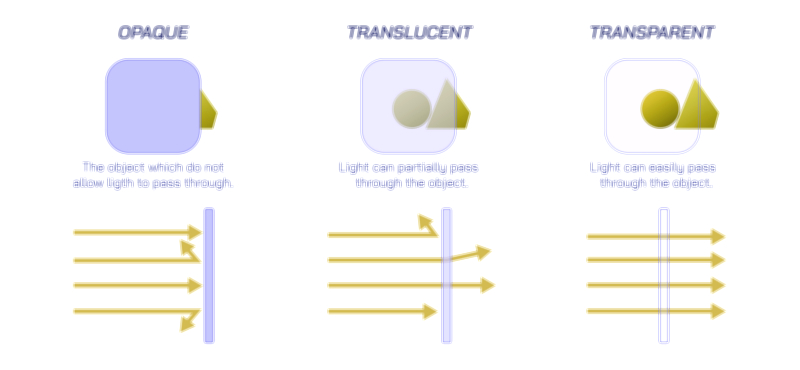
Reflection depends strongly on the smoothness of a surface, but refraction depends on the optical density of a material. A rough piece of metal may appear dull because it scatters light diffusely, but the same metal polished can become a brilliant mirror. A block of glass may appear transparent and clear, yet if powdered or ground into grains, it becomes opaque because light no longer refracts smoothly through it. These differences emphasize that visibility is determined not by material alone but by how its surface or internal structure interacts with light.
In the broader scientific context, reflection and refraction illustrate that light possesses wave-like behaviour: bouncing from surfaces with geometric consistency and bending when its propagation speed changes. These principles guide modern technologies such as laser guidance systems, optical computing, medical imaging devices, autonomous-vehicle sensors, and precision measurement tools. Whether a ray of light is redirected by a polished mirror or bent by a transparent prism, both reflection and refraction arise from the same underlying physical fact—that electromagnetic waves respond predictably to boundaries and material properties.
Reflection keeps light within its original medium by sending it back, while refraction transfers light from one medium to another and changes direction due to speed variation. Both behaviours allow human beings to see, measure, focus, redirect, and harness light in countless ways. Through their interplay, the visual world becomes understandable, and optical systems become controllable, enabling technologies that range from simple mirrors to the most advanced telescopes that study the universe.