Law of Reflection Principles and Light Behavior – Interaction of Incident Rays, Reflection Geometry, Smooth vs Rough Surfaces, Image Formation, and Real-World Optical Applications in Physics
Light is one of the most fundamental agents of perception, and its ability to reflect from surfaces allows humans to see the world in detail. When light encounters an object, it can be absorbed, transmitted, or reflected; the reflection of light is the process that enables mirrors to produce images and shiny surfaces to cast glints. The Law of Reflection is the governing rule that describes how light behaves when it bounces off a surface. It applies not only to mirrors but to everything that reflects light—still water, polished metal, glass panes, glossy tiles, or even human eyes. Reflection is not mysterious or random; it is predictable, measurable, and consistent under all conditions, whether light is produced by a laser beam, a torch, the Sun, or any other source. Understanding how light behaves during reflection helps explain the mechanisms of vision, the function of optical instruments, and numerous scientific and industrial technologies that depend on the precise control of light.
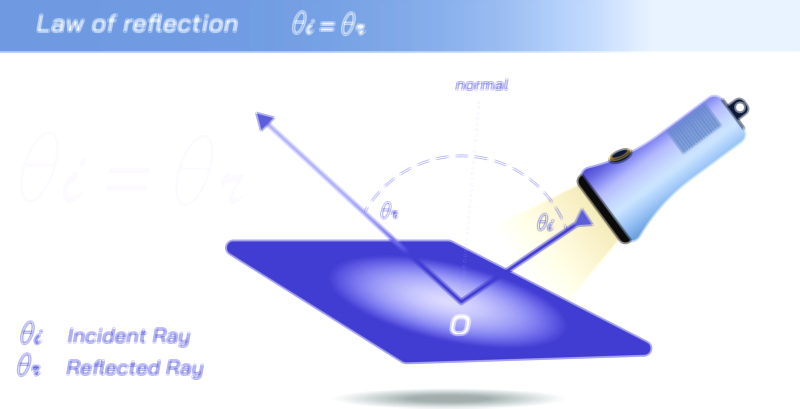
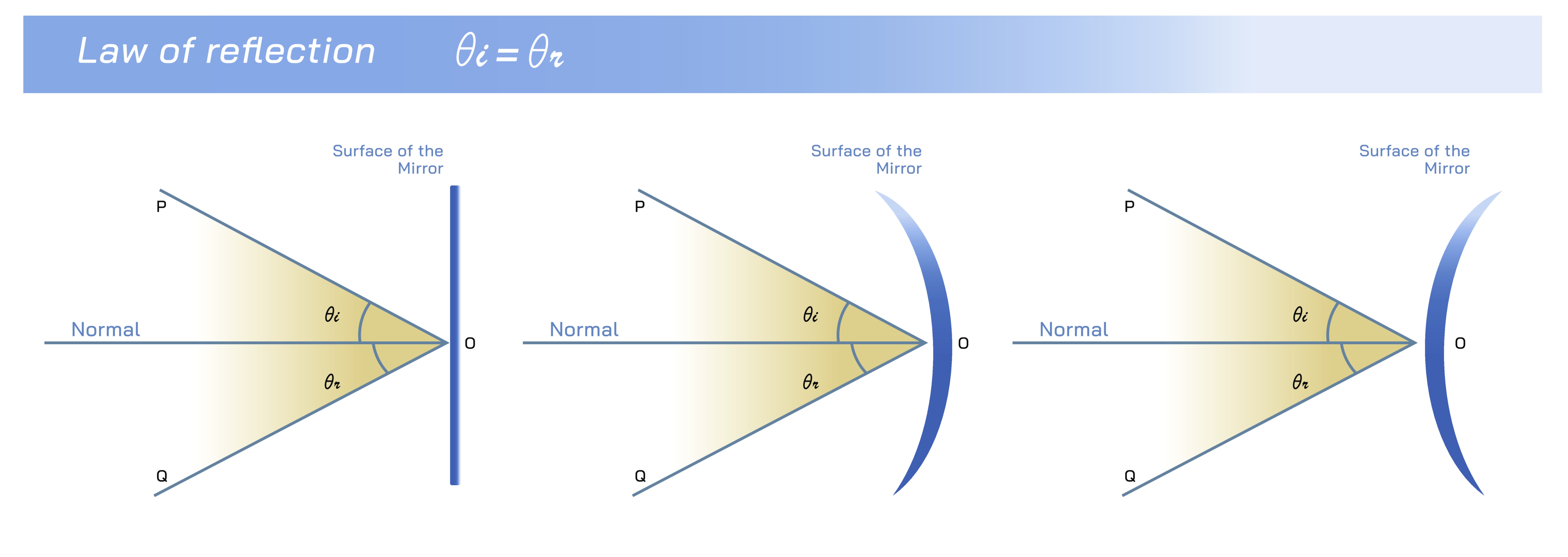
The principle of the Law of Reflection rests on two key statements that apply when a beam of light meets a reflecting surface. The first statement explains the spatial arrangement: the incident ray (the incoming ray of light), the reflected ray, and the normal (an imaginary perpendicular line drawn at the point where the ray strikes the surface) all lie in one single plane. This means that light does not leave that plane or deviate in three-dimensional unpredictability; instead, it stays geometrically consistent. The second statement defines the equality of directional angles: the angle of incidence is always equal to the angle of reflection. The angle of incidence is measured between the incoming ray and the normal, while the angle of reflection is measured between the outgoing ray and that same normal. This perfect symmetry is what makes reflection reliable, allowing engineers and physicists to design instruments that depend on accurate bouncing of light, such as periscopes, scanners, telescopes, and vehicle headlights.
A conceptual diagram often helps explain the Law of Reflection clearly. A straight line representing the reflecting surface is drawn, and a perpendicular line from that surface marks the normal. A ray approaching the surface at an angle is labeled the incident ray, and a ray leaving the surface is labeled the reflected ray. The angles between both rays and the normal are shown and marked equal. Although simple, this representation captures the exact geometry that governs countless optical behaviors. Even though the diagram looks mathematical, its implications appear visually in daily life whenever you turn toward a mirror or observe a beam of sunlight bouncing from polished floors.
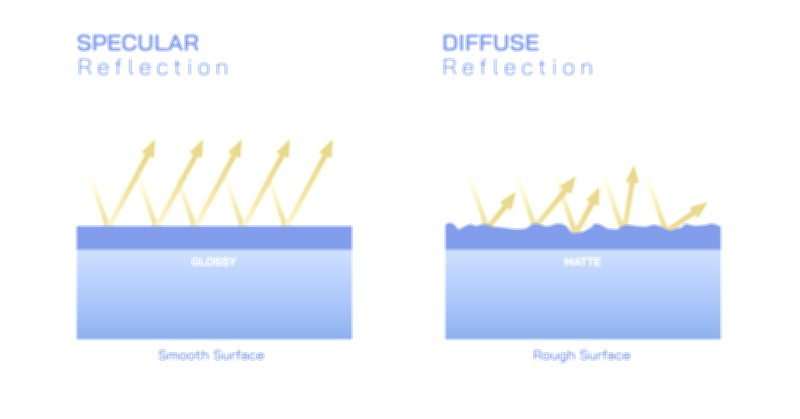
The nature of the reflecting surface plays a major role in determining how reflected light appears. When light strikes a smooth and polished surface, such as a mirror or still water, the incident light rays hit the surface with consistent alignment and therefore reflect in the same uniform direction. This effect is known as regular reflection, and it produces clear, sharp images because the reflected rays travel in a coordinated manner. This type of reflection allows mirrors to function, telescopes to capture starlight, and optical sensors to detect signals accurately. By contrast, when light strikes a rough or irregular surface, each microscopic bump or groove has a slightly different orientation, so each ray reflects in a different direction. This is called diffuse reflection. Although the Law of Reflection still holds at every individual point on the rough surface, the reflected rays scatter rather than travel in a unified beam. Diffuse reflection is why we can see objects like walls, notebooks, skin, or clothing even though they do not produce images—they scatter light in multiple directions, allowing it to reach our eyes from anywhere around the object.
Reflection plays a crucial role in image formation, particularly in mirrors. When rays reflect from a plane mirror, they appear to come from a point behind the mirror even though the light never actually travels there. This produces a virtual image—one that seems real to the eyes but cannot be captured on a screen. The image is upright, of the same size as the object, and laterally inverted (left becomes right and vice versa). This inversion is a direct result of the geometry of reflected rays rather than any distortion within the mirror. When mirrors are curved, reflection becomes more complex but continues to obey the same law. A concave mirror, which curves inward like a spoon, can form magnified or reduced images depending on the object’s distance from the mirror. These images may be real (formed on a screen) or virtual (only seen by the eye). A convex mirror, which curves outward, reflects light in a way that causes rays to diverge, forming upright and diminished virtual images. This property makes convex mirrors ideal for vehicle side mirrors because they allow a wider field of view.
Beyond mirrors, reflection has an enormous role in technology and problem-solving across physics and engineering. Periscopes used in submarines and military operations rely on two plane mirrors arranged at angles so that light reflecting from a distant object can travel through the device to the observer’s eye, enabling vision without direct exposure. Solar cookers and parabolic reflectors use curved reflective surfaces to direct sunlight to a concentrated point for heating or energy generation. Reflectors on roads, bicycles, and safety equipment are designed using microstructures that return light toward the source through controlled reflection, ensuring visibility at night. Laser scanners, barcode readers, camera flash systems, and optical sensors depend on precise reflective surfaces to guide beams of light. Even in medical imaging and scientific research, reflection is used to direct light inside devices such as optical endoscopes and spectrometers. Every application works because we know exactly how light rays behave when they strike reflective surfaces.
Reflection also contributes to how humans visually experience the world. Our ability to recognize shiny or glossy materials results from the presence of regular reflection, while our perception of matte or textured materials depends on diffuse reflection. The sparkle of sunlight on water, reflections in glass skyscrapers, illumination in brightly lit rooms, and even artistic photography techniques all rely on the predictable nature of reflection. Whether in everyday life or advanced scientific fields, the Law of Reflection shapes the movement of light and therefore shapes visual reality itself.
The universality of the Law of Reflection—its absolute validity regardless of the wavelength of light, the type of material, or the intensity of illumination—makes it a fundamental rule of physics. Every ray of light that touches a surface obeys the law, whether magnified through a giant telescope or faintly scattered across a wall. The consistency of reflection is what allows optical systems to be designed with precision, ensuring that light can be directed, controlled, and used to form images with reliability. Understanding this law gives learners an insight into both simple and sophisticated technology and reveals the remarkable structure underlying everyday visual experience.
In summary, the Law of Reflection describes how light reflects symmetrically from surfaces, ensuring that the angle of incidence always equals the angle of reflection and that the incident ray, reflected ray, and normal all lie in the same plane. Smooth surfaces produce regular reflection and sharp images, while rough surfaces produce diffuse reflection and scattered visibility. These principles govern everything from mirrors and vehicle safety to optical systems, scientific instruments, and even natural visual perception. Through reflection, light becomes not just illumination but information—allowing us to see, measure, explore, and understand the world with clarity and precision through the elegance of physics.