Law of Reflection of Light Rays on a Mirror Surface — Optical Behaviour and Image Formation
The law of reflection governing the behaviour of light rays striking a mirror surface is one of the simplest yet most powerful principles in physics, forming the foundation of geometric optics and shaping how humans perceive the world visually as well as how optical devices are designed. Every time a person looks into a mirror, sees sunlight sparkle on water, notices headlight glare from a shiny surface, or observes the beam of a laser striking a reflective plate, the law of reflection is operating with complete reliability. What appears to be a casual bounce of light is actually a highly ordered interaction that obeys precise rules for direction and geometry. These rules allow mirrors to form images that appear clear, stable, realistic, and properly positioned, and they provide the basis for controlling light paths in advanced instruments ranging from telescopes to microscopes, scanners, sensors, and laser assemblies.
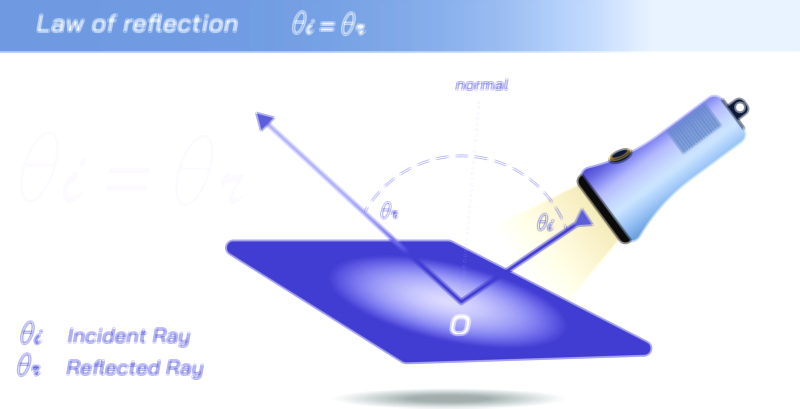
When a light ray approaches a mirror surface, three key reference lines define the optical interaction: the incident ray, the reflected ray, and the normal. The incident ray is the incoming beam of light that strikes the reflecting surface. The reflected ray is the outgoing beam that bounces away from the surface after the interaction. The normal is an imaginary line drawn perpendicular to the mirror at the exact point where the incident ray meets the surface. The law of reflection states that the angle of incidence always equals the angle of reflection, with both angles measured relative to the normal. This means that light does not bounce randomly but leaves the surface in a direction precisely determined by the direction from which it arrived. A second part of the law is equally important: the incident ray, the reflected ray, and the normal always lie in the same plane. Light never reflects into a direction out of this plane. These two rules together make reflection a predictable process that allows optical engineers and physicists to calculate ray paths with accuracy.
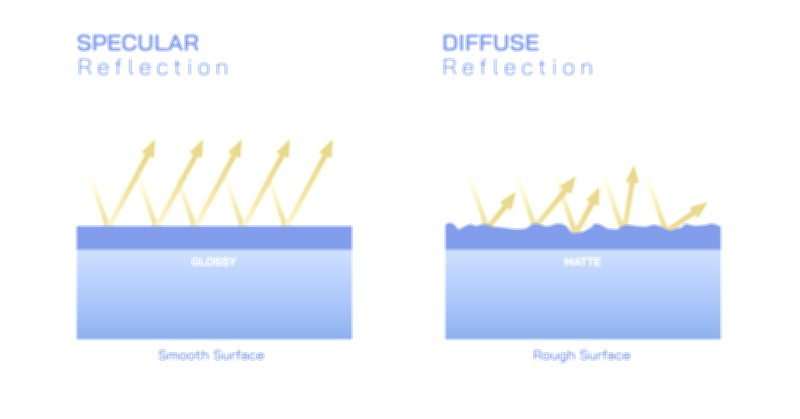
The mirror surface plays a crucial role in this behaviour. A smooth and polished surface—such as silvered glass, polished metal, or calm water—ensures that neighbouring rays strike a uniform surface orientation and therefore reflect in an orderly manner. This type of reflection, known as specular reflection, preserves the angular relationships between rays and allows the eye to reconstruct a sharp image of the object that emitted the rays. Because the angles remain consistent across the surface, a plane mirror reproduces an image that is virtual, upright, and identical in size to the original object, appearing behind the mirror at the same distance as the object is in front of it. Even though no light actually originates from behind the mirror, the brain interprets the reflected rays as if they travel in straight lines from the image location. This is why a person sees their own reflection where it appears rather than on the surface of the glass itself.
Although the law of reflection applies universally, the nature of the reflected appearance depends on surface texture. When a surface is rough at the microscopic level, each tiny region still follows the law of reflection, but the directions vary from point to point. Rays scatter outward in multiple directions, preventing the formation of a clear image. This phenomenon, called diffuse reflection, makes everyday objects visible. If diffuse reflection did not exist, the world would be filled with mirror-like images everywhere rather than colours and textures. Books, skin, clothes, concrete, trees, and nearly every visible object reflect light diffusely. In contrast, mirrors reflect specularly, producing recognised images because angular uniformity is preserved. The distinction reinforces the idea that visibility results not simply from the presence of light but from the way surfaces interact with it.
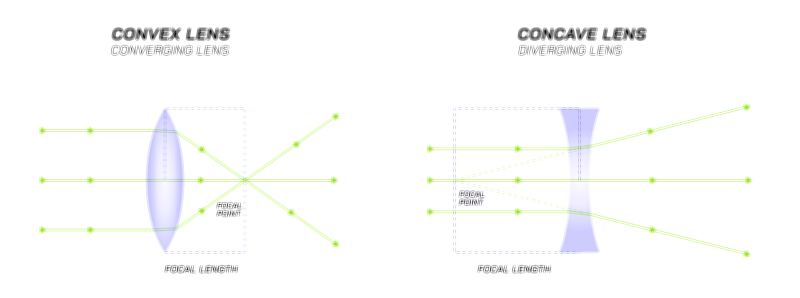
The law of reflection remains true even on curved mirror surfaces, although the geometry is more complex. In a concave mirror, light striking different parts of the curved surface reflects according to the law of reflection at each microscopic point, but the surface curvature causes parallel incoming rays to converge toward a common focal point. This behaviour enables concave mirrors to magnify objects when viewed up close and to concentrate light beams when rays arrive parallel, which explains their use in telescopes, solar furnaces, shaving mirrors, and vehicle headlight assemblies. In a convex mirror, the surface bulges outward. Each point still follows the law of reflection, but the geometry causes rays to diverge, creating a wider field of view rather than a magnified image. Because of this property, convex mirrors are widely used as side mirrors on vehicles, in parking lots, on blind road turns, and in security systems because they allow observation over a broad area.
The reliability of the law of reflection empowers many optical instruments. Periscopes rely on two plane mirrors oriented at precise angles so that light entering the top opening reflects downward and travels into the observer’s eye, enabling vision over obstacles or from protected positions. Projectors use internal mirrors to reflect and direct beams to form bright images on screens. Barcode readers and optical scanners use reflective principles to read codes with high precision. Laser machining systems guide high-energy beams via mirrors to enable accurate cutting, engraving, and welding. Even astronomical telescopes, especially large reflecting telescopes, depend on meticulously crafted concave mirrors to collect faint starlight and reflect it into a focal point for observation or digital capture. The consistent angle equality required by the law of reflection ensures that these instruments function with extremely high accuracy.
Reflection also influences natural optical experiences. Sunlight bouncing off still water creates shimmering patterns because specular reflection comes from smooth water patches, while nearby ripples scatter light diffusely. A mirror-like appearance emerges on a wet road because water fills surface irregularities, reducing diffuse scattering and increasing specular reflection, sometimes creating dangerously high glare at night. The sparkling brilliance of gemstones and polished metal surfaces comes from numerous facets reflecting specularly at different angles, creating intense flashes of brightness. Designers in fields ranging from architecture to photography use an understanding of reflection to control lighting, soften shadows, enhance textures, or create dramatic highlights in visual composition.
Beyond practical applications, the law of reflection reveals important characteristics of light at a physical level. It demonstrates that light travels in straight lines within a single medium and responds to surfaces with geometric consistency. At the microscopic scale, reflection occurs because electrons in the mirror surface absorb oscillating electromagnetic energy and then re-emit it in a direction required by the conservation of energy and momentum; the macroscopic equality of angles emerges from these quantum interactions. Even in advanced scientific fields such as optical interferometry and gravitational-wave detection, mirrors must reflect photons according to the law of reflection with precision measured in nanometres. The same law that governs an everyday bathroom mirror also controls some of the most delicate and powerful scientific instruments ever created.
Therefore, the law of reflection of light rays on a mirror surface is more than a rule about angles — it is the universal principle that enables image formation, visibility, beam steering, optical design, and scientific measurement. It governs the appearance of both the natural world and engineered systems, turning reflective materials into tools for perception and discovery. Every clear reflection, every precisely focused telescope image, every efficiently directed laser path, and every intentional redirecting of light owes its accuracy to the single foundational rule: the angle of incidence is always equal to the angle of reflection.