Law of Reflection Explained with Rays and Angles – Light Interaction, Incident and Reflected Ray Geometry, Normal Line Concept, Smooth vs Rough Surfaces, and Optical Image Formation in Physics
The behavior of light when it strikes a surface is one of the most essential foundations of optics, and the Law of Reflection explains this behavior with remarkable clarity and consistency. Whether someone looks into a mirror, sees sunlight glimmer on the ocean, notices the shine on a metal surface, or observes a laser spot bounce off glass, the same physical rule governs the direction in which light travels. Reflection refers to the process in which light striking a surface returns to the medium from which it came, instead of being absorbed or allowed to pass through. The mathematical and conceptual basis for reflection is so universally reliable that optical instruments such as telescopes, microscopes, periscopes, cameras, fiber-optic sensors, and even common household mirrors depend on it. When we speak of the law of reflection with rays and angles, we are describing not only an abstract rule in physics but also a principle that shapes the fundamental nature of human vision, technology, and scientific observation.
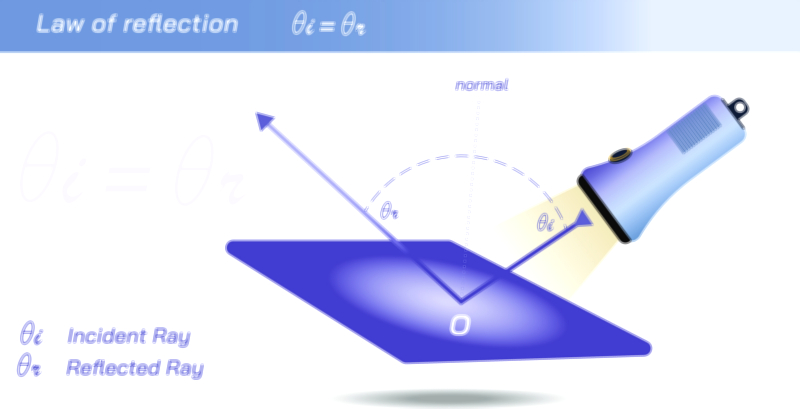
The law of reflection begins with the understanding of light rays and the normal line. A light ray is a directional path along which light energy travels. When a ray of light strikes a surface, the point at which it touches is called the point of incidence. At this point, physicists imagine a line drawn at a perfect right angle to the surface; this imaginary perpendicular line is called the normal. The normal does not actually exist as a physical object — it is a reference that allows us to measure angles accurately. The ray traveling toward the surface is the incident ray, and the ray that leaves the surface after bouncing is the reflected ray. These three elements — the incident ray, the normal, and the reflected ray — form the geometric foundation for understanding reflection.
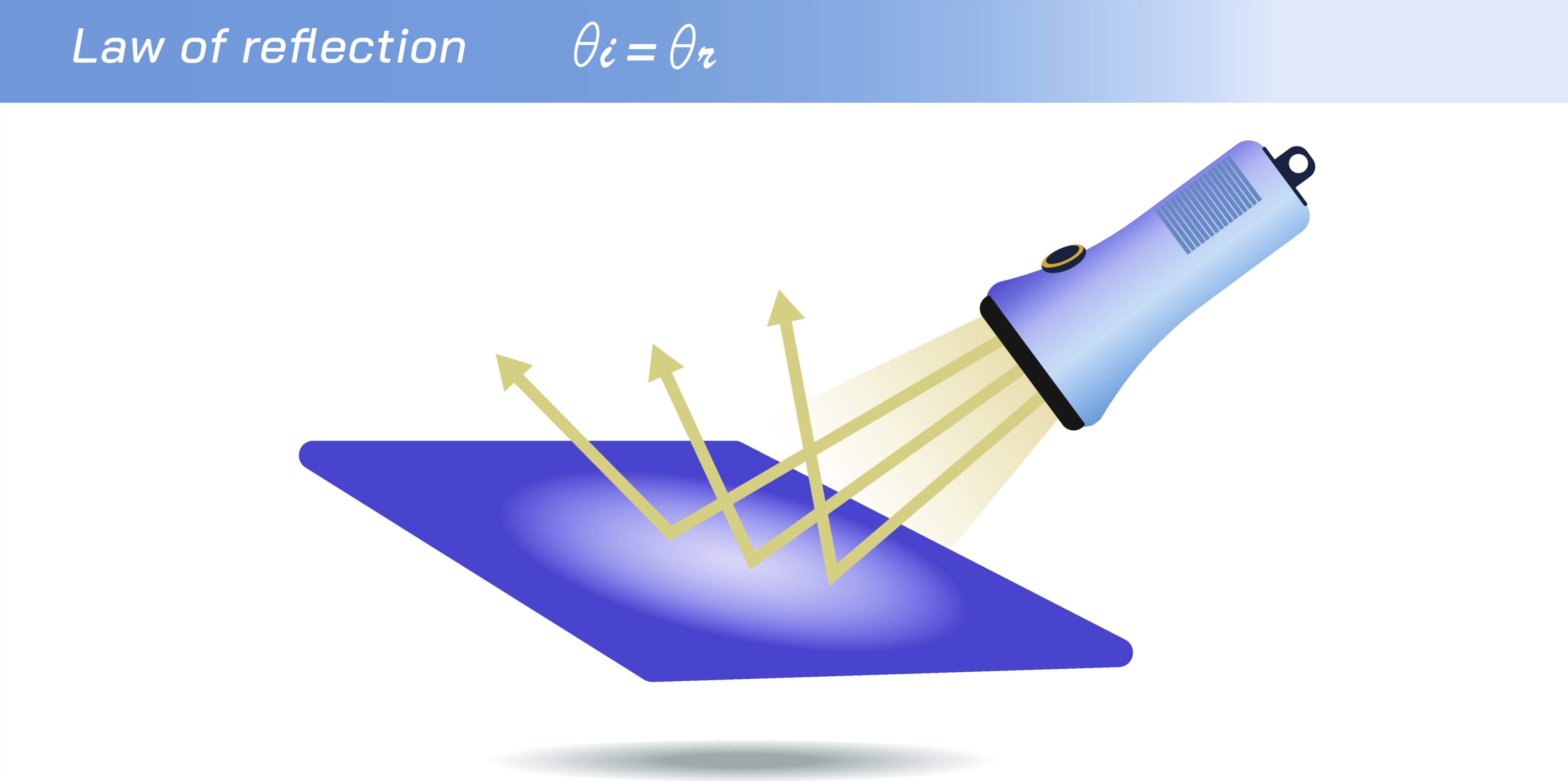
The first rule of the law of reflection states that the incident ray, the reflected ray, and the normal all lie in the same plane. This means that the light does not scatter in random directions or leave that plane when the surface is smooth. The light comes in and goes out in a predictable two-dimensional path, which is essential for precise optical calculations. The second rule of the law of reflection explains the exact relationship between the incident and reflected rays: the angle of incidence is always equal to the angle of reflection. The angle of incidence is measured between the incident ray and the normal, and the angle of reflection is measured between the reflected ray and the normal. These two angles are always equal, no matter how the surface is positioned or how intense the light is. This perfect symmetry defines the geometry of reflection and ensures that reflected light behaves in a structured and repeatable way.
To visualize this law, physics uses a ray diagram, which demonstrates the geometry clearly. The reflecting surface is drawn as a straight horizontal line. From the point where the ray hits the surface, a perpendicular line is drawn upward to represent the normal. A slanted incoming line striking the surface represents the incident ray. From that point, another slanted line leaving the surface on the opposite side represents the reflected ray. The angle between the incident ray and the normal is labeled angle of incidence, and the angle between the reflected ray and the normal is labeled angle of reflection. The diagram highlights that both rays and the normal lie in the same plane and that the two angles mirror each other precisely. Even a simple drawing captures the exact physics that governs advanced optical systems.
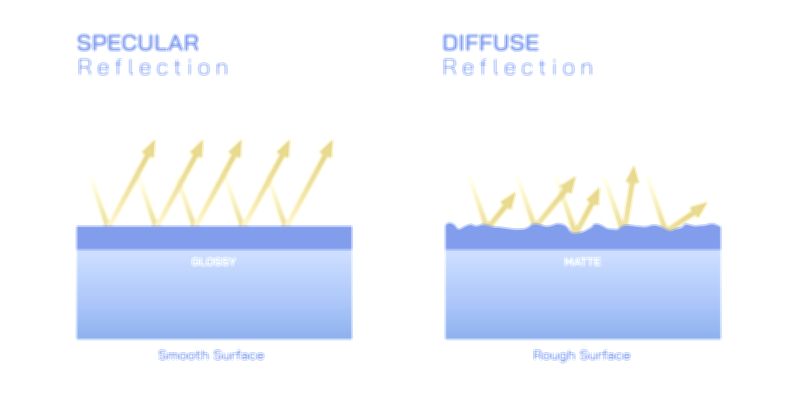
The type of reflection we observe depends strongly on the nature of the surface. When the reflecting surface is smooth and polished, the tiny microscopic bumps on it are uniform enough that each ray reflects predictably at the same angle relative to the normal. This produces regular reflection, which results in clear and sharp images. A bathroom mirror, a calm lake, a glass panel, and shiny metal surfaces all create regular reflection, enabling a person to see detailed images. By contrast, when a ray of light falls on a rough surface, such as paper, fabric, concrete, brick, or unpolished wood, each small uneven surface segment has a different physical tilt. While the law of reflection applies at every microscopic point, the rays bounce off in many directions instead of one unified angle. This type of reflection is known as diffuse reflection, and it does not form an image. Instead, it allows an object to be visible from many directions — this is why desks, walls, plants, or human skin can be seen even though they do not behave like mirrors.
Reflection also plays a crucial role in image formation. In a plane mirror, reflected rays appear to come from a location behind the mirror, even though they never travel inside the mirrored glass. The brain traces these rays backward and interprets them as originating from behind the mirror, producing a virtual image. This image is upright, has the same size as the object, and is laterally inverted (the right side becomes the left in the reflection and vice versa). Curved mirrors — concave and convex — also obey the same law of reflection but cause rays to converge or diverge due to their shape, forming magnified, diminished, upright, inverted, real, or virtual images depending on the distance of the object. These features are used in makeup mirrors, shaving mirrors, telescopes, headlights, searchlights, satellite dishes, and security mirrors.
Beyond mirrors, the predictable behavior of reflection drives real-world technology in important ways. Periscopes used in submarines let observers see objects above water by reflecting light down a tube using angled mirrors. Solar cookers and parabolic reflectors direct sunlight toward a single focus point to generate heat. Automobile headlights and stage spotlights reflect light in specific directions to maximize brightness. Retroreflectors on road signs and bicycles return light toward its source using micro-reflective structures, improving nighttime visibility. Barcode scanners, laser-based surveying instruments, digital microscopy, and spectroscopic equipment depend on accurate reflection to direct light beams. Even optical fibers use total internal reflection — a form of reflection within a medium — to transmit signals efficiently over long distances.
Reflection also enhances human perception. The sparkling surface of a river, reflections in skyscraper windows, glowing city lights at night, the gleam on polished furniture, and artistic photography all depend on the law of reflection. The human eye interprets reflected rays to understand the shape, size, texture, and location of objects. Without reflection, the visual world would not exist in the detailed form that humans experience.
The great significance of the Law of Reflection lies in its universal consistency. It applies to single rays or beams, lasers or ordinary light, bright daylight or dim illumination, macro surfaces or microscopic textures. No matter the wavelength of light or the source, the law remains valid: light reflects so that the angle of incidence equals the angle of reflection, and the rays along with the normal lie in one plane. This unwavering rule ensures that scientists and engineers can mathematically predict light paths and design optical systems with confidence.
In summary, the Law of Reflection describes light behavior with two core principles: the incident ray, reflected ray, and normal always lie in the same plane, and the angle of incidence always equals the angle of reflection. Smooth surfaces produce regular reflection and clear images, while rough surfaces scatter rays and allow visibility without image formation. These reflective interactions underpin technologies from everyday mirrors to high-precision scientific instruments. By understanding the relationships between rays and angles, learners discover why light behaves the way it does and how this predictable behavior enables vision, communication, energy systems, navigation, and innovation across physics and engineering. Reflection turns light into information — allowing the world to be not only illuminated but interpreted, visualized, and understood.