Law of Reflection of Light — Principles Governing the Behaviour of Light on Surfaces
The law of reflection of light describes one of the most fundamental and elegant principles in physics, explaining how light behaves when it encounters a surface and bounces back into the surrounding space. Although the reflection of light is so common that people rarely stop to analyze it—whether it is the image seen in a mirror, the sparkle of sunlight on water, the visibility of objects around us, or the way polished metals shine—this law forms the basis of optics, imaging, photography, astronomy, laser engineering, and technology used in daily life. Reflection provides one of the simplest demonstrations that light travels in straight lines and obeys predictable geometric rules. These rules allow scientists and engineers to precisely manipulate light to form images, control beams, build instruments, and analyze physical systems. At its core, the law of reflection states that the angle at which an incoming beam of light strikes a surface determines the angle at which it bounces away, producing highly predictable outcomes that shape many of the visual phenomena we experience.
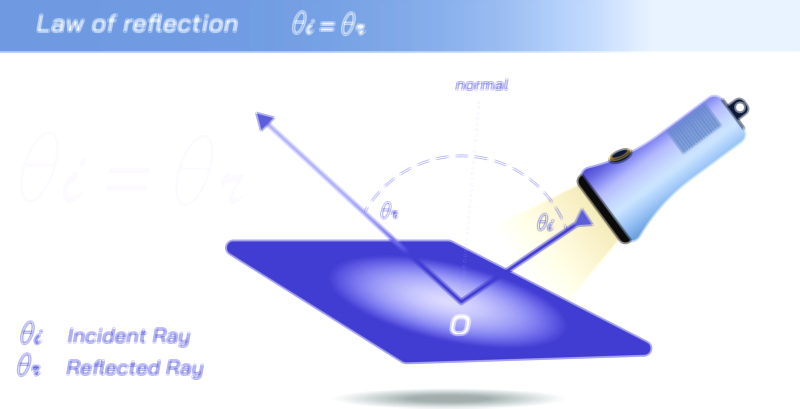
When a ray of light strikes a surface, it interacts with the atoms and electrons of that surface at a microscopic level. Light does not simply hit and bounce in a random direction; its reflection is governed by the smoothness of the surface and by conservation of energy and momentum on a microscopic scale. The incident ray is the beam of light approaching the surface, the reflected ray is the beam leaving the surface after bouncing, and the normal is an imaginary line drawn perpendicular to the surface at the point of incidence. The law of reflection states that the angle of incidence—measured between the incident ray and the normal—is always equal to the angle of reflection—measured between the reflected ray and the normal. This relationship holds for every reflected ray, regardless of the type of reflecting surface, the colour or frequency of the light, or the intensity of the beam. It demonstrates that the behaviour of light is not arbitrary but governed by precise, universal rules that apply across all optical systems.
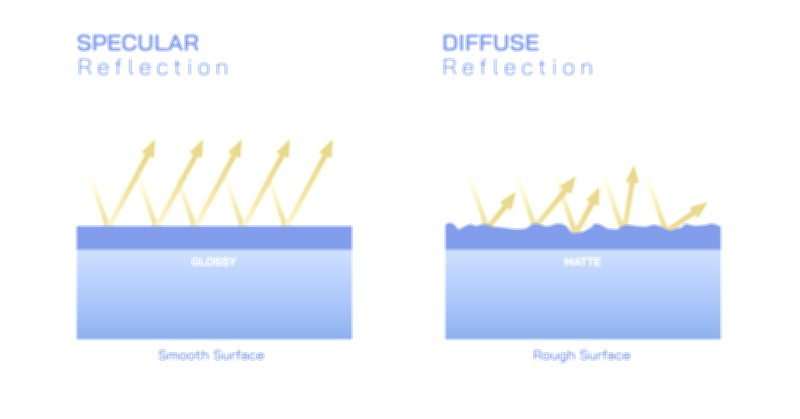
Reflection occurs because the incoming light disturbs the electrons in the material it strikes. These electrons oscillate and then re-radiate energy in a direction consistent with the law of reflection. In perfectly smooth and polished surfaces such as glass mirrors, stainless steel, and calm bodies of water, reflection occurs in a well-organized and uniform manner. This type of reflection, known as specular reflection, produces a clear and sharp image because neighbouring light rays reflect at identical angles, preserving the geometric relationships between them. The human eye relies on this predictable behaviour to form consistent images. Mirrors exploit this principle by presenting a smooth coating of reflective material that ensures each ray returning to the eye maintains its original angular relationship with neighbouring rays, allowing us to see a clear replica of the object in front of the mirror.
In contrast, when light reflects from rough or uneven surfaces, the direction of the reflected rays becomes scattered. Although the law of reflection applies individually to each microscopic point on the surface, the irregular orientation of countless tiny regions causes the reflected rays to scatter in many directions. This behaviour is called diffuse reflection and is responsible for making most objects visible to us. If real-world objects reflected light only specularly, we would see reflections everywhere instead of stable colour surfaces. The diffuse scattering of light ensures that objects like walls, clothes, books, plants, and skin appear evenly lit and visible from many angles rather than acting like mirrors. Diffuse reflection therefore enables the everyday visibility of the world while specular reflection allows us to see crisp images in mirrors and polished materials.
The law of reflection becomes even more meaningful when considering the formation of images using optical systems. Mirrors—both flat and curved—use reflection to manipulate light paths and project images in predictable ways. A plane mirror reflects light without altering the size or orientation of the image, creating a virtual image that appears behind the mirror at the same distance from the surface as the object in front of it. Concave mirrors, which curve inward, focus light because reflected rays converge at a point called the focal point, enabling applications such as telescopes, shaving mirrors, reflecting flashlights, and satellite dishes. Convex mirrors, which bulge outward, diverge light because reflected rays spread apart, producing wider fields of view, which makes these mirrors ideal for vehicle side mirrors and surveillance systems. All of these diverse behaviours still follow the same law: the angle at which each ray strikes the curved surface equals the angle at which it is reflected with respect to the normal at that point on the curve.
Reflection also plays a critical role in the design of optical instruments and scientific technologies. Periscopes in submarines use internal mirrors to redirect light and allow observation without exposure. Telescopes rely on precisely curved mirrors to gather faint starlight and form amplified images for study. Microscopes use internal reflective surfaces to direct light across lenses and samples. Laser cutters, projectors, barcode scanners, fibre-optic measurement systems, and optical sensors require mirrors positioned at calculated angles so that beams of light follow exact pathways. The extreme predictability of the law of reflection is what makes these technologies work with accuracy on the scale of micrometres or nanometres.
The orientation and smoothness of surfaces determine how reflection shapes our perception of the world. The reason a wooden table does not show a perfect reflection is not because the law of reflection fails but because each microscopic irregularity acts like a tiny mirror pointed in a slightly different direction. Each small point still reflects with equal angles, but the overall effect is scattered light. This behaviour explains why athletes’ reflective clothing shines when headlights hit it, why paintings appear textured under angled lighting, why polished gemstones sparkle, and why wet roads cause glare—water smoothens the surface and converts some diffuse reflection into specular reflection, changing the way light returns to the eye.
Reflection is also crucial for safety applications. Vehicle headlights, traffic reflectors, bicycle reflectors, aircraft runway lights, traffic signs with reflective paint, and emergency clothing rely on engineered reflection to transmit light back toward the source rather than in random directions. Many retroreflective surfaces use microscopic prism-shaped structures or spherical beads that take an incoming ray and reflect it back toward the original direction. Although the internal geometry differs, the behaviour still rests on the law of reflection at multiple internal surfaces. This optimized reflection enables high visibility in low-light environments and helps prevent accidents.
Beyond engineering and daily life, reflection plays a conceptual role in understanding the nature of light. It demonstrates that light behaves like a wave capable of bouncing from surfaces in predictable ways, but simultaneously retains particle-like energy transfer properties. It provides one of the first steps in teaching geometric optics to students because the rules of reflection can be illustrated easily while introducing deeper ideas about energy conservation, electromagnetic waves, and the geometry of light paths. The fact that everything from the polished surface of a mirror to the shimmering reflection of the setting sun on the ocean obeys the same law reinforces the universality of physical principles.
Reflection extends into advanced scientific fields as well. Astronomers use reflective optics to detect light that has travelled billions of years across space. Physicists use reflection in precision experiments such as interferometry, gravitational-wave detection, and photonic-crystal research. Materials scientists design coatings that reflect or absorb targeted wavelengths to improve solar panels, thermal control systems, and infrared cameras. Even in quantum optics, single photons follow reflective rules that allow scientists to manipulate them for computation, encryption, and communication.
The law of reflection, simple in statement yet powerful in implication, governs how light interacts with matter at surfaces. It determines how we perceive the world visually, how we capture and magnify distant objects, how we illuminate environments, and how we engineer optical systems across science, technology, and industry. Whether light meets a polished mirror, a rough wall, a metallic surface, or a water droplet, the same underlying rule ensures that the path of the reflected beam remains predictable and measurable. Through this consistency, reflection acts as a bridge between fundamental physics and the daily experience of seeing, shaping both practical technology and the human understanding of the visual universe.