Law of Reflection – Principles of Light Behavior on Surfaces, Angle Relationships, Characteristics of Incident and Reflected Rays, Image Formation, and Conceptual Diagram in Physics
The Law of Reflection describes how light behaves when it strikes the surface of an object. This law is one of the most fundamental principles in optics because it explains how mirrors form images, how shiny objects reflect light, and how visibility occurs on smooth or polished surfaces. Reflection happens when light waves strike a surface and bounce back into the same medium instead of passing through or being absorbed. Every time you see your face in a mirror, observe a beam of light from a torch bouncing off a wall, or watch sunlight glitter on water, reflection is taking place in accordance with the Law of Reflection. This principle is simple yet universal — it applies whether the reflecting surface is a bathroom mirror, a calm lake, a piece of glass, polished metal, or any smooth material capable of directing light uniformly.
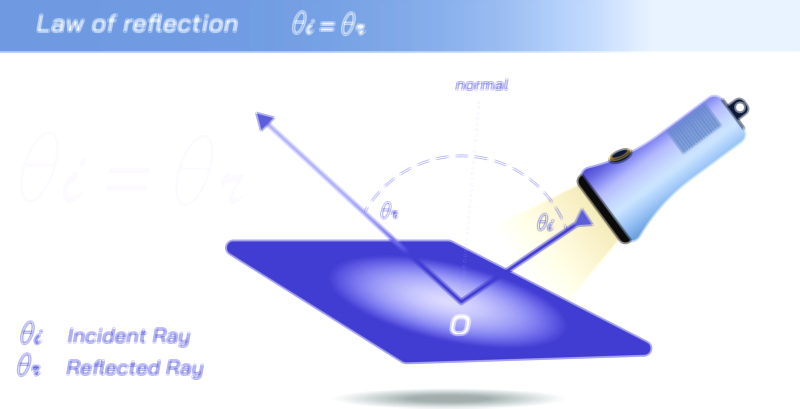
The Law of Reflection is based on two core rules. The first rule states that the incident ray, the reflected ray, and the normal to the reflecting surface at the point of incidence all lie in the same plane. The second rule states that the angle of incidence is always equal to the angle of reflection. The angle of incidence is the angle formed between the incoming light ray (incident ray) and the imaginary line perpendicular to the surface called the normal. The angle of reflection is the angle formed between the reflected ray and the normal. When a ray of light strikes a surface, it bounces away in such a way that the measure of these two angles remains equal. This symmetry ensures that reflection is predictable and measurable — a necessary property for optical instruments like microscopes, telescopes, periscopes, cameras, and even modern laser-based technologies.
The law is often illustrated using a conceptual diagram, which helps learners visualize the behavior of light at the point of reflection. The diagram includes a straight horizontal line representing the surface or mirror. A perpendicular line drawn upward at the point where the ray hits the surface represents the normal. A ray of light approaching the surface is shown as the incident ray, forming an angle with the normal. A ray bouncing away from the surface on the other side of the normal is drawn as the reflected ray. The angle between the incident ray and normal is labeled angle of incidence, while the angle between the reflected ray and normal is labeled angle of reflection. The two angles are always equal, representing the second rule of the law of reflection, and both rays and the normal lie in the same plane, fulfilling the first rule.
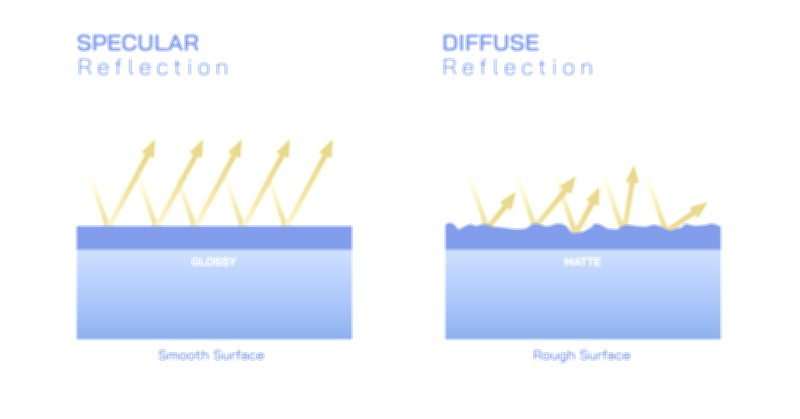
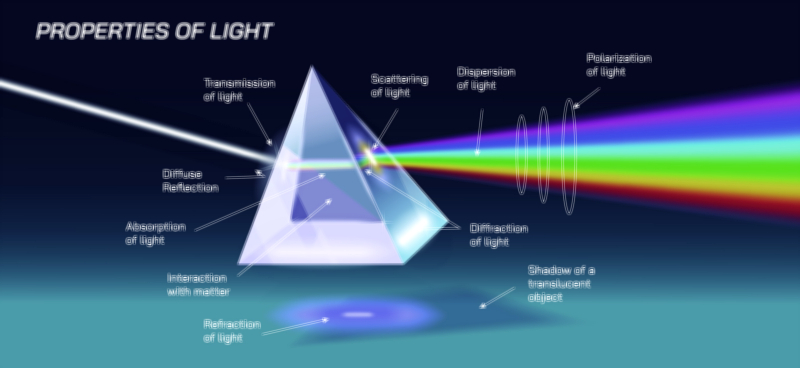
Light reflects differently depending on the nature of the surface. On a smooth and polished surface, such as a mirror or still water, the reflection is regular and uniform because each ray of light reflects in the same direction relative to the normal. This phenomenon is called regular reflection, and it produces clear and sharp images, allowing us to see specific shapes and details. On the other hand, rough or uneven surfaces scatter light in many different directions because each micro-part of the surface has its own orientation. This effect is called diffuse reflection, and although light still follows the law of reflection at every tiny point, the randomness of angles prevents us from seeing clear images. Rough surface reflection gives us visibility of objects without mirror-like images — which is why we can see a wall, clothing, paper, or skin even though they are not reflective like glass.
Reflection also plays an important role in how we perceive the world through image formation. When the surface is perfectly smooth and flat, the reflected rays appear to come from a point behind the mirror, creating a virtual image. This image cannot be captured on a screen because no real light originates from behind the mirror. The image produced by a plane mirror is upright, original-size, and laterally inverted (left–right reversed). When the surface is curved — such as a concave or convex mirror — reflection follows the same laws but creates magnified, diminished, upright, inverted, real, or virtual images depending on the curvature and distance of the object. All mirror technologies, from optical microscopes to automobile side mirrors, rely on the accuracy and predictability of reflection.
In everyday life, the Law of Reflection governs many visual and technological experiences. A periscope uses angled plane mirrors to change the direction of light and allow a user to see from a lower position. A solar cooker uses reflective surfaces to concentrate sunlight at a focal point for heating. Road signs and reflective tapes use microstructures based on reflection principles to return light toward drivers at night. Telescopes depend on reflective mirrors to collect faint starlight and bring distant celestial bodies into focus. Even lasers bouncing inside scanners, fiber optic sensors, and communication devices rely on predictable reflection to transmit signals effectively.
The universality of the Law of Reflection — that the angle of incidence equals the angle of reflection, and that all interacting rays and the normal lie in the same plane — makes it one of the foundational pillars of optics. Across science, engineering, astronomy, photography, architecture, and everyday visual perception, reflection remains essential for image formation and light manipulation. The conceptual diagram serves as a guiding tool to understand that light does not behave randomly but follows strict physical rules whenever it strikes a surface. Ultimately, the Law of Reflection reveals that the world we see is shaped by light’s remarkable ability to bounce, bend, and carry visual information to our eyes — allowing us to perceive objects, navigate our surroundings, and explore advanced optical technologies with the elegance of simple physics.