Law of Reflection of Light Rays on a Mirror Surface — Behaviour of Light, Geometry of Reflection, and Image Formation
The law of reflection of light rays on a mirror surface describes one of the most uniform and predictable interactions in all of physics, and it determines how light behaves when it encounters a shiny, reflective boundary. Every time light strikes a mirror and produces a clear image, every time a laser beam is redirected by a reflective plate, every time sunlight glitters on still water, and every time a shiny object throws back highlights toward an observer, the exact same physical law is operating with perfect consistency. What appears to be a simple “bounce” of light is actually a precise geometric phenomenon that follows a rule that never varies regardless of the brightness of the light, the wavelength, the colour, the source, or the type of reflective material. Without this law, mirrors could not form images, optical instruments would not function, and visual experience itself would be drastically different from what humans perceive today.
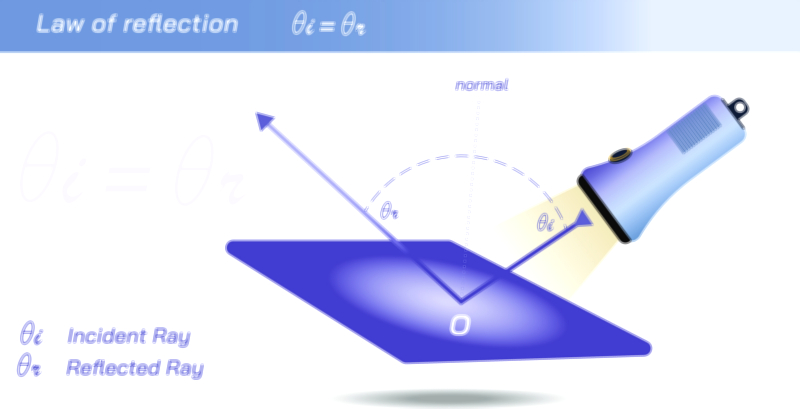
When a ray of light approaches a smooth mirror, its behaviour at the point of contact is defined by three essential elements: the incident ray, which is the incoming beam of light; the reflected ray, which is the outgoing beam after bouncing off the mirror; and the normal, which is an imaginary line drawn perpendicular to the mirror at the point where the light ray meets the surface. The law of reflection states that the angle of incidence is exactly equal to the angle of reflection, with both angles measured relative to the normal, not the mirror itself. In addition, the incident ray, the reflected ray, and the normal always lie in the same plane. These two simple but powerful rules guarantee that light reflects in a way that maintains symmetry and predictability. Because of this, a person looking at an object in a mirror sees the image in the direction determined by the geometry of reflection rather than scattered light, creating a recognizable and stable visual impression.
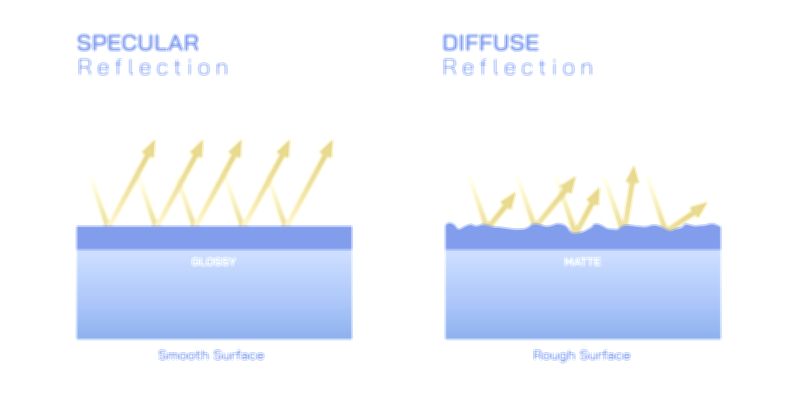
The clarity of a reflection depends heavily on the smoothness of the surface. On a perfectly smooth surface such as polished glass or metal, the normals at each microscopic point along the mirror align uniformly, and the angles of incidence and reflection are consistent across the entire reflective area. This results in specular reflection, where light reflects in an ordered manner and forms sharp images. When a person stands in front of a bathroom mirror, every light ray reflecting from their face follows the law of reflection, and the collective reflected rays enter their eyes in the same spatial patterns that originally left the face. This precise preservation of ray relationships is what allows the visual system to reconstruct a clear, lifelike image.
When a surface is not microscopically smooth, each tiny bump has its own local normal line, and the law of reflection applies independently at every point—but because the orientations vary randomly, the rays scatter in many directions. This is called diffuse reflection. Although diffuse reflection prevents image formation, it is what makes the world visible. If every surface reflected light specularly like a mirror, humans would see reflections everywhere instead of colours and textures. Paper, concrete, fabrics, skin, leaves, and most visible objects reflect diffusely, allowing light to reach the eye from many angles so that objects appear bright and visible from multiple viewpoints. Thus, the same law of reflection governs both sharp reflections and everyday visibility; the outcome depends only on microscopic surface structure, not on a change in physical law.
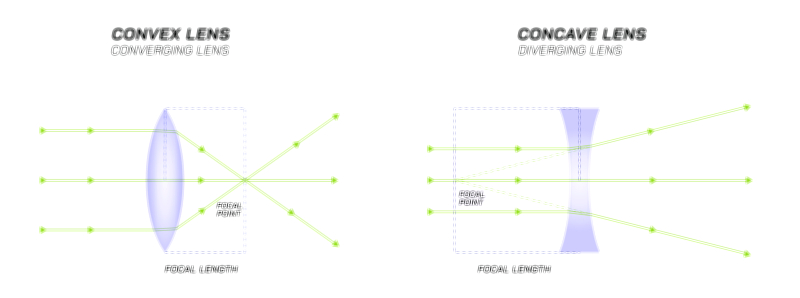
The law of reflection remains valid even when mirrors are curved rather than flat. In a concave mirror, the surface curves inward, and each microscopic surface element still reflects according to the rule of equal angles. However, because the normals on the curved surface point in slightly different directions, parallel rays reflected from different parts of the mirror converge toward a focal point. This gives concave mirrors the power to magnify images when viewed at close range and to focus distant rays when positioned far from the eye. Reflecting telescopes use this property to gather faint light from stars and galaxies and concentrate it into detectors or eyepieces. Solar concentrators use concave mirrors to focus sunlight into a small region to generate heat or electricity, and vehicle headlights rely on concave reflectors to project beams outward in straight, powerful paths.
In a convex mirror, the surface bulges outward, and the law of reflection operates at every point just the same, but the geometry causes reflected rays to diverge, spreading out instead of converging. This divergence creates a wider field of view, making convex mirrors useful anywhere wide-angle visibility is important—on car side mirrors, at parking lot exits, in shop surveillance setups, and around blind corners on roads. Even though concave and convex mirrors produce very different image results, both depend entirely on the same physical law applied across differently oriented surface normals.
The law of reflection is indispensable across scientific and engineering disciplines. Periscopes use two plane mirrors placed at precise angles to allow soldiers or submariners to see over obstacles without exposure. Barcode scanners, optical switches, projection systems, and industrial laser cutters use reflections to route beams to their exact destinations. Astronomical telescopes, including the largest and most sophisticated installations on Earth and in orbit, depend on massive concave mirrors polished to extreme smoothness to reflect light without distortion. Even interferometers, instruments sensitive enough to detect vibrations smaller than the width of a proton, rely on the law of reflection to direct laser beams through optical pathways with exquisite precision. The same rule that produces an everyday reflection from a mirror governs the measurements that allow scientists to study black holes, gravitational waves, and the deepest structures of the universe.
Reflection also shapes countless natural visual experiences. Sunlight glinting across gentle waves forms rapidly shifting stripes of light because smooth patches reflect specularly while ripples distort surface orientation and reflect unpredictably. The blinding glare of headlights on a wet road appears because water fills the tiny crevices in asphalt, converting what used to be a diffusely reflecting surface into a partially specular one. The sparkling brilliance of gemstones arises because their polished facets reflect light specularly at many orientations, sending intense flashes into the surrounding space. Even the soft glow of the full Moon reflecting on still water is governed by individual ripples reflecting rays according to the same law.
At the microscopic scale, the law of reflection results from the interaction between electromagnetic waves and electrons in the mirror’s surface. When light reaches a reflective material, surface electrons absorb the energy momentarily and then re-radiate it in a direction determined by energy and momentum conservation. The macroscopic observation—that the angle of incidence equals the angle of reflection—emerges naturally from this electromagnetic process. The astonishing part is that this rule remains exact everywhere, from a child’s toy mirror to the perfectly engineered coatings used inside the most advanced research observatories.
Thus, the vector behaviour of light rays reflecting from a mirror surface is guided by a physical law that is simple to express yet profound in consequence. It provides the foundation for image formation in mirrors, the predictability of optical paths, the functioning of complex optical instruments, the design of light-based technology, and even the interpretation of natural visual patterns. Through its precision and universality, the law of reflection establishes a stable structure in the interaction between light and matter—supporting everything from ordinary visual experience to the most advanced scientific measurements achieved by humankind.