The Second Law of Thermodynamics: Principles, Direction of Energy, and the Irreversible Nature of Physical Processes
The Second Law of Thermodynamics stands as one of the most profound and influential principles in all of physics, shaping our understanding of energy flow, heat transfer, and the limits of physical processes in nature. It introduces the concept that while energy may be conserved according to the First Law of Thermodynamics, the quality and usability of that energy tend to diminish over time. This law essentially defines the arrow of time by explaining why certain processes happen spontaneously while their reverse counterparts do not occur under the same conditions. Whether we examine mechanical systems, chemical reactions, biological metabolism, or the formation of stars, the Second Law determines the inevitable direction of natural transformations. It also establishes the deep connection between energy and entropy, revealing why disorder tends to increase in closed systems and why perfect efficiency is unattainable in machines and heat engines.
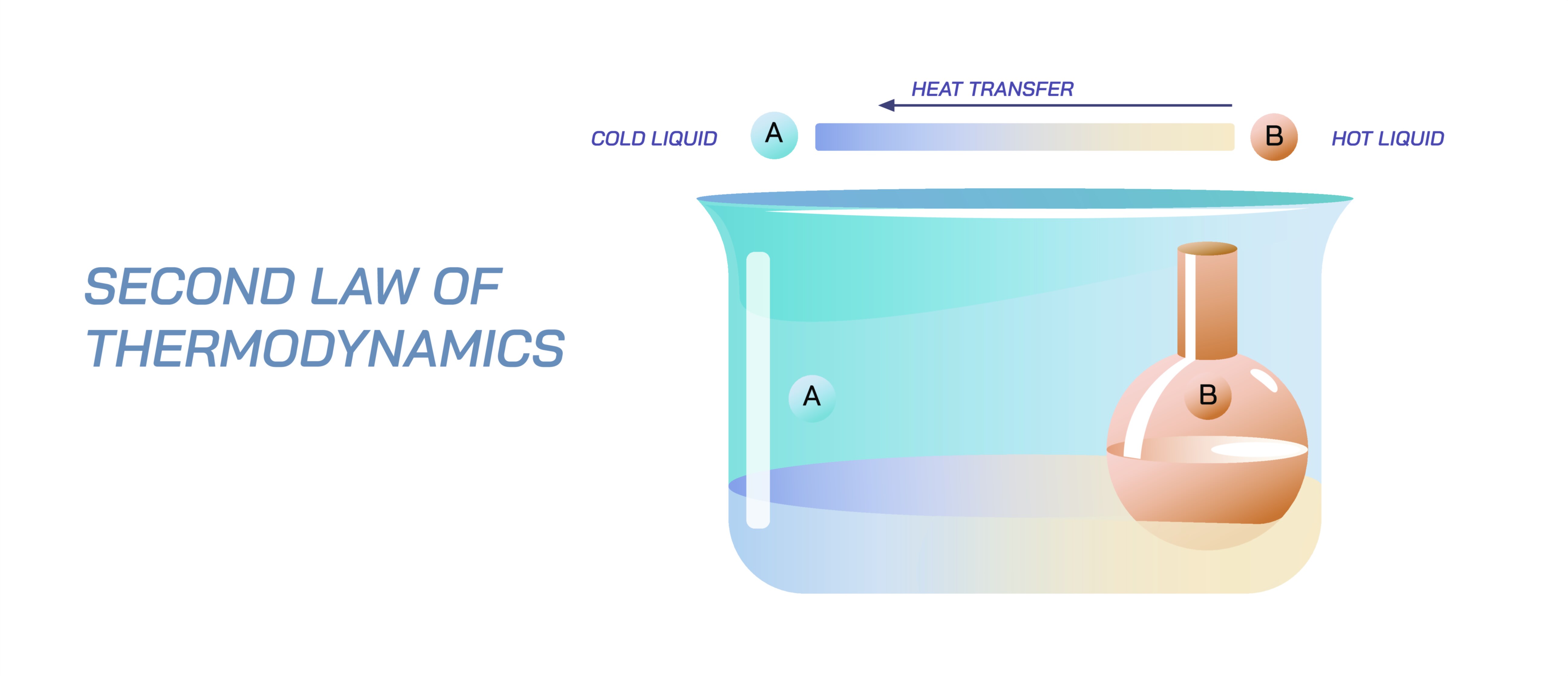
At its core, the Second Law states that heat always flows spontaneously from a higher-temperature body to a lower-temperature body and never in the reverse direction without external work being applied. This simple observation explains why a hot cup of coffee cools down on a table, why ice melts in warm air, and why no refrigerator can operate without consuming electrical energy. In each case, the movement of heat reflects a universal preference for energy to spread out, becoming increasingly dispersed across available molecular states. This natural redistribution of energy aligns with the rise of entropy, a measure of the system’s disorder or randomness. As energy spreads evenly across a system, the ability to extract useful work from that energy gradually declines, revealing a fundamental limitation of all physical processes. Even though the total amount of energy in the universe remains constant, the Second Law tells us that usable energy inevitably decreases.
Entropy and the direction of natural processes
Entropy is the central concept behind the Second Law. In everyday language, entropy may be interpreted as increasing disorder, but in physics it specifically refers to the number of microscopic configurations consistent with a system’s macroscopic state. A situation where energy is highly concentrated in one location corresponds to low entropy, while a situation where energy is evenly spread corresponds to high entropy. The Second Law declares that in an isolated system, entropy cannot decrease; it either remains constant or increases with time. The consequences of this are both subtle and wide-ranging. Reversible processes—those that can be undone without leaving any change in the system or its surroundings—are idealizations that require entropy to remain constant. However, real-world processes are always irreversible and result in entropy growth. Friction, turbulence, electrical resistance, chemical reactions, nuclear decay, and biological aging all represent irreversible processes driven by entropy increase. This natural tendency toward higher entropy is what prevents perpetual motion machines and guarantees that every energy conversion involves some losses that cannot be avoided.
Heat engines, efficiency, and the limits imposed by the Second Law
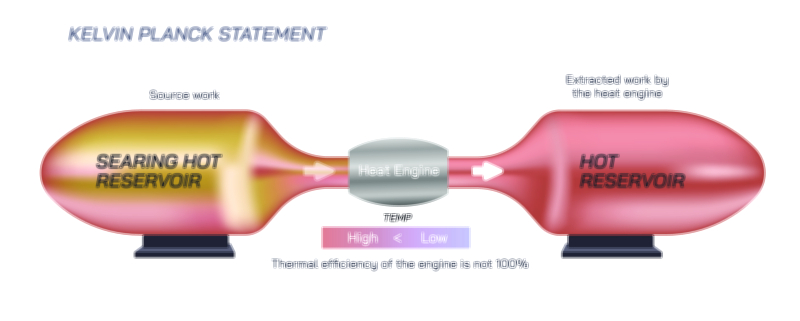
The Second Law plays a pivotal role in thermodynamics by defining the ultimate limit of efficiency for machines that convert heat into mechanical work. Heat engines—devices like car engines, steam turbines, and power plant generators—operate by absorbing heat from a high-temperature reservoir, performing work, and expelling some heat to a low-temperature reservoir. The Second Law mathematically demonstrates that no heat engine can convert all absorbed heat into useful work because complete conversion would imply no entropy increase. The theoretical maximum efficiency of a heat engine is determined by the temperature difference between its heat source and its heat sink; the larger the temperature gap, the greater the potential efficiency. This insight, first formulated in the Carnot cycle, exposes strict thermodynamic limits that engineers must respect. It reminds us that energy systems based on combustion, nuclear fuels, geothermal sources, or even solar heat will always produce waste heat that is ultimately released into the surroundings.
Heat pumps and refrigerators operate under the same principles, but they move heat in the direction opposite to its natural flow. Because heat does not spontaneously migrate from cold regions to warm ones, mechanical work must be supplied to drive this process. Whether cooling food in a refrigerator or heating a home with a heat pump, the energy cost is required to compensate for entropy reduction in one region by producing a greater entropy increase elsewhere. Even when these devices are designed with exceptional efficiency, the Second Law ensures that they can never operate at a costless level.
The Second Law, randomness, and the evolution of the universe
Beyond machinery and heat flow, the implications of the Second Law extend to cosmic and biological scales. In astronomy, the evolution of stars, black holes, and galaxies follows paths that are consistent with increasing entropy. Over immense time scales, the universe appears to be gradually transitioning from organized energy states to increasingly dispersed and uniform ones. The idea of the “heat death” of the universe arises from this prediction, proposing that the cosmos may eventually reach a state where temperature differences vanish and no useful work can be performed. Even life on Earth, although astonishingly complex and organized, does not contradict entropy. Living organisms import energy from their environment—such as sunlight or chemical energy—and use it to maintain structure and decrease entropy locally, but always with the consequence of increasing entropy in the surroundings by an even greater amount. In this way, the Second Law provides a profound explanation for how life can exist within a universe that tends toward disorder.
Human technology and energy sustainability under the guidance of the Second Law
Understanding the Second Law has shaped the design of nearly all modern energy systems. Whether developing more efficient power plants, electric vehicles, thermal insulators, renewable energy systems, or waste-heat recycling units, engineers constantly work within the boundaries set by entropy. When society looks toward sustainable energy solutions, reducing entropy production becomes a key challenge. If industries can lower energy waste, capture and repurpose excess heat, or operate closer to ideal thermodynamic cycles, the world can improve energy security and reduce environmental impact. Although the limitation imposed by the Second Law can never be erased, thoughtful design and innovative technologies can minimize losses and make energy use more efficient.
In its broadest interpretation, the Second Law of Thermodynamics is not just a rule about heat; it is a law about the unavoidable direction of time, the fate of energy, and the structure of the universe itself. It teaches that change is not symmetric, that perfection in efficiency is unattainable, and that every act of energy conversion carries an irreversible thermodynamic cost. From the cooling of a simple cup of tea to the evolution of galaxies, the Second Law governs the natural progression of events, binding every system—from atoms to stars—to the same universal thermodynamic destiny.