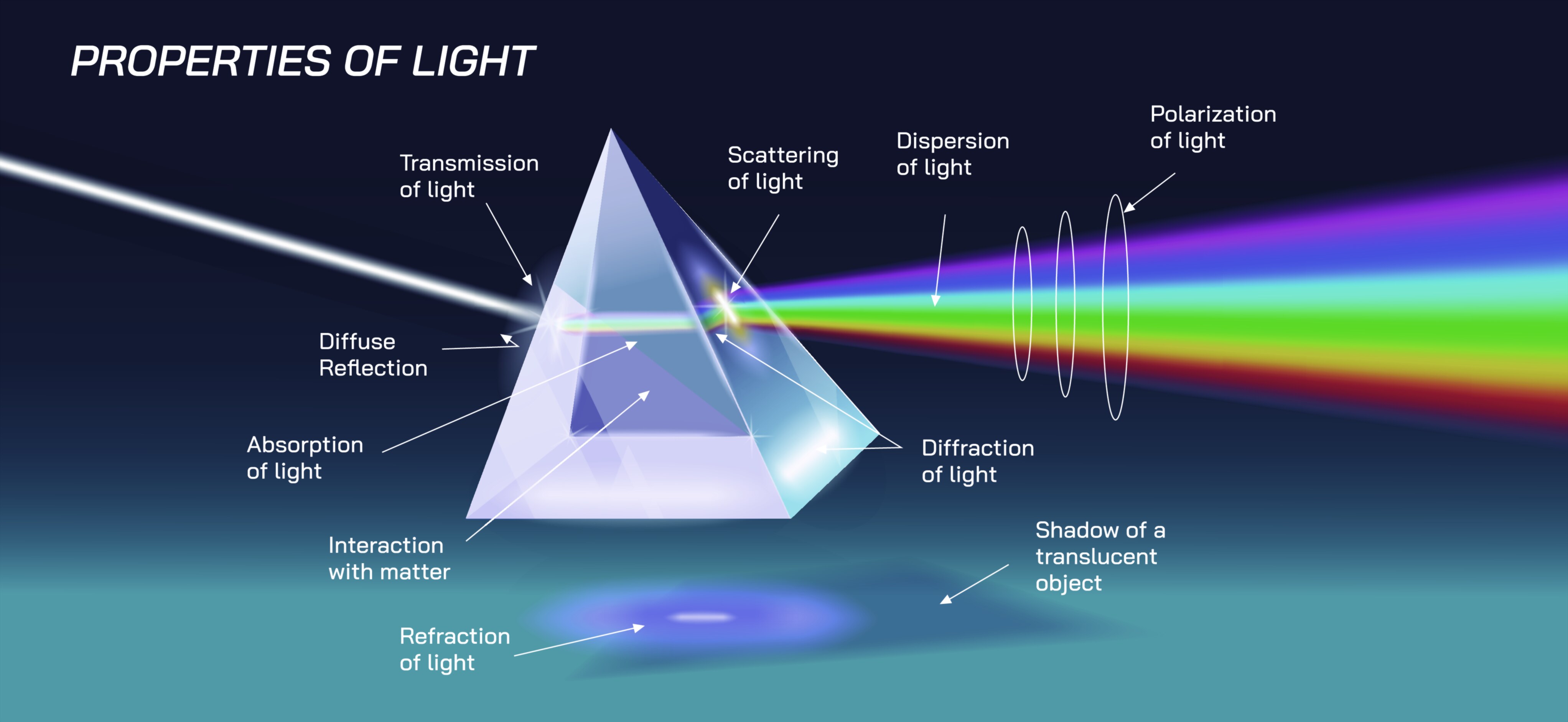
𝐏𝐫𝐨𝐩𝐞𝐫𝐭𝐢𝐞𝐬 𝐨𝐟 𝐋𝐢𝐠𝐡𝐭 𝐢𝐧 𝐏𝐡𝐲𝐬𝐢𝐜𝐬 — 𝐅𝐮𝐥𝐥 𝐃𝐞𝐞𝐩 𝐄𝐱𝐩𝐥𝐚𝐧𝐚𝐭𝐨𝐫𝐲.
Light is one of the most fundamental physical phenomena in the universe, and its properties form the basis of numerous fields such as optics, astronomy, quantum mechanics, photography, fibre-optic communication, and visual perception. At the deepest level, light is a form of electromagnetic radiation, meaning it consists of oscillating electric and magnetic fields that propagate through space while carrying energy. Unlike mechanical waves such as sound, light does not require a material medium for transmission and can travel through the vacuum of space, delivering energy from the Sun to Earth and from distant galaxies to our telescopes. The dual nature of light has fascinated scientists for centuries because it behaves both like a wave and like a particle, a combination that is central to modern physics. Understanding the properties of light helps explain how we see the world, why colours exist, how lenses and mirrors create images, how lasers and optical devices function, and how information travels rapidly across the world through the Internet and satellite networks.
One of the key properties of light is that it travels in straight lines through uniform and transparent media, a fact observable through everyday shadows and directional beams of light. When a flashlight is pointed at a wall, the beam forms a straight path until it encounters an object that blocks it, producing a shadow. This straight-line travel forms the foundation of geometric optics, a branch of physics that deals with the paths of light rays. When light reaches a reflective surface, it undergoes reflection, changing direction in a predictable manner. The angle at which light strikes a reflective surface equals the angle at which it leaves, giving mirrors their ability to form clear images. Everyday tasks such as combing hair using a mirror, driving with the aid of rear-view mirrors, or applying makeup involve reflection, demonstrating that one of the fundamental properties of light governs simple daily actions. Reflection also plays a role in technology: telescopes and periscopes use mirrors to control the path of light and form magnified or redirected images.
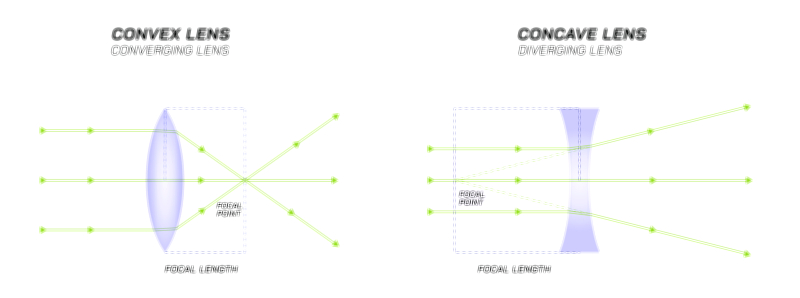
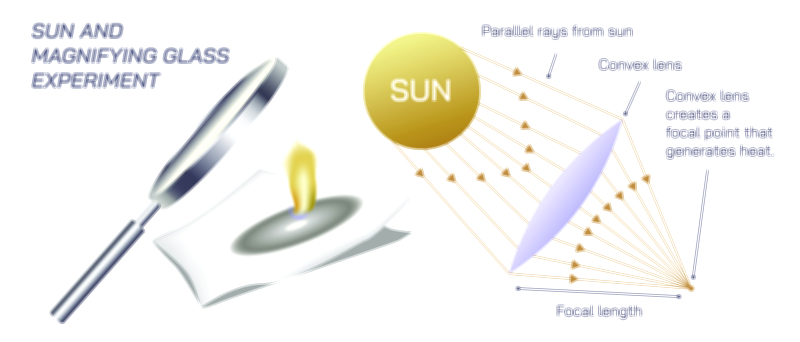
Light also exhibits refraction, the bending of its path when traveling from one medium into another of different optical density. When a straw in a glass of water appears bent or broken at the surface, or when a swimming pool looks shallower than it actually is, refraction is responsible. Light changes speed when entering a new medium; it slows down in denser media like glass or water and speeds up again when returning to air. This change in speed produces a change in direction. Refraction allows lenses to function, focusing or diverging beams of light to form images. Corrective eyeglasses help people see clearly by refracting light onto the retina in a way that compensates for defects in the natural eye lens. Cameras, microscopes, telescopes and projectors also rely on precisely shaped lenses to manipulate light through refraction. Without this property, optical devices would not exist, and human vision would be far less understood.
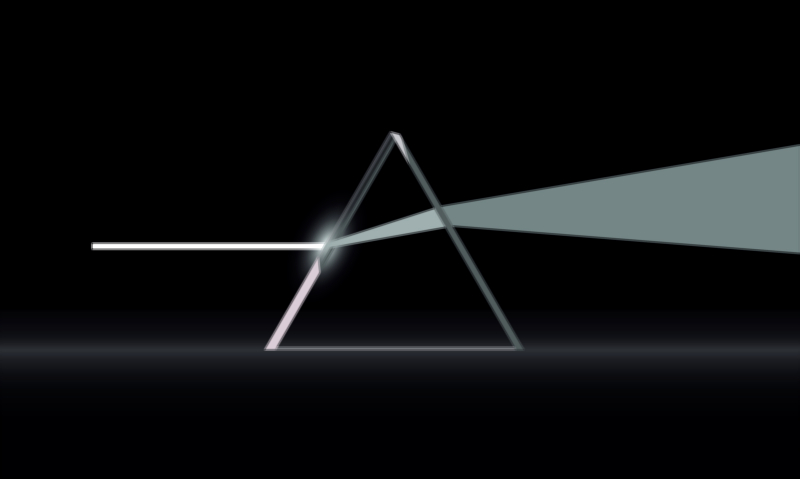
Another remarkable property of light is dispersion, which refers to the separation of white light into its constituent colours when it passes through a prism or water droplets in the atmosphere. White light contains a spectrum of colours with different wavelengths. When these wavelengths encounter a refractive medium, they bend by different amounts because their speeds change differently. Short-wavelength colours such as violet and blue bend more strongly than longer wavelengths like red. The result is the spread of colours into a rainbow. Dispersion explains why we see rainbows after rain, why prisms produce vibrant colour bands, and why the sky changes colour throughout the day. It also establishes that colour is not created by objects themselves but is an inherent property of light wavelengths. Objects appear coloured because they reflect some wavelengths and absorb others; the reflected wavelengths reach our eyes while the absorbed ones vanish.
Light possesses wave-like behaviour, demonstrated through interference and diffraction. When two or more light waves meet, they combine in a process called interference. If their peaks align, the result is a brighter region; if a peak meets a trough, they cancel each other, creating darkness. Interference is visible in soap bubbles, oil films on water, and holograms. Diffraction occurs when light bends around obstacles or spreads after passing through small openings. It explains the fuzzy edges of shadows and the shimmering pattern seen on compact discs. These wave properties are critical in technologies such as fibre-optic cables, microscopes, laser devices, and spectrometers. The complete success of communication networks relies heavily on wave behaviour to transmit signals reliably over long distances.
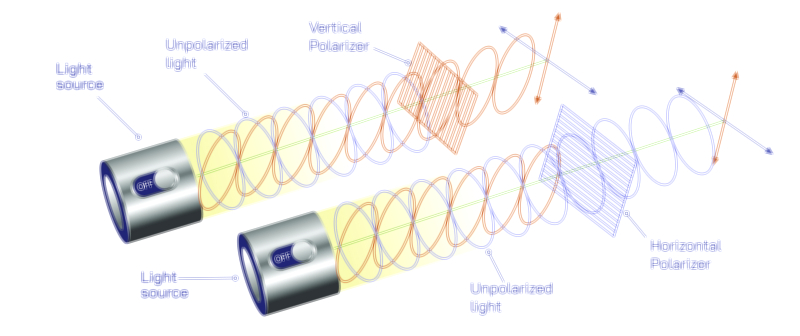
Polarization is another key property of light, demonstrating the orientation of light waves. Unpolarized light vibrates in multiple directions, but polarized light vibrates in only one direction. This property explains how glare-reducing sunglasses work; they block horizontally polarized reflected light, improving visual comfort. Photography filters use polarization to deepen contrast in skies and water reflections. Liquid crystal displays (LCD screens) depend on polarization, aligning molecules so that light transmission changes based on electrical signals. These applications show how a microscopic property of light transforms into major innovations in modern technology.
The particle nature of light becomes evident at the atomic scale, where light transfers energy in discrete packets called photons. This quantum property explains why ultraviolet radiation can damage skin while red light cannot—photons in ultraviolet light carry more energy because they correspond to higher frequencies. The discovery of photons transformed physics by establishing that energy in light is not continuous but quantized. Photoelectric experiments showed that when light strikes certain metals, electrons are released only if the photons carry enough energy. This phenomenon led to quantum mechanics and the invention of solar panels, which convert light directly into electricity. Thus, the particle nature of light not only reshaped scientific theory but also paved the way for renewable energy technologies.
One of the most extraordinary properties of light is the constancy of its speed in a vacuum. Light travels in empty space at approximately 300,000 kilometres per second, the fastest speed possible in the universe. Its speed is fundamental to Einstein’s theory of relativity and sets the limit for information transfer. The fixed speed of light explains astronomical observations, such as how we see distant stars as they were millions of years ago because their light has taken that long to reach Earth. GPS satellites, scientific imaging, and space exploration all depend on precise knowledge of light’s speed. Without it, time measurement, navigation, and cosmology would be impossible.
Light also carries momentum and can exert pressure on objects, even though it has no mass. This property, called radiation pressure, explains why long-term sunlight affects comet tails and why solar sails in space travel can harness light as propulsion. The ability of light to exert physical force—although extremely subtle—demonstrates that its energy has tangible mechanical influence.
Together, these properties reveal that light is not a simple beam of brightness but a deeply rich physical entity that shapes our perception of the world and drives technological progress. It travels in straight lines yet bends through refraction; it exhibits wave behaviour yet interacts like a particle; it carries energy and momentum while requiring no medium to propagate. It encodes information from objects and celestial bodies, making vision, photography, astronomy, and remote sensing possible. From the colours of nature to the communication systems that connect the world, the properties of light define both our physical reality and the scientific understanding that guides modern civilization.