Raman and Rayleigh Scattering – Fundamental Principles of Light–Matter Interaction, Molecular Vibrational Effects, Elastic vs Inelastic Scattering, Spectral Signatures, and Key Differences in Scientific and Industrial Applications
When light interacts with matter, it does not simply continue in a straight path. Instead, part of the light may be absorbed, part transmitted, and part scattered. Scattering refers to the redirection of light due to its interaction with atoms, molecules, or particles, and it represents one of the most revealing mechanisms for understanding the internal structure and dynamic behavior of materials. Among the numerous scattering processes, Rayleigh scattering and Raman scattering are the two most important in optical spectroscopy because they explain how light encodes information about molecular composition, structure, vibrations, and polarization. Although both phenomena occur when light interacts with molecules, their principles are fundamentally different. Rayleigh scattering involves elastic scattering, where photons emerge with the same energy they had before collision, while Raman scattering involves inelastic scattering, where photons exchange energy with molecules, producing new wavelengths associated with molecular vibrations. The comparison between Rayleigh and Raman scattering is not just a contrast of physical definitions — it provides one of the clearest demonstrations of how light serves as a probe for molecular identity and behavior.
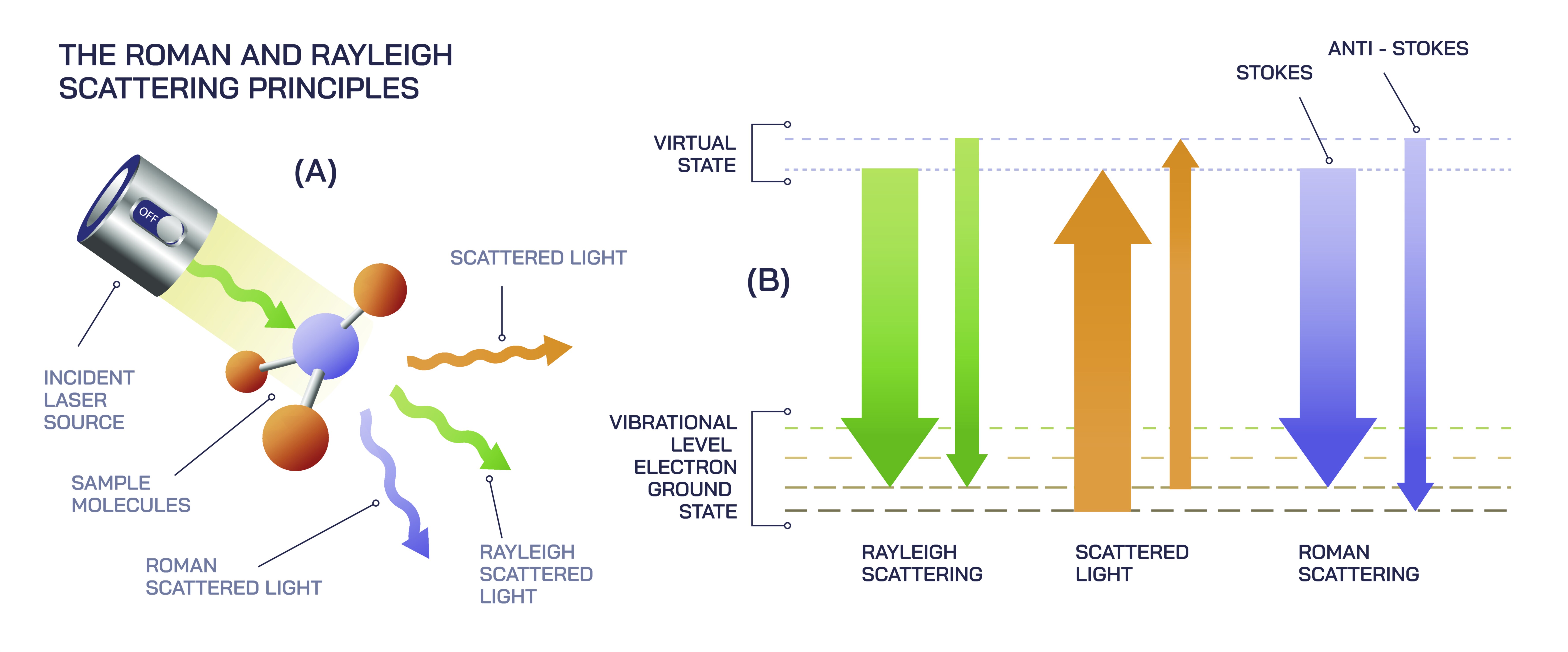
Rayleigh scattering is the most common and dominant form of scattering when light encounters very small particles, such as molecules or atoms that are much smaller than the wavelength of light. Its core principle is simple: the scattered photon has the same frequency, wavelength, and energy as the incoming photon. During the interaction, the light induces a temporary dipole in the molecule by distorting its electron cloud, but because the distortion is extremely brief and returns instantly to the original configuration, the molecule ends the interaction in the same energy state in which it started. Because no net exchange of energy occurs between the photon and the molecule, Rayleigh scattering is described as elastic. The scattered light, therefore, continues with the original color while being redirected in space. Rayleigh scattering intensity depends strongly on wavelength — shorter wavelengths scatter much more efficiently than longer wavelengths. This unequal scattering explains why the sky appears blue: the shorter blue wavelengths of sunlight scatter more effectively in the atmosphere compared with longer red wavelengths. During sunset, when sunlight travels through a thicker atmosphere, much of the blue scattering is removed from the direct path, allowing the red and orange components to dominate. Thus, Rayleigh scattering shapes both atmospheric color and the soft glow of remote planetary atmospheres.
Raman scattering is far less common than Rayleigh scattering — only a tiny fraction of scattered photons (roughly 1 in 10 million) undergo this process — yet its scientific value is enormous. Raman scattering occurs when the scattered photon has a different frequency and energy from the original photon because the interaction involves molecular vibrational energy levels. When light interacts with a molecule, it can briefly excite it to a virtual energy state. If the molecule absorbs energy from the photon during this brief interaction, the scattered photon returns with lower energy and longer wavelength — this is called Stokes Raman scattering. If the molecule loses vibrational energy to the photon, the scattered photon returns with higher energy and shorter wavelength — this is called Anti-Stokes Raman scattering. In both cases, the process is described as inelastic scattering because there is an energy shift between the photon and the molecule. This shift directly corresponds to specific molecular vibrations, which means Raman scattering provides a molecular fingerprint: every material has its own unique Raman spectrum depending on the chemical bonds present, their vibrational modes, electron density, and symmetry. As a result, Raman spectroscopy is one of the most powerful methods for identifying substances, analyzing chemical structures, monitoring industrial products, and studying living tissues without destruction.
Because Rayleigh and Raman scattering occur simultaneously when light interacts with matter, they form complementary signatures. Rayleigh scattering dominates the spectrum and appears at the same wavelength as the excitation source, representing the elastic scattering peak. Raman signals appear as smaller peaks at wavelengths shifted relative to the original laser line — these spectral shifts (Raman shifts) encode chemical information. In modern spectroscopy, Rayleigh scattering is filtered out so that the weaker Raman signals can be analyzed. In this sense, Rayleigh scattering is a background process, while Raman scattering is the informational process that researchers intend to detect. Both behaviors depend on molecule–photon interactions, but the outcomes tell profoundly different stories. Rayleigh scattering informs us about particle size, refractive index, and atmospheric behavior, while Raman scattering reveals bonds, vibrations, molecular symmetry, and even biological activity.
One deep physical difference between the two processes lies in what the scattered light responds to within the molecule. Rayleigh scattering depends primarily on polarizability in an equilibrium configuration but does not probe structural change. It shows how the electron cloud oscillates in the presence of a light wave, producing an instantaneous dipole that radiates light. Raman scattering, on the other hand, occurs only if the polarizability of the molecule changes during vibration. The strength of Raman signals depends on whether a vibrational mode alters the electron cloud’s deformation characteristics. Because different bonds stretch, bend, twist, rock, or wag uniquely, Raman scattering becomes sensitive to internal geometry and symmetry. The spectrum therefore reveals not only that a molecule is present but also how its atoms are connected and how they move relative to one another.
These principles translate into deeply different scientific and technological applications. Rayleigh scattering plays a central role in optical communication, atmospheric physics, nanoparticle characterization, elasticity measurements, and non-invasive biological imaging. It is used to study aerosol concentration, measure particle size in colloids, determine the behavior of gases in the atmosphere, quantify turbidity in liquids, and analyze optical fiber quality. In astronomy and planetary science, Rayleigh scattering reveals atmospheric composition and the scattering patterns around stars and planets. In contrast, Raman scattering has become a dominant method in chemical, pharmaceutical, forensic, biomedical, mineralogical, polymer, and semiconductor research. Raman spectroscopy can detect explosives on luggage, diagnose cancer through optical biopsies, assess pharmaceutical purity, measure stress in semiconductor wafers, identify gemstones, and map chemical distribution at microscopic scales. Because Raman scattering is non-invasive and requires minimal sample preparation, it is increasingly used in art conservation, environmental analysis, battery research, food safety testing, fuel chemistry, and industrial quality control. The ability to analyze materials through transparent containers without contact makes Raman spectroscopy invaluable for hazardous materials and biological samples.
One of the most striking conceptual differences between Rayleigh and Raman scattering lies in what they reveal about the world. Rayleigh scattering explains macroscopic visual phenomena — the colors of the sky, visibility of distant mountains, softening of distant landscapes, and visual glow of planets. It is a process of distribution of light in space, dictated by wavelength and particle size. Raman scattering explains the internal identity of molecules, converting optical interaction into precise chemical information. Where Rayleigh scattering describes the shape of the visible world, Raman scattering describes the chemistry that builds it.
In summary, Rayleigh and Raman scattering represent two intertwined yet fundamentally different outcomes of light interacting with matter. Rayleigh scattering preserves photon energy, reflecting the external optical environment through elastic scattering and producing wavelength-dependent visual effects. Raman scattering alters photon energy by exchanging vibrational energy with molecules, creating inelastic spectral shifts that reveal structural and chemical insights. The former explains why the sky is blue; the latter explains what molecules make up the world we see. Together, they form a powerful demonstration of how light can both illuminate the universe and interrogate the matter within it — one scattering phenomenon revealing beauty and color at a distance, and the other revealing molecular truth beneath the surface.