Properties of Light — Reflection, Refraction, Dispersion, and Diffraction in Wave Behaviour and Optical Phenomena
Light is one of the most fundamental and fascinating forms of energy in nature, and its behaviour shapes how human beings see, interpret, and interact with the world. Although it appears simple and familiar in everyday life, light possesses multiple distinct properties that reveal its complex wave nature and its remarkable ability to interact with matter in predictable yet astonishing ways. The key properties of light—reflection, refraction, dispersion, and diffraction—describe how light behaves when it encounters surfaces, boundaries, or obstacles. These properties are not isolated events; they form a unified understanding of optical phenomena that governs everything from the ability to see one’s own image in a mirror and the bending of sunlight through a glass of water, to the rainbow-like separation of colours in prisms and the bending of waves around edges. Each property demonstrates a different pathway through which light travels, changes direction, separates into components, or spreads out, forming the foundation for optical science and enabling the design of countless tools and technologies used in communication, research, medicine, imaging, and everyday life.
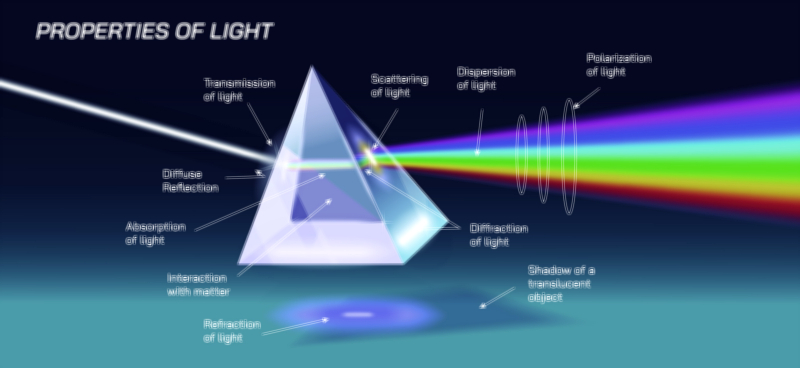
Reflection is the first and most immediately observable property of light. It occurs when a light ray strikes a surface and bounces off instead of passing through or being absorbed. When light hits a smooth surface—such as a mirror, polished metal, still water, or glossy plastic—the incident ray, the reflected ray, and the normal create a predictable geometric interaction where the angle of incidence equals the angle of reflection. This exact relationship allows mirrors to form clear images because light maintains its spatial arrangement as it returns to the observer’s eyes. Reflection enables the simple act of seeing one’s face but also powers technologies ranging from periscopes to telescopes, scanners, and laser-based instruments. In nature, reflection shapes shimmering effects on water, glints from metal, and the brightness of moonlight on ocean waves. Even rough surfaces exhibit diffuse reflection, scattering light in all directions and making objects visible from multiple angles without forming images. Without reflection, vision, illumination, image formation, and optical engineering would not exist in their familiar forms.
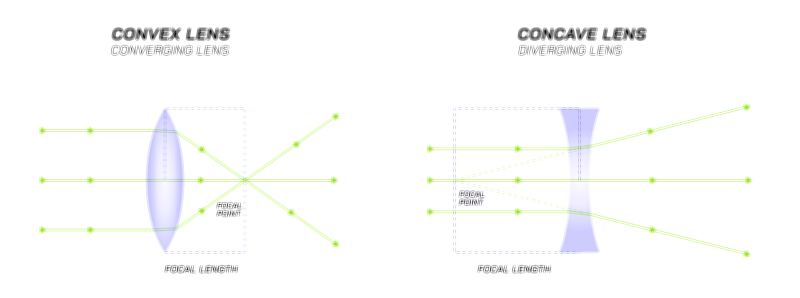
Refraction is the change in direction of a light ray when it passes from one transparent medium to another—such as from air into water or from glass into air. This property occurs because light travels at different speeds in different materials. When a ray enters a new medium at an angle, it bends either toward or away from the normal depending on whether the medium slows or accelerates its speed. Refraction explains why a straw in water appears bent, why distant objects shimmer over hot surfaces, why lenses magnify text, and why the sky appears blue but the sun looks flattened near the horizon. The bending of light in lenses forms real and virtual images that make microscopes, eyeglasses, projectors, cameras, telescopes, binoculars, and even the human eye function correctly. Refraction not only reveals the wave-based behaviour of light but also provides a pathway for controlling focus, magnification, and visual clarity. Through refraction, light can be redirected, concentrated, or dispersed in ways that enhance human perception and scientific capability.
Dispersion demonstrates that white light is not a single colour but a mixture of many wavelengths that travel differently through materials. When white light passes through a prism or raindrop, each wavelength (corresponding to colours from red to violet) refracts at a slightly different angle. This separation produces a spectrum of colours—red, orange, yellow, green, blue, indigo, and violet—arranged by wavelength and frequency. Dispersion creates rainbows in the sky, colourful patterns through glass chandeliers, and the vivid fire of gemstones. In scientific applications, dispersion allows instruments like spectrometers to analyse substances based on how they absorb and emit specific wavelengths. Because dispersion reveals the composite nature of white light, it forms a bridge between optics and material science, showing that transparency does not mean uniform transmission. Instead, materials influence each wavelength differently, creating effects that can be visualized, measured, and manipulated.
Diffraction highlights the wave nature of light more dramatically than any other property. Unlike reflection or refraction, which change the direction of light in clean and predictable ways, diffraction causes light to spread out when it encounters edges, narrow openings, or obstacles. When light passes through a narrow slit, it bends outward and produces an interference pattern of bright and dark bands. When it meets an obstacle, it spreads around the edges rather than stopping abruptly. Diffraction is responsible for the iridescent colours of peacock feathers and soap bubbles, the halos around streetlights in fog, and the shimmering patterns on CDs and DVDs. It also plays a foundational role in modern science: microscopes and telescopes are limited by diffraction, and their magnification power depends on overcoming it; engineers use diffraction to design gratings that separate wavelengths with extreme precision; and laser technology relies on diffraction to measure distances and create interference effects for communication and sensing. In everyday experience, diffraction often goes unnoticed, yet it silently influences how light travels and what humans can see at fine detail.
Understanding reflection, refraction, dispersion, and diffraction as a unified set of light properties reveals deeper truths about the dual nature of light. Reflection and refraction emphasize the geometry of ray behaviour, dispersion exposes the variation of wavelengths within white light, and diffraction demonstrates the spreading and interference patterns that only waves can generate. Together, these properties confirm that light behaves as a wave in space while interacting with matter in predictable and measurable ways. They explain why lenses can focus light but also why magnification has limits; why mirrors create images but also why scattering makes objects visible; why rainbows form only under certain atmospheric conditions; and why optical instruments must be carefully designed to balance direction, wavelength separation, and wave interference.
These properties also form the basis of nearly all modern optical applications. Reflection shapes mirrors, projectors, laser systems, and high-precision optical instruments. Refraction powers eyeglasses, camera lenses, microscopes, telescopes, fibre optics, and medical imaging tools. Dispersion enables spectroscopy, chemical analysis, forensic detection, atmospheric monitoring, and artistic visual effects. Diffraction forms the heart of holography, synthetic aperture imaging, nanolithography, optical communication networks, and deep scientific measurement—including the detection of gravitational waves through extreme interference sensitivity. Every field that uses light—from astronomy and quantum physics to photography and optometry—relies on these four properties to observe, analyse, manipulate, and understand the physical world.
Light therefore is not merely a passive illumination source; it is an active, structured physical phenomenon governed by wave interactions with matter. Reflection allows light to return; refraction bends it; dispersion separates it; diffraction spreads and interferes with it. Through these combined properties, light becomes a tool for vision, communication, scientific analysis, and technological innovation. Whether illuminating a room, forming a rainbow, enabling a microscope to reveal microscopic life, or helping engineers send information through optical fibres across oceans, the foundational behaviours of light shape nearly everything humans see, measure, and discover.