Properties of Magnets and Magnetic Field Behavior – Understanding Magnetism, Attraction and Repulsion, Field Patterns, Poles, Strength, Materials, and How Magnetic Forces Shape the Physical World
Magnets have fascinated human curiosity for centuries because they exert invisible forces that act across space, causing attraction or repulsion without direct physical contact. What makes magnetism remarkable is that it is not random but follows strict, consistent, and predictable rules based on the arrangement of electric charges and atomic structure within materials. All magnets, whether simple refrigerator magnets, industrial electromagnets, or the magnetic field of Earth itself, share the same core characteristics: they generate a magnetic field, have two poles, influence certain materials, and follow defined laws of force and orientation. Understanding the properties of magnets and the behavior of magnetic fields reveals how unseen lines of force organize motion, maintain stability in nature, enable technology, and control interactions between charged particles and moving electrons.
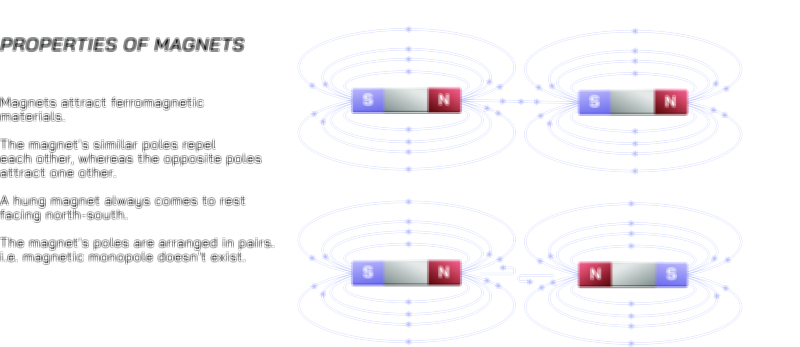
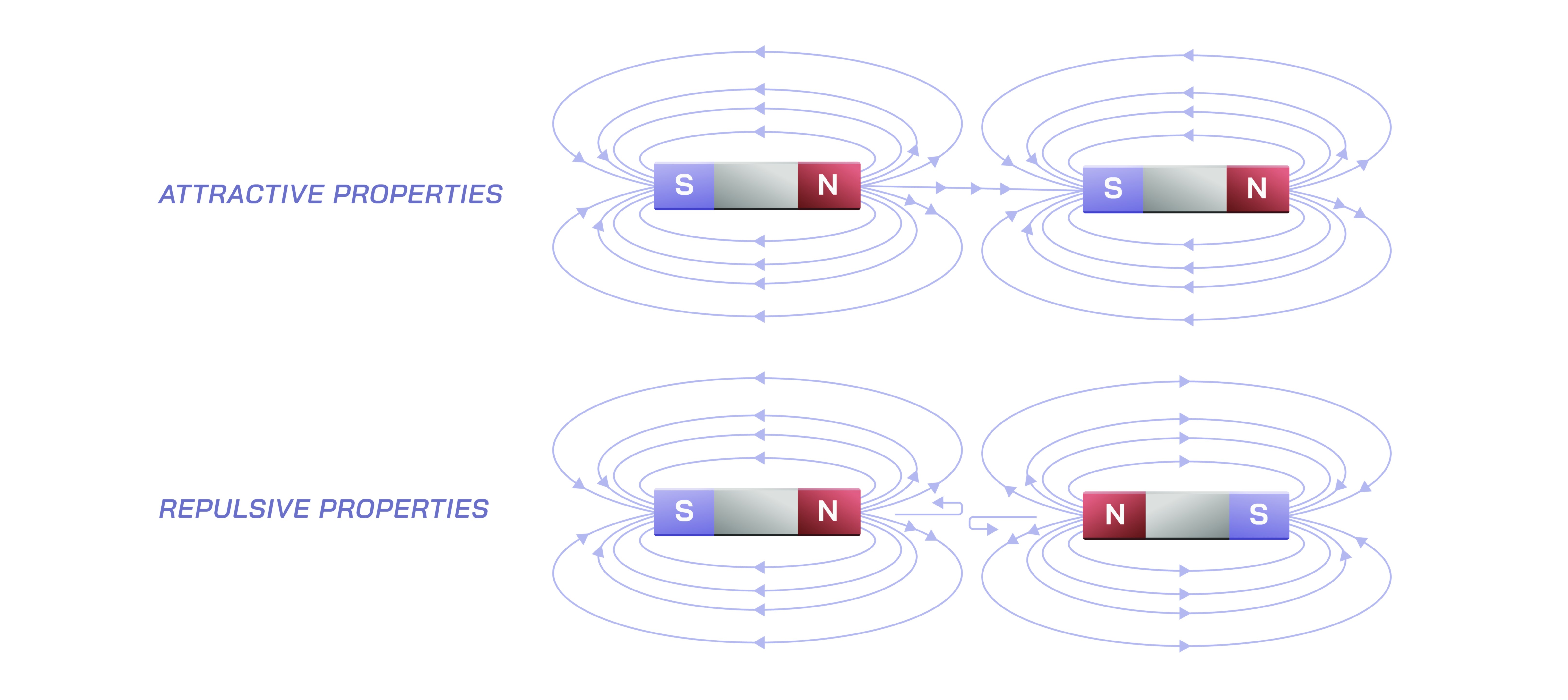
A defining property of every magnet is that it has two poles, known as the north pole and the south pole. These poles are always paired, and no matter how many times a magnet is cut or broken, each piece will always contain both a north and south pole. A magnet cannot be reduced to just one pole because the atomic sources of magnetism — tiny magnetic moments linked to spinning electrons — always arise in dipole form rather than as single, isolated poles. The poles of magnets obey predictable rules: like poles repel each other, while opposite poles attract. A north pole pushes away another north pole but pulls toward a south pole, and the same is true in reverse. These attractive and repulsive forces create tension and alignment, which can hold objects together, allow magnetic levitation in special conditions, or cause bodies to align to large-scale planetary magnetic fields, as in the case of compasses pointing north.
The invisible influence of a magnet is called a magnetic field, and this field extends outward from each pole and curves through space in a pattern that can be visualized using iron filings or magnetic field sensors. Field lines emerge from the north pole of a magnet, travel through the surrounding space, and re-enter at the south pole, forming a closed loop. Though field lines are only a representation rather than a physical object, they make it easier to understand the intensity and direction of magnetic influence. Regions where the field lines are closer together indicate stronger magnetic force, while areas where they spread apart show weaker force. Inside the magnet, the field returns from south to north, completing the loop. This continuous circuit illustrates that magnetic fields do not begin or end in empty space; they flow in complete loops through and around magnetic materials. This concept demonstrates the continuity of magnetic fields, an essential rule of magnetism that governs everything from electric motors to particle motion in space.
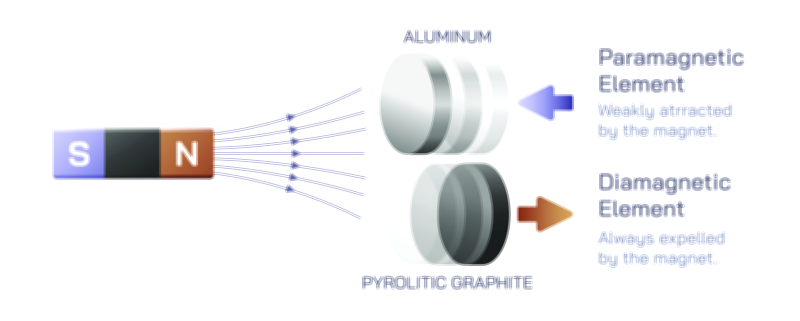
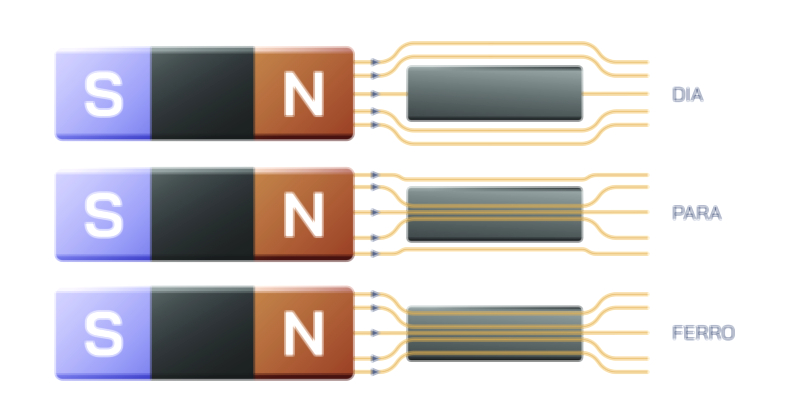
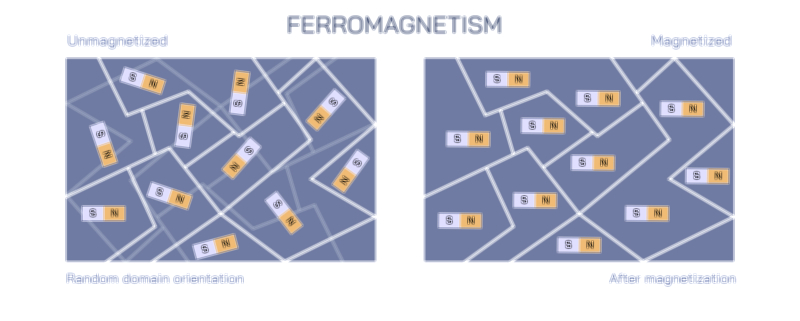
The behavior of magnets and magnetic fields is determined by the arrangement of microscopic magnetic domains — tiny regions in a material where atomic magnetic moments are aligned in a single direction. In nonmagnetic materials such as wood, rubber, glass, or most metals, these magnetic domains are randomly oriented and cancel each other’s effects. But in magnetic materials like iron, nickel, cobalt, and their alloys, the magnetic domains can align in the same direction. When an external magnetic field causes this alignment, the material becomes magnetized. If the alignment remains even after the field is removed, the material becomes a permanent magnet. If the alignment disappears once the external field is gone, the material is a temporary magnet, which is useful when magnetic attraction is needed only for short periods or when the ability to switch magnetism on and off is important. This domain-based understanding shows how the internal atomic arrangement controls whether a substance behaves magnetically or not.
The strength of a magnet depends on how many magnetic domains are aligned and how strongly they hold their orientation. Materials with high magnetic hardness, such as neodymium alloys, maintain alignment very strongly and create extremely powerful permanent magnets. Softer magnetic materials such as soft iron align easily but lose their magnetism when the inducing field is removed, making them suitable for electromagnets and transformers because they enable controlled switching. Heat and mechanical shock can disrupt domain alignment; therefore, strong magnets may weaken if exposed to high temperatures or heavy impacts. Conversely, carefully controlled processes like annealing and alloying can enhance domain alignment and create specialized magnetic materials with tailored strengths and behaviors.
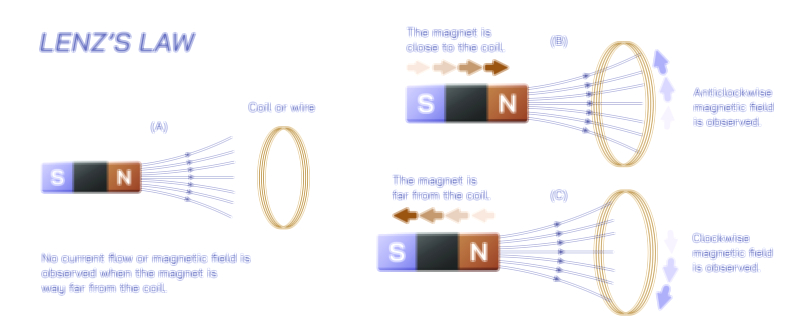
Magnets become especially powerful when combined with electric current. A wire carrying electric current generates a magnetic field around it, and when the wire is coiled, the field intensifies and becomes more organized. Placing a soft iron core inside the coil magnifies the field dramatically because the domains inside the iron align with the magnetic influence. This structure forms an electromagnet, which can be turned on and off by controlling the electric current. Electromagnets make possible an enormous range of modern technologies — electric motors, generators, transformers, maglev trains, MRI scanners, speakers, relays, and industrial lifting magnets. In each case, the predictable behavior of magnetic fields directs motion, transforms energy, or builds communication systems.
Magnetic fields also shape the natural world. Earth itself acts as a gigantic permanent magnet with a magnetic field extending far into space. The north pole of a compass needle aligns with Earth’s magnetic field lines, allowing navigation by using magnetism rather than sight. Earth’s magnetic field forms a protective shield called the magnetosphere, which deflects harmful charged particles from solar wind, safeguarding life from radiation and preventing atmospheric erosion. Magnetic fields guide bird migration, influence mineral patterns in rocks, and store geological records of ancient pole reversals. These large-scale examples show that magnetism is not limited to small laboratory settings — it plays a protective and organizing role in planetary science and ecosystems.
Magnets also generate forces that operate in specialized environments such as electronics and digital data storage. Inside a computer hard drive, patterns of magnetized domains represent 0s and 1s, storing billions of digital bits. In speakers and headphones, magnetism translates electrical signals into physical motion of speaker cones, converting electric energy into sound waves. In credit cards and security passes, magnetic stripes encode identification data. Scanning technology, robotics, industrial automation, semiconductor fabrication, electric vehicles, and power generation all depend heavily on magnetic field behavior. What began as an ancient curiosity has evolved into one of the most important foundations of modern engineering.
The study of magnets also highlights a deeper principle in physics: magnetic effects arise from electricity. A stationary electric charge creates an electric field, while a moving electric charge creates a magnetic field. Inside atoms, electrons orbit and spin — forms of motion that give rise to tiny magnetic moments. When many of these moments align, magnetism becomes noticeable at the macroscopic scale. This connection between electricity and magnetism forms the basis of electromagnetic theory, which explains how magnetic forces, electric forces, and light are all interconnected parts of a single physical framework.
In summary, the properties of magnets and magnetic fields show that an invisible but highly ordered force governs how certain materials interact at both small and large scales. Magnets always have two poles that determine attraction and repulsion, they create continuous magnetic field loops, they influence materials based on atomic alignment, and they show strength based on domain behavior and material composition. Magnetic fields guide compasses, drive electric motors, support digital communication, enable transportation, and shield Earth from cosmic radiation. Understanding magnetic properties is not only about identifying which objects stick to a magnet but about recognizing how unseen fields structure matter, motion, and technology. Whether present in a fridge magnet holding a note or in the rotating machinery powering a city, magnetism remains one of the most transformative and essential forces shaping both nature and human innovation.