Projectile Motion – Principles, Forces, Trajectory Formation, and the Physics Behind Curved Paths in Two-Dimensional Motion
Projectile motion describes the path of any object that is launched into the air and moves under the influence of gravity alone, without propulsion after release. Everyday examples include a thrown ball, a kicked football, water from a fountain, a cannon shell, a javelin, or even droplets in a rain splashes pattern. What makes projectile motion unique is that the object simultaneously moves horizontally and vertically, and both components combine to form a curved trajectory rather than a straight line. While the motion may look complex, it follows a beautifully ordered logic: the horizontal part of the motion remains uniform and constant, while the vertical motion accelerates downward under gravity. Together, these independent motions create the familiar parabolic path. Understanding projectile motion introduces some of the most important ideas in physics — independence of motion along perpendicular axes, constant acceleration due to gravity, and the predictable nature of curved trajectories — all of which help explain how objects move through space.
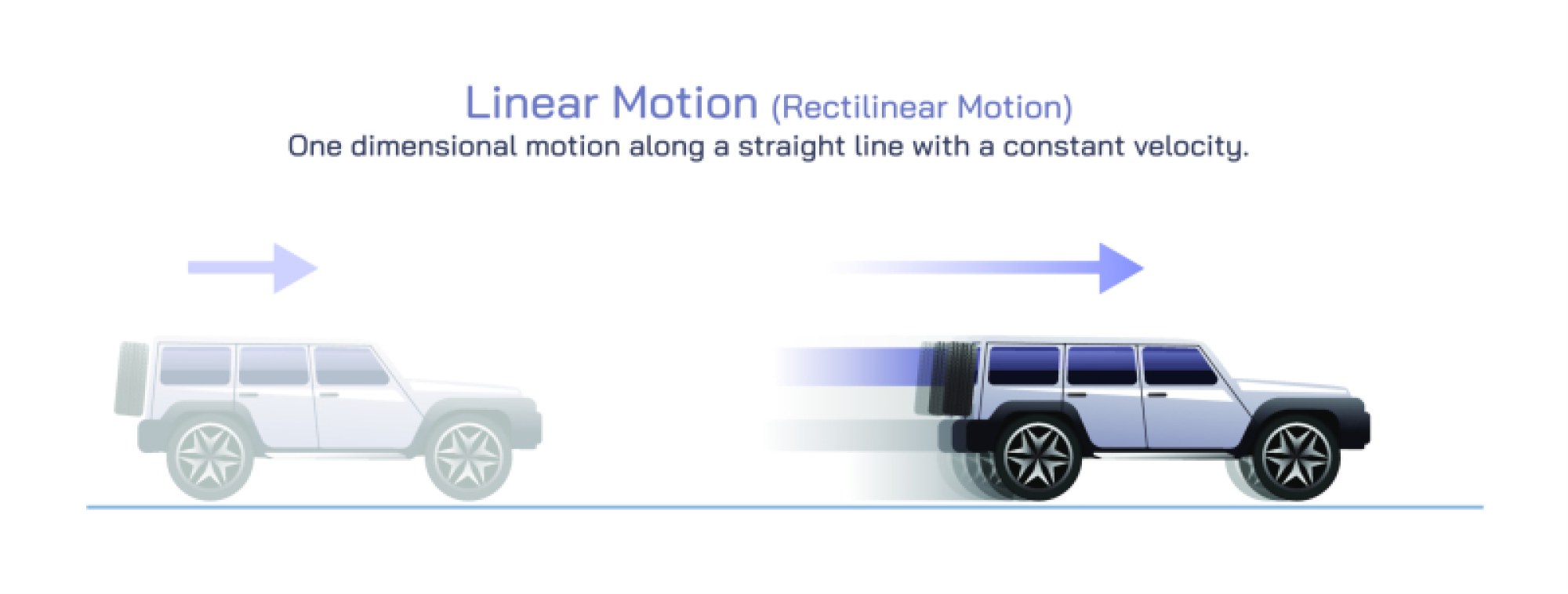
The foundation of projectile motion lies in the principle that the horizontal and vertical motions of a projectile are independent of each other. Once an object is launched, its horizontal motion does not affect its vertical fall, and its vertical fall does not influence the horizontal movement. At the moment of launch, the projectile has a certain initial velocity, which can be resolved into two components: a horizontal component responsible for forward travel and a vertical component responsible for upward or downward motion. The horizontal component remains constant, because air resistance is usually neglected in basic physics and no external force pulls the object forward or backward. The vertical component, however, experiences continuous downward acceleration due to gravity, which gradually weakens the upward movement, brings the projectile to its highest point, and then speeds up its downward drop. This synchrony — constant forward motion combined with accelerated downward motion — creates the curved path that defines projectile motion.
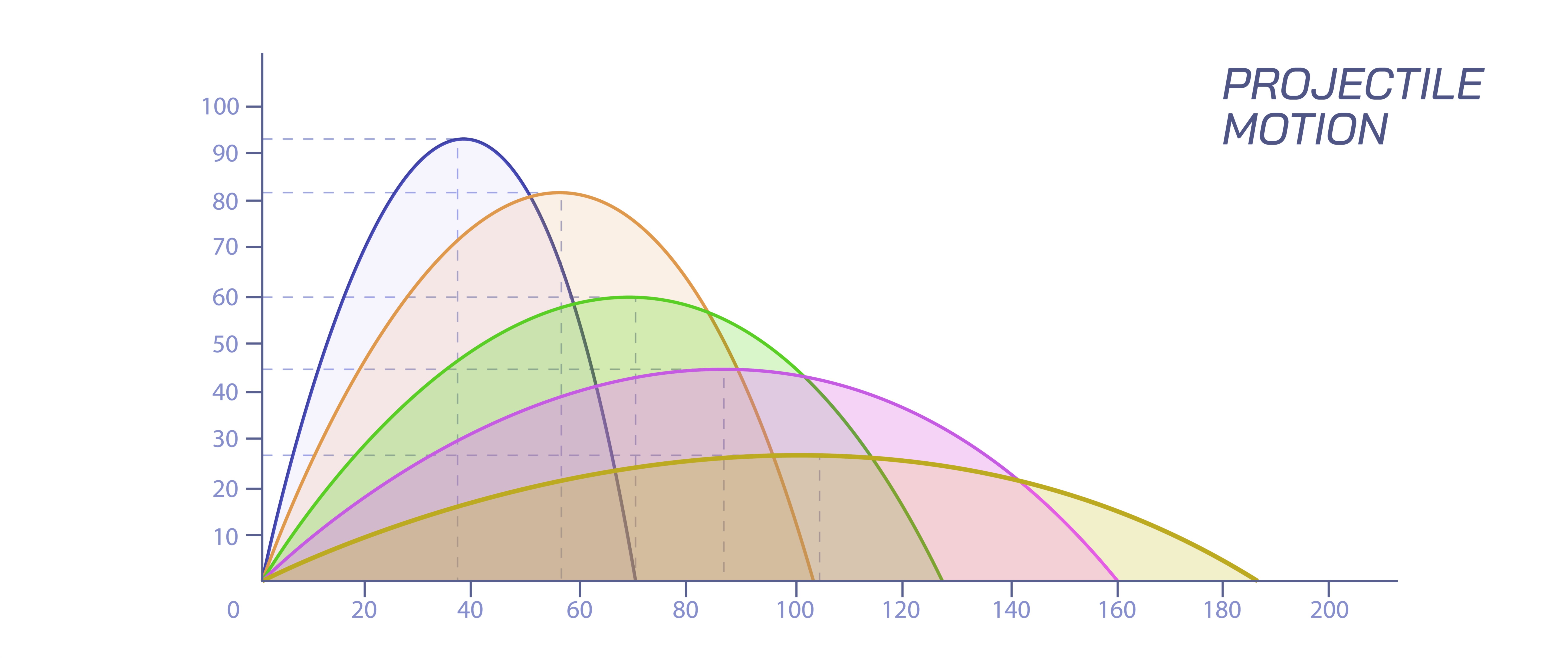
A trajectory is the visible or imagined arc through which the projectile travels. Its shape depends directly on three launch factors: initial velocity, launch height, and launch angle. When the projectile is thrown at a steep angle, most of its energy contributes to vertical motion, making the projectile climb higher but not travel very far horizontally. When thrown at a shallow angle, most energy contributes to horizontal motion, making the projectile travel far with little height. At a 45-degree launch angle, the projectile typically reaches maximum range because the horizontal and vertical components of velocity are balanced in the most efficient proportion. Another key feature of the trajectory is the apex, or highest point, which occurs when the vertical component of velocity becomes momentarily zero. After the apex, the vertical component increases downward due to gravity, while the horizontal component remains unchanged. Thus, the upward and downward parts of the motion are symmetrical in ideal conditions. This symmetry explains why a projectile launched and landing at the same vertical level takes the same time rising to its peak as it does descending.
Time plays an important role in shaping motion. The moment the projectile is in the air — called time of flight — increases when the projectile has a larger vertical component of velocity or starts from a higher elevation. If thrown from an elevated platform, the projectile spends extra time falling to the ground, increasing its total horizontal distance. Conversely, if thrown from ground level and caught or landing at the same level, the motion is perfectly mirrored around the apex. The faster the projectile is launched, the longer it takes gravity to undo the upward acceleration, and the wider the arc becomes. These relationships show why velocity direction during launch matters just as much as velocity magnitude, and why small changes in technique — whether in sports, engineering, or military applications — dramatically affect trajectory.
Understanding projectile motion also reveals why falling and moving forward at the same time does not change the rate of fall. If someone throws a ball straight forward from a high platform at the exact same time they drop another ball with no horizontal speed, both balls hit the ground simultaneously. The projectile travels forward, but its vertical fall is identical to that of the dropped object because gravity pulls all objects downward equally regardless of sideways motion. This idea helps avoid the misconception that “forward motion keeps the projectile in the air.” Horizontal speed cannot defeat gravity; it merely stretches the flight path into a curve instead of a straight fall. The only reason projectiles appear to fly longer is that while gravity makes them fall, they continue moving forward at the same time, covering ground before landing.
Air resistance modifies projectile motion in the real world by slowing down the projectile horizontally and slightly reducing its height. This effect is noticeable in fast-moving or lightweight objects, such as arrows, bullets, or tennis balls, especially when spin is applied. Backspin increases lift and prolongs flight, topspin makes the ball dip quickly, and sidespin curves the horizontal path. However, these deviations are refinements built on the same core physics — the ideal parabolic motion remains the baseline model of how gravity shapes movement.
Projectile motion is not just an abstract concept; it plays a crucial role in various fields. In sports, players adjust launch angles, spin, and force to ensure accurate throws, passes, jumps, and kicks. In engineering and architecture, projectile motion helps define water fountain arcs, amusement park ride design, irrigation spray reach, and material transport systems. In ballistics and military applications, precise calculations of projectile physics determine targeting accuracy. Meteorology uses projectile principles to track eruptive debris from volcanoes and blowing snow arcs. Even space science relies on the underlying concepts — rockets apply thrust only to escape the atmosphere, after which bodies continue on curved trajectories governed by gravitational pull across space.
What makes projectile motion conceptually beautiful is that it transforms what appears to be complex, unpredictable curved motion into a predictable and repeatable pattern. No matter how random a throw may seem, the arc it follows obeys strict rules dictated by gravity and initial conditions. The two-dimensional path is merely the combined effect of one uniform motion and one uniformly accelerated motion. Once those components are understood, the trajectory becomes fully explainable and predictable.
In essence, projectile motion is a vivid demonstration of how physics clarifies natural behavior. It reminds us that movement in the real world is not chaotic; it follows elegant principles governed by forces and vector components. Whether analyzing how high a basketball jumps off a free throw, how far a long jumper travels, how water flows from a hose, or how a spacecraft moves through airless space after launch, the same foundational idea persists: the combination of horizontal motion and vertical acceleration creates curved paths. Recognizing this not only deepens understanding of mechanics but also shows how scientific laws transform observation into knowledge — revealing the order, predictability, and symmetry hidden within motion that we see around us every day.