Statistics vs Econometrics – Educational Comparison, Conceptual Foundations, Methodological Differences, and Real-World Applications
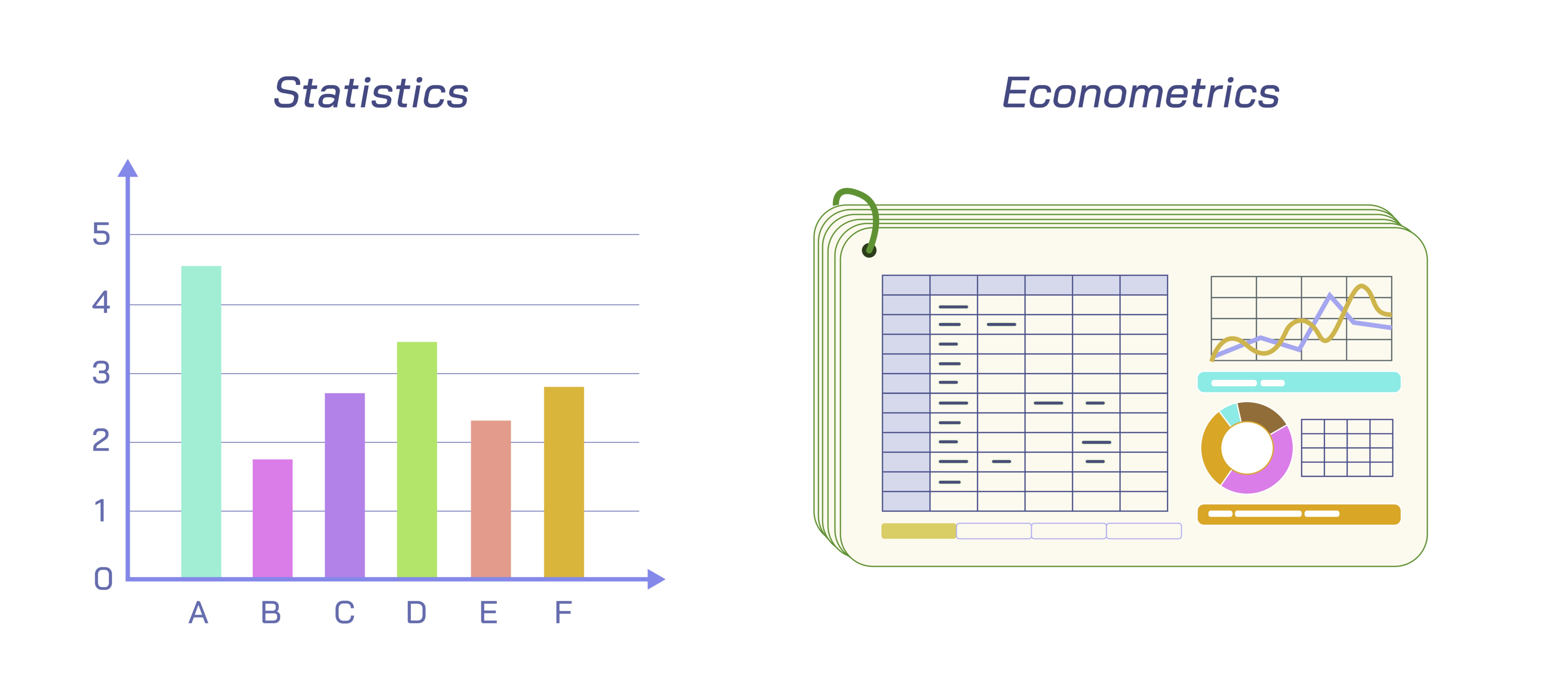
The comparison between statistics and econometrics offers students an opportunity to understand how two closely related disciplines share a significant overlap in theory while diverging in purpose, application, and interpretation. At first glance, both fields rely on data, probability, estimation, inference, and prediction, making them seem interchangeable. However, a deeper educational exploration reveals that statistics emerges as a broad and universal science of data analysis, whereas econometrics applies statistical reasoning specifically to economic and social questions that involve behavioral responses, incentives, markets, and dynamic interactions over time. Statistics provides the mathematical backbone, tools, and logic of inference, while econometrics expands those tools by integrating economic theory to explain complex real-world outcomes and causal relationships. Appreciating their similarities and differences allows learners to understand why economists cannot rely solely on general statistical techniques and why econometrics holds a distinct identity shaped by economic behavior and policy interpretation.
Statistics can be understood as the foundational science devoted to the collection, organization, summarization, analysis, and interpretation of data arising from any field. Its core focus is on patterns and variability—how to make sense of randomness and uncertainty using probability models. Statistics emphasizes designing methods that determine whether observed patterns in data result from chance or represent meaningful effects. It provides concepts such as hypothesis testing, estimation, confidence intervals, sampling distributions, regression, and prediction. Importantly, statistics is deliberately universal. The same statistical method can be used to evaluate drug efficacy, forecast rainfall, study consumer preferences, or analyze student grades. It aims to produce correct inferences regardless of context, so it avoids discipline-specific assumptions unless they can be justified mathematically. A statistical model might reveal that two variables are correlated, quantify the strength of that correlation, and measure uncertainty around the result, but it does not assume why that relationship exists or what theory should justify it. The emphasis is on empirical validity rather than cause-and-effect interpretation guided by a specific worldview.
Econometrics, on the other hand, is grounded in the idea that statistics alone cannot fully analyze economic and social systems because such systems involve decision-making, constraints, expectations, and feedback effects. Therefore, econometrics keeps the mathematical and computational elements of statistics but remains inseparable from economic theory. Where statistics seeks correlations and patterns, econometrics seeks causal mechanisms that explain human behavior within markets, firms, policies, and macroeconomic systems. Econometric analysis must consider complex questions such as whether higher education increases lifetime income, whether a minimum wage affects employment, whether government spending stimulates growth, or whether interest rate changes slow inflation. These questions involve variables that influence each other simultaneously, making traditional statistical assumptions insufficient. Econometrics adapts statistical techniques to circumstances where randomness does not enter only through sampling variation but also through strategic human choice, endogeneity, omitted factors, policy effects, and expectations about the future. The result is a field where modeling and inference depend on aligning empirical analysis with theoretical constraints.
A crucial educational distinction lies in the purpose of modeling. In general statistics, a model is chosen because it fits the data well and captures relationships efficiently. In econometrics, a model is chosen because it reflects economic reasoning; it must be consistent with supply and demand behavior, utility maximization, cost minimization, rational expectations, or intertemporal decision-making, even before estimation begins. A purely statistical model that predicts well could still be unacceptable in econometrics if the argument supporting it contradicts economic logic. This dual obligation—to satisfy economic theory and empirical precision—defines econometrics as both stricter and more interpretive than general statistics. Students often notice that econometric models include structural components and behavioral constraints that would rarely appear in a generic statistical context. This explains why econometrics textbooks devote substantial attention not just to probability and inference but also to identification, causality, parameter interpretation, and policy relevance.
The challenge of causality represents another key divergence. Statistics traditionally emphasizes association: if two variables move together in a reproducible pattern, the relationship is real regardless of explanation. Econometrics insists that understanding relationships requires isolating genuine causal effects. For example, statistical analysis might show that years of schooling and income are positively associated, but econometrics asks whether schooling causes higher income or whether other factors—such as family background or individual motivation—generate the observed correlation. Econometricians therefore design methods to remove or reduce bias, including instrumental variables, panel data models, natural experiments, difference-in-differences, time-series estimators, fixed effects, and machine-learning-based causal inference. These techniques arise because economic data rarely come from controlled experiments; nearly everything is observational and subject to confounding influences. As a result, econometrics teaches students how to extract causal conclusions from imperfect and noisy real-world data, an ability that is indispensable for evaluating public policy and market behavior.
Another educational point of comparison lies in the types of data each field most commonly studies. Statistics deals with every possible form of data, from biological to industrial to psychological, depending on the research question. Econometrics draws overwhelmingly from real economic environments—household surveys, labor market records, trade statistics, national accounts, financial markets, firm performance databases, experimental development interventions, and historical macroeconomic trends. Economic data seldom follow ideal distributions and often involve missing values, measurement error, structural change, interdependence among agents, and strong time dynamics. Therefore, econometrics requires especially careful handling of issues such as autocorrelation, heteroskedasticity, simultaneity, and dynamic lag effects. Students learn that most statistical models assume independent observations, but economic data frequently violate independence because individuals and firms continuously react to each other’s decisions. Econometric methods compensate for this reality rather than ignoring it.
When comparing educational goals, statistics aims to train students to think critically about evidence, uncertainty, and variability in any experimental or observational setting. It prepares learners to evaluate claims using data, to question whether patterns are meaningful or coincidental, and to quantify how confident society should be in any numerical conclusion. Econometrics builds on this foundation by developing the ability to evaluate economic decision-making and policy design. A student trained in econometrics learns not only to analyze economic data but to interpret the results in ways meaningful to citizens, governments, firms, and financial institutions. Econometrics asks not only whether a relationship exists, but whether it is strong enough to justify an intervention, whether it would remain stable if circumstances changed, and whether it reflects rational economic responses rather than artifacts of the dataset. In this sense, econometrics merges scientific rigor with real-world responsibility.
Despite their differences, the relationship between statistics and econometrics should not be seen as competitive but complementary. Statistics provides the foundational mathematics without which econometrics cannot exist. Econometrics extends statistics into domains where data interact with theory and human behavior. A student gaining expertise in both fields acquires the rare ability to design scientifically valid studies, implement rigorous estimation techniques, interpret results in an economically meaningful way, and translate findings into recommendations that can influence policy and industry. This synthesis explains why economics degrees require both statistical training and dedicated econometrics courses, and why employers in research, finance, government, and consulting value applicants with econometric ability. They are not simply data analysts; they are interpreters of causality and behavior in systems where decisions and incentives matter.
Ultimately, comparing statistics and econometrics enriches a student’s educational journey because it demonstrates how scientific tools evolve according to the questions they are built to answer. Statistics seeks truth through mathematical rigor and generality. Econometrics seeks truth through the additional lens of economic structure and real-world mechanism. Statistics is the science of learning from data in the widest possible sense; econometrics is the science of learning from data when that data arises from markets, policies, incentives, and strategic human decisions. Recognizing this distinction helps students appreciate both fields not as rivals but as stages of a continuum—from pure inference to applied economic reasoning. The more deeply students understand this relationship, the more effectively they can use data to describe the world, explain it, and ultimately improve it through informed decision-making grounded in solid empirical evidence.