Stearic Acid – Molecular Structure, Physical Characteristics, Chemical Behavior, and Educational Significance in Organic Chemistry
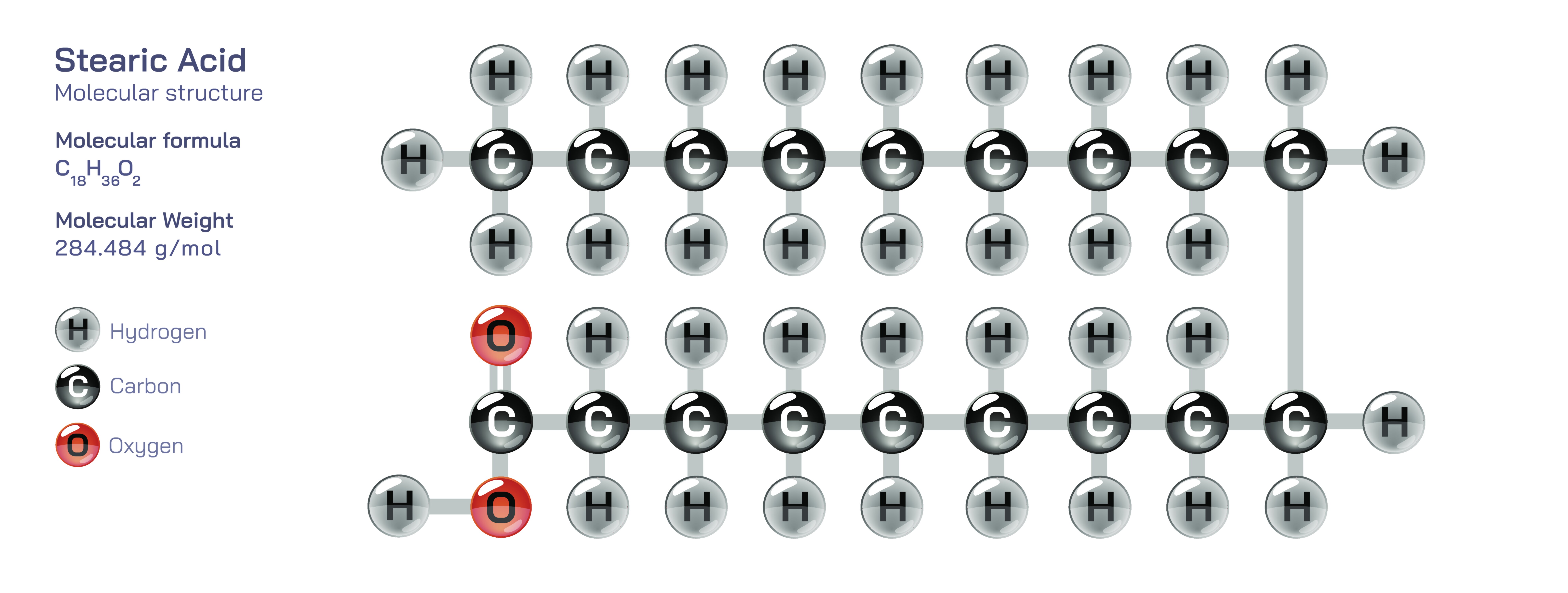
Stearic acid offers an exemplary gateway into understanding organic molecules because its structure, reactions, and physical properties give students a clear view of how the arrangement of atoms influences the behavior of matter on both microscopic and macroscopic scales. Represented by the molecular formula C₁₈H₃₆O₂, stearic acid belongs to the family of long-chain saturated fatty acids, and its chain contains eighteen carbon atoms bonded in a continuous, unbranched sequence. The molecule ends in a carboxylic acid functional group, which is responsible for its chemical reactivity, while the long hydrocarbon tail contributes to its hydrophobic nature and its solid, waxlike character at room temperature. When learners visualize stearic acid on a molecular level, they often recognize that a molecule can possess two distinct personality regions: one that is polar and chemically active—represented by the carboxyl (-COOH) group—and one that is nonpolar and largely inert, represented by the long alkyl chain. This dual character illustrates an essential organic chemistry concept: physical and chemical behavior depend on the balance between functional groups and hydrocarbon structure. In the case of stearic acid, the dominance of nonpolar carbons and hydrogens explains why it is insoluble in water yet readily soluble in organic solvents, and it also explains why it assumes a solid form at relatively low temperatures compared with unsaturated fatty acids that possess double bonds.
The length and saturation of the carbon chain in stearic acid contribute profoundly to its physical properties, providing an intuitive example of how small structural differences among molecules produce large differences in material behavior. Because the hydrocarbon chain contains only single bonds, the molecule adopts a zigzag conformation that maximizes packing efficiency in its solid lattice. These closely packed molecules reinforce each other through van der Waals forces, which collectively produce a high melting point relative to shorter or unsaturated fatty acids. When one compares stearic acid to oleic acid—a monounsaturated C₁₈ fatty acid—the educational contrast is striking. Although both molecules contain the same number of carbons, the presence of a double bond in oleic acid introduces a kink that disrupts crystal packing and drastically lowers the melting point. This contrast helps students see how variations at the molecular scale produce changes in texture and phase that can be observed directly in daily life. Stearic acid remains solid in many natural fats and waxes, while oleic acid remains liquid in oils. Through this connection, learners come to understand that melting temperatures in lipids are not arbitrary but the result of intermolecular interactions determined by molecular shape and saturation.
Stearic acid also provides an excellent educational model for teaching the chemistry of carboxylic acids and the ways in which functional groups dictate reactivity. The carboxyl group at the terminal carbon gives stearic acid the ability to donate a proton under appropriate conditions, making it a weak acid. When dissolved in alkaline solutions such as sodium hydroxide or potassium hydroxide, stearic acid undergoes neutralization to form salts called stearates. This reaction is central to saponification, the process through which fatty acids are converted into soaps. During saponification, the nonpolar hydrocarbon tail of stearic acid becomes the hydrophobic region of a soap molecule, while the ionized carboxylate group becomes the hydrophilic region. As a result, the amphiphilic structure of a soap molecule arises naturally from the amphiphilic structure of stearic acid itself. By following this transformation, students see that real-world products emerge directly from predictable chemical logic. Soap molecules form micelles in water, surrounding oily particles and lifting them into solution, and this behavior can be traced to the structure of the parent fatty acid. Thus, while stearic acid in isolation is not soluble in water, its salt form becomes an important detergent due to exactly the same structural features, interpreted through a new ionic framework.
In the context of biological and environmental chemistry, stearic acid teaches learners how molecular properties influence biological function and metabolic pathways. While its saturated structure tends to associate with solid fats, its role in living organisms is multifaceted. Stearic acid occurs naturally in animal fat and in plant sources such as cocoa butter and shea butter, contributing to the structural stability of membranes and stored energy supplies. Its relatively high melting point assists organisms in storing energy densely without fluidity loss. Metabolic processes further demonstrate how structure affects biochemical fate: the β-oxidation of stearic acid in cells proceeds through a cyclic sequence that shortens the carbon chain by two carbons per cycle, producing acetyl-CoA molecules that feed energy-generating pathways. Students observing how a simple repeating mechanism can break down a long carbon chain to power biological energy cycles begin to understand that biochemistry operates through predictable patterns built on organic chemical foundations. Moreover, because stearic acid is fully saturated, it undergoes hydrogen removal in a more linear and uniform oxidation pattern than unsaturated fatty acids, highlighting once again how chemical composition directs biological outcomes.
Stearic acid also becomes a useful teaching tool in industrial and physical chemistry because of its role in modifying material properties. It is widely employed in cosmetics, pharmaceuticals, rubber processing, lubricants, and candle manufacturing because its solid yet workable consistency allows it to stiffen mixtures, improve binding between particles, and stabilize emulsions. These applications derive from the unique structural balance of hydrophobic tail and hydrophilic head: stearic acid can align at interfaces, reduce friction between solids, increase viscosity in formulations, and control the crystalline texture of products. When students explore why candles burn slowly and evenly or why lotions maintain a semi-solid consistency, the explanation ultimately returns to the presence of fatty acids like stearic acid. The material properties we experience—texture, firmness, smoothness, burn rate—are not random but arise from molecular interactions. This realization empowers learners to see chemistry not as an abstract discipline but as the guiding force behind everyday products and materials.
From an educational perspective, stearic acid serves as a central example for teaching structural analysis, stereochemistry, functional groups, intermolecular forces, solubility, acid–base reactions, and industrial applications within a single molecule. It demonstrates how organic chemistry progresses from identifying formula and structure to predicting properties, explaining reactivity, and applying those insights to real problems. Students who work with stearic acid in laboratory settings—whether through melting point determination, neutralization reaction, soap preparation, or spectral analysis—gain hands-on experience that reinforces textbook knowledge. They learn that every experimental observation has a structural basis and that molecular features can be used to anticipate physical and chemical behavior before experiments even begin. This predictive power is one of the defining achievements of studying organic chemistry.
In the end, stearic acid illustrates the educational journey from structure to function more clearly than many other molecules of similar size. Its long hydrocarbon chain teaches about hydrophobicity and intermolecular attraction, its carboxyl group teaches about acidity and functional group reactivity, its solid texture teaches about packing efficiency and melting point trends, and its conversion into soaps teaches about amphiphilicity and interfacial chemistry. Through each of these conceptual lenses, students develop not only a deeper understanding of stearic acid but also a broader appreciation for the logic that governs organic molecules as a whole. The compound becomes a touchstone for understanding how chemistry explains natural materials, industrial products, biological energy, and the physical properties of everyday substances. By studying stearic acid in a detailed and interconnected way, learners strengthen their ability to interpret the chemical world around them and build the conceptual foundation necessary for advanced study across organic, biological, physical, and applied chemistry.