Sodium Nitrite — Molecular Structure, Bonding Chemistry, Reactions, and Educational Insights for Science Students
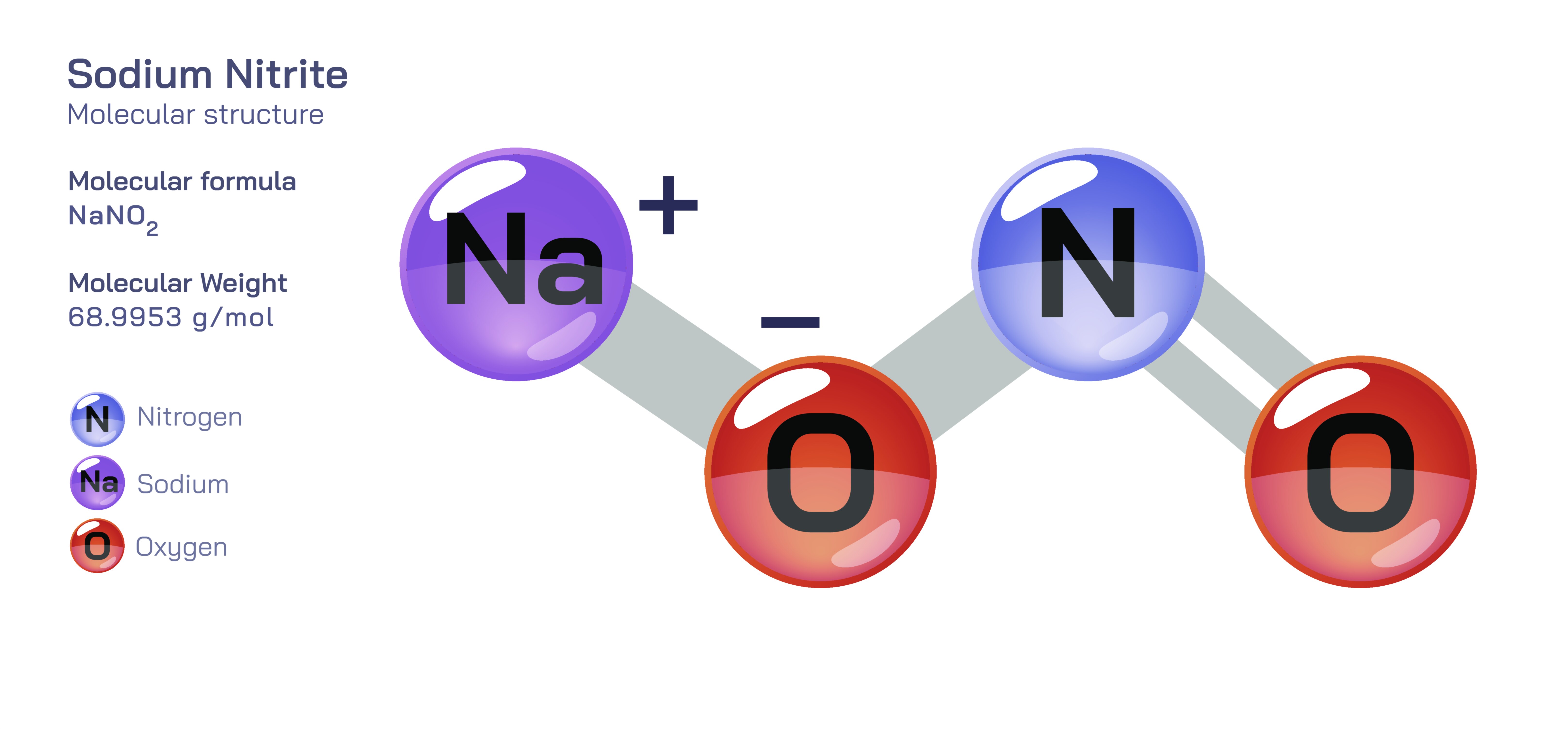
Sodium nitrite is an important inorganic compound that offers science students a valuable window into the relationship between molecular structure and chemical behavior. Known chemically as NaNO₂, it consists of sodium ions and nitrite ions arranged in a stable ionic lattice, yet the compound displays properties that go beyond simple ionic interaction. The structural and bonding features of the nitrite ion reveal fundamental concepts of resonance, hybridization, electron distribution, molecular geometry, and reactivity patterns that are central to modern chemistry. Sodium nitrite appears as a pale yellow to white crystalline solid that dissolves readily in water, forming a solution that behaves as a weak base and an effective reducing agent under many conditions. It is used widely in analytical chemistry, industrial synthesis, corrosion inhibition, pharmaceutical formulations, and food processing, but its most instructive value in an educational setting comes from the way its molecular arrangement connects to observable chemical reactivity. When students explore sodium nitrite, they are not simply memorizing a formula; they are learning how atomic arrangement affects electron distribution, how resonance contributes to molecular stability, how blended ionic and covalent traits affect functionality, and how structure-derived properties determine how the compound interacts with other substances in real environments.
The molecular foundations of sodium nitrite center on two distinct components: the sodium cation (Na⁺) and the nitrite anion (NO₂⁻). The sodium ion behaves as a classic alkali metal cation, losing one electron to achieve a stable noble gas configuration and interacting with surrounding negative ions primarily through electrostatic attraction. The nitrite ion, however, contains richer structural complexity because it is not simply a fixed arrangement of atoms but an example of resonance-stabilized bonding. The nitrite ion contains one nitrogen atom bonded to two oxygen atoms, and although students might initially picture this as a single nitrogen–oxygen double bond and a single nitrogen–oxygen single bond, experimental evidence shows that both N–O bonds are identical in length and strength. This observation can only be explained by resonance, meaning that the true structure of the ion is not one rigid arrangement but a hybrid of more than one valid electronic structure. In resonance depictions, one oxygen atom carries a negative charge while a double bond attaches to the other, but the real electron density is spread evenly across the ion. This delocalization lowers potential energy, making the molecule more stable than any single non-resonant structure could predict. Understanding the nitrite ion therefore helps students appreciate that Lewis structures are models rather than literal pictures, and that resonance provides a conceptual tool for representing electrons that are shared across more than one bond.
The geometry of the nitrite ion further reinforces how electron behavior directs molecular shape. Nitrogen in NO₂⁻ is surrounded by three electron domains: two bonding domains associated with the N–O bonds and one lone pair. As emphasized in lessons about VSEPR theory, the lone pair–bonding pair repulsions create a bent molecular shape rather than a straight line. The bond angle is reduced because the lone pair occupies proportionally more space than bonding pairs, pushing the oxygen atoms closer together. This geometric distortion is not merely a visual detail, but it is integral to understanding reactivity. Bent geometry combined with uneven charge distribution creates a molecular dipole, meaning the ion responds strongly to polar environments and interacts differently depending on solvent polarity, acidity, and electrostatic surroundings. The nitrite ion therefore becomes an excellent classroom example of how geometry, electron distribution, and polarity intersect to produce predictable chemical behavior.
When dissolved in water, sodium nitrite separates into free ions, but the nitrite ion participates actively in acid–base equilibria. NO₂⁻ behaves as a weak base because it can accept a proton from acidic solutions to form nitrous acid (HNO₂). Students studying acid–base chemistry learn that this behavior differs dramatically from the strong hydroxide-base behavior typically associated with alkali metal salts such as sodium hydroxide. The distinction is rooted entirely in structure: nitrous acid is weak because the protonated form maintains only partial stability before reverting to the ionic state, whereas strong bases rely on highly reactive hydroxide ions. This reversible proton transfer makes sodium nitrite a useful buffering agent and allows it to participate in pH-dependent reactions that are widely studied in analytical chemistry. In more advanced lessons on redox chemistry, sodium nitrite becomes an instructive example of a reducing agent. Under appropriate conditions — especially in acidic solutions — the nitrite ion can donate electrons to oxidizing agents and undergo conversion to nitrate or nitrogen-containing gases. This capacity to influence oxidation states helps students visualize how electron movement, not merely proton movement, governs chemical change.
One of the most academically useful reaction pathways connected to nitrite chemistry is diazotization, a process central to organic analysis and dye synthesis. In acidic solution, sodium nitrite produces nitrous acid, which in turn reacts with aromatic primary amines to form diazonium salts — highly reactive intermediates used to create azo dyes and complex aromatic compounds. The reaction demonstrates selectivity, temperature sensitivity, and the importance of complete control over pH, teaching students how reaction conditions shape chemical outcomes. This role in diazotization links a seemingly simple inorganic salt to entire branches of organic chemistry, showing that ionic compounds influence molecular transformations across disciplines.
Beyond theoretical and instructional importance, sodium nitrite has long been studied for its practical roles. In corrosion control, it protects steel and iron from rust by promoting the formation of a passivating oxide layer rather than destructive oxidation processes. This protective behavior illustrates the concept that not all redox reactions are unwanted; some are carefully engineered to enhance material longevity. In industry, sodium nitrite is used to synthesize rubber chemicals, pharmaceuticals, and dyes, demonstrating how versatile reactivity supports industrial innovation. In food preservation, sodium nitrite prevents the growth of harmful bacteria and contributes to the color and flavor of cured meats. These uses, however, are tightly regulated because excessive nitrite in food can participate in unwanted reactions forming nitrosamines under certain conditions. This safety dimension provides an ethical learning opportunity for students: the same structural and reactive traits that make a compound valuable can become dangerous if mismanaged. Chemistry education therefore includes not only knowledge of molecular structure but also awareness of how dose, exposure, and reaction environment shape risk.
Sodium nitrite also contributes to an understanding of how chemistry crosses from the atomic scale into ecological and environmental concerns. When introduced into water systems at high concentrations, nitrite can interfere with biological oxygen transport by converting hemoglobin into methemoglobin, reducing the ability of organisms to utilize oxygen effectively. This effect is especially studied in the context of aquatic life and infant health. Students examining such effects learn that the properties of compounds cannot be viewed in isolation but must be connected to the environments in which these compounds operate. Safe handling guidelines are based on understanding both chemical reactivity and biological impact — yet another example of how structural awareness supports responsible chemistry.
From an educational perspective, sodium nitrite offers a complete learning pathway. Students begin by studying the formula and ion composition, then progress to resonance and molecular geometry, followed by polarity and aqueous behavior, and finally arrive at acid–base chemistry, redox chemistry, and reactions used in organic synthesis. As they move through these topics, they discover that every observed property originates from structural features: the layout of atoms, the distribution of electrons, and the shape that results from those interactions. Safety and environmental considerations then complete the learning cycle by reinforcing that chemical knowledge is not only descriptive but also actionable, with real-world implications.
Sodium nitrite therefore stands as a valuable compound for science students because it links structural chemistry to practical reactivity, theoretical learning to industrial practice, and molecular understanding to biological and environmental responsibility. Even though the compound is simple in formula, it is rich in teaching relevance. It demonstrates how chemistry is not merely a collection of facts or names, but a system of connected principles that explain how matter behaves, reacts, and influences the world. By studying sodium nitrite carefully — from electron arrangement to industrial use — students build a conceptual foundation that supports deeper exploration of both inorganic and organic chemistry, and they gain appreciation for how chemical structure governs everything from reaction pathways to societal applications.