𝐒𝐨𝐝𝐢𝐮𝐦 𝐍𝐢𝐭𝐫𝐚𝐭𝐞 — 𝐌𝐨𝐥𝐞𝐜𝐮𝐥𝐚𝐫 𝐒𝐭𝐫𝐮𝐜𝐭𝐮𝐫𝐞, 𝐈𝐨𝐧𝐢𝐜 𝐁𝐨𝐧𝐝𝐢𝐧𝐠, 𝐍𝐢𝐭𝐫𝐚𝐭𝐞 𝐈𝐨𝐧 𝐁𝐞𝐡𝐚𝐯𝐢𝐨𝐮𝐫, 𝐑𝐞𝐚𝐜𝐭𝐢𝐯𝐢𝐭𝐲 𝐚𝐧𝐝 𝐄𝐝𝐮𝐜𝐚𝐭𝐢𝐨𝐧𝐚𝐥 𝐂𝐡𝐞𝐦𝐢𝐬𝐭𝐫𝐲 𝐒𝐮𝐦𝐦𝐚𝐫𝐲.
Sodium nitrate, chemically expressed as NaNO₃, is an inorganic ionic salt widely used in fertilizers, food curing, explosives, pyrotechnics and chemical synthesis. Though it appears outwardly as a white, crystalline solid that dissolves readily in water, the compound represents much more than its everyday applications. At the molecular scale, sodium nitrate reveals profound lessons in ionic bonding, resonance behaviour of polyatomic ions, oxidation states of nitrogen, electrolyte properties, thermal and redox reactivity and industrial nitrogen chemistry. Understanding its structure uncovers the basis of many natural and technological processes, from plant nutrient cycles to combustion reactions.
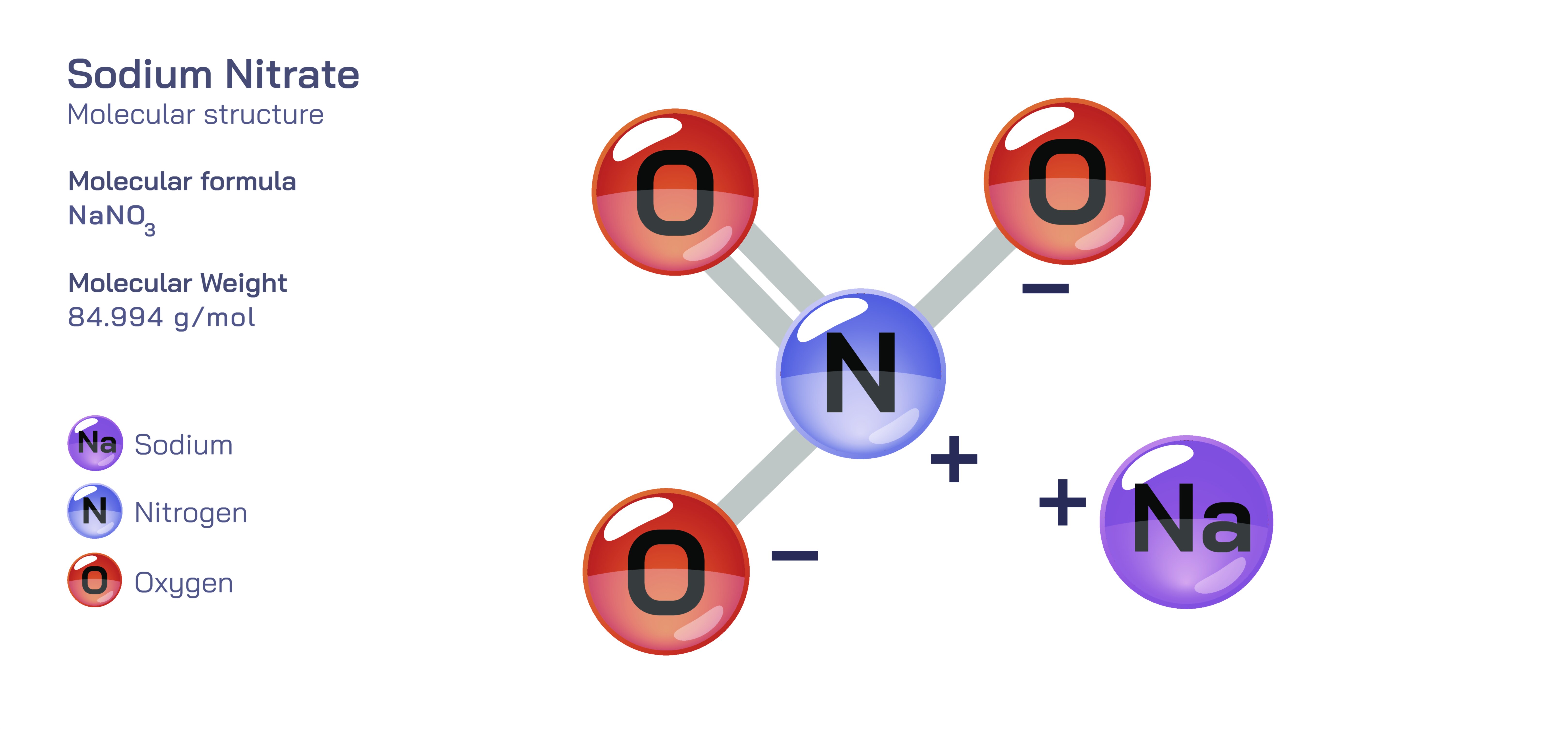
The identity of sodium nitrate originates from two ions of entirely different chemical personalities: the sodium cation (Na⁺) and the nitrate anion (NO₃⁻). Sodium, an alkali metal, possesses a single valence electron that it readily donates to achieve the stable electronic configuration of a noble gas. Once the electron is lost, the sodium atom becomes Na⁺ — a small, stable cation that seldom participates in redox or bonding chemistry beyond charge stabilization. Nitrogen inside the nitrate ion, however, exists in the +5 oxidation state, one of the highest for nitrogen. The nitrogen atom is covalently bonded to three oxygen atoms in a planar trigonal structure. Each N–O bond appears identical in length and energy because electrons are not confined to a single double bond; instead, resonance delocalizes electron density across all three oxygen atoms, making the nitrate ion highly stable and symmetric. This resonance is the foundation of nitrate’s chemical behaviour.
In the solid state, sodium and nitrate ions arrange themselves into an extended ionic lattice. This arrangement is not composed of discrete NaNO₃ molecules but a repeating three-dimensional network of alternating Na⁺ and NO₃⁻ ions. The electrostatic attraction between the positively charged sodium ions and the negatively charged nitrate ions gives the crystal its strength, rigidity, and definite geometric form. Because the lattice contains strong ionic forces, sodium nitrate has a relatively high melting point. Yet, because nitrate ions do not form directional covalent bonds with sodium, the structure breaks apart readily in water.
The moment sodium nitrate dissolves in water, the behaviour of the compound changes drastically. Water molecules hydrate each ion individually: partially negative oxygen ends of water orient toward sodium ions, while partially positive hydrogen ends orient toward the negatively charged oxygen-rich surface of nitrate ions. This hydration process overcomes lattice attraction and frees Na⁺ and NO₃⁻ into solution. In this state, sodium nitrate becomes a strong electrolyte, meaning it conducts electricity due to the mobility of ions. The resulting solution remains stable because the nitrate ion, with its resonance-stabilized structure, resists further hydrolysis or transformation under normal conditions. This behaviour provides an instructive model of electrolyte chemistry, showing how solubility and conductivity emerge from ionic dissociation.
The nitrate ion is the reactive centerpiece of sodium nitrate. Nitrogen in oxidation state +5 has a strong thermodynamic tendency to be reduced to lower oxidation states, especially to ammonia or nitrogen gas. For this reason, nitrate acts as an oxidizing agent in many chemical reactions. In pyrotechnics, refining, and combustion processes, nitrate enables rapid oxidation of fuel sources, releasing energy in the form of heat and light. These transformations illustrate fundamental redox chemistry: nitrate accepts electrons, while fuels donate them. Nitrate’s oxidizing power also explains why sodium nitrate is a key ingredient in black powder substitutes and solid rocket propellants — reactions are driven by electron exchange, not by mere mixing of chemicals.
In biological and agricultural chemistry, sodium nitrate highlights a different aspect of chemical behaviour. Plants require nitrogen to build proteins and nucleic acids, and nitrate is one of the most accessible nitrogen sources for plant roots. After dissolving in soil water, nitrate is transported through plant tissues and enzymatically reduced to ammonia and organic nitrogen compounds. Although sodium ions remain passive, the nitrate ion drives essential growth processes. When nitrate concentrations become excessive, however, environmental problems such as eutrophication arise because nitrate fuels explosive growth of algae, demonstrating that concentration and context determine chemical consequences.
In food chemistry, sodium nitrate transitions from a simple salt to a biological preservative. Inside cured meats, nitrate gradually converts to nitrite, which then interacts with haem pigments to stabilize colour and inhibit microbial growth. Nitrite’s antibacterial activity stems from oxidative interference with metabolic enzymes in bacteria. This pathway illustrates that the behaviour of sodium nitrate in living systems is not static — it depends on enzymatic reduction, oxygen availability and pH conditions. The scientific lesson is that the same nitrate ion that nourishes plants can, under different biochemical pathways, help preserve food.
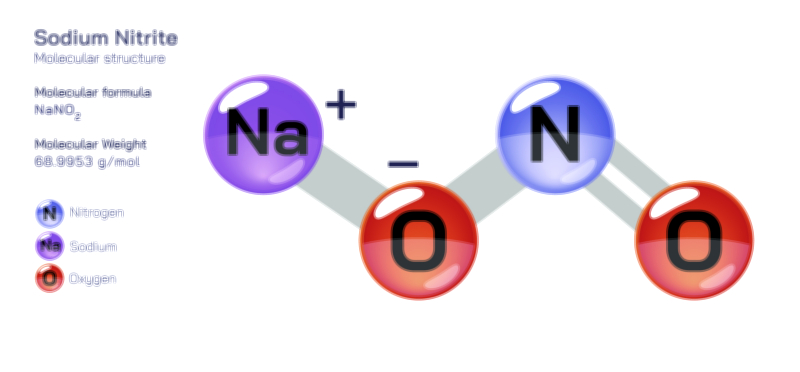
Thermally, sodium nitrate reveals additional structure–function relationships. When heated strongly, nitrate does not simply melt; it decomposes to sodium nitrite (NaNO₂) and oxygen gas (O₂). This decomposition makes sodium nitrate a crucial oxidizer in pyrotechnics and metallurgy because the released oxygen supports combustion even in the absence of atmospheric oxygen. At even higher temperatures or with reducing agents present, nitrate can convert to nitrogen oxides or nitrogen gas. These pathways emphasize that nitrate decomposition follows redox rules and electron-transfer energetics, not arbitrary breakdown.
Sodium nitrate is also a key compound in analytical and solution chemistry. In acid–base equilibria, nitrate behaves as the conjugate base of a strong acid (nitric acid, HNO₃) and therefore does not tend to accept protons in water. This means that nitrate solutions are neutral in pH, illustrating an important concept: the acidity or basicity of an ion depends on the strength of the acid from which it originated. Because nitrate ions do not undergo hydrolysis, they serve as inert counterions in titrations and buffer formulations.
From a materials science perspective, the mechanical and thermal stability of nitrate crystals originate from the uniform charge distribution over their planar triangular anions — a symmetry that allows tight packing with sodium ions and efficient heat transfer. This property explains why sodium nitrate has been explored in solar thermal energy storage, where molten nitrate salts absorb heat and later release it without decomposing rapidly.
Safety and environmental context also reinforce core principles of chemistry. Sodium nitrate is not toxic in the form of Na⁺ and NO₃⁻ alone, but large amounts can influence biological and ecological systems by altering nitrogen balance. The compound does not persist unchanged indefinitely because microbial and chemical processes convert nitrate to other nitrogen forms in soil and water. This nitrogen cycling — ammonification, nitrification and denitrification — is one of the largest chemical processes occurring naturally on Earth, powered entirely by electron transfer and oxidation-state changes in nitrogen.
From an educational viewpoint, sodium nitrate is a powerful teaching tool because its behaviour encompasses ionic bonding, resonance, oxidation states, electrolyte chemistry, solubility, thermal decomposition, agricultural chemistry, biological pathways and redox energetics. The sodium ion acts as a stabilizing spectator, while the nitrate ion dictates virtually all reactive behaviour. This division of roles demonstrates why the properties of a compound cannot be understood simply by its formula; the identity and electron behaviour of each ion must be considered.
Ultimately, sodium nitrate illustrates the fundamental law of chemistry: atomic structure and electron arrangement determine every property of matter. A single electron transferred from sodium to nitrogen-containing oxyanions creates a system that supports plant life, cures food, fuels fireworks, propels rockets and stores thermal energy. NaNO₃ is therefore not merely a fertilizer or oxidizer — it is a striking example of how molecular structure translates directly into observable behaviour across industry, technology and biology.