𝐒𝐨𝐝𝐢𝐮𝐦 𝐏𝐨𝐭𝐚𝐬𝐬𝐢𝐮𝐦 𝐓𝐚𝐫𝐭𝐫𝐚𝐭𝐞 — 𝐌𝐨𝐥𝐞𝐜𝐮𝐥𝐚𝐫 𝐒𝐭𝐫𝐮𝐜𝐭𝐮𝐫𝐞, 𝐈𝐨𝐧𝐢𝐜–𝐂𝐨𝐯𝐚𝐥𝐞𝐧𝐭 𝐁𝐨𝐧𝐝𝐢𝐧𝐠, 𝐒𝐭𝐞𝐫𝐞𝐨𝐜𝐡𝐞𝐦𝐢𝐬𝐭𝐫𝐲, 𝐇𝐲𝐝𝐫𝐚𝐭𝐢𝐨𝐧 𝐁𝐞𝐡𝐚𝐯𝐢𝐨𝐮𝐫, 𝐑𝐞𝐚𝐜𝐭𝐢𝐯𝐢𝐭𝐲 𝐚𝐧𝐝 𝐀𝐝𝐯𝐚𝐧𝐜𝐞𝐝 𝐂𝐡𝐞𝐦𝐢𝐬𝐭𝐫𝐲 𝐄𝐝𝐮𝐜𝐚𝐭𝐢𝐨𝐧𝐚𝐥 𝐒𝐮𝐦𝐦𝐚𝐫𝐲.
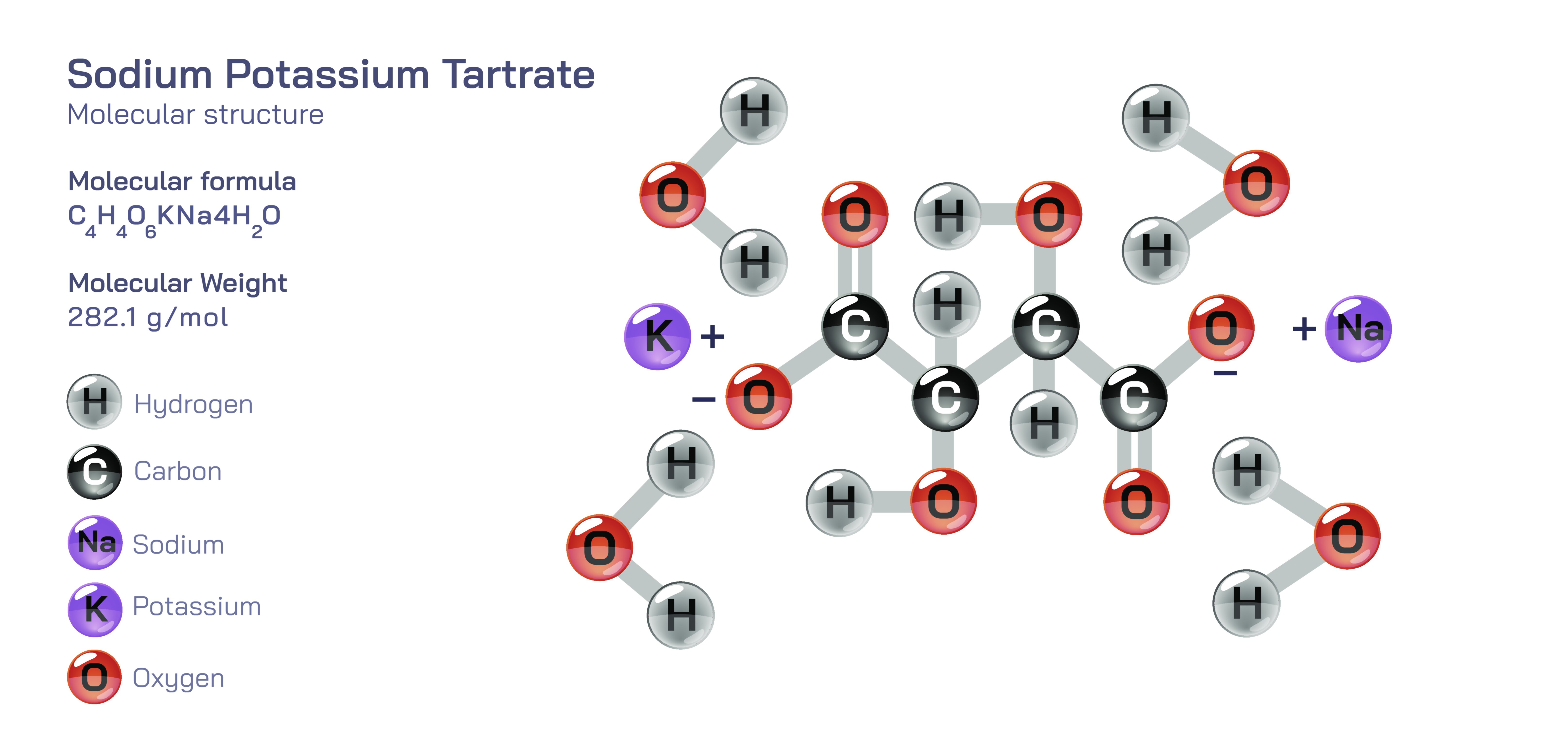
Sodium potassium tartrate, chemically represented as NaK(C₄H₄O₆)·4H₂O, is an extraordinary compound that bridges the worlds of organic and inorganic chemistry in a single molecular structure. Known historically as Rochelle salt, it has played crucial roles in crystallography, early electrochemistry, piezoelectric device development and analytical laboratory procedures. What makes sodium potassium tartrate so educationally significant is not only its practical applications, but the way its structure illustrates ionic bonding, covalent bonding, stereochemistry, hydration, chirality, coordination chemistry and intermolecular interactions all at once.
3. The structure of tartrate is uniquely important because the two hydroxyl groups on adjacent stereogenic carbons generate chirality. In its most common form, the tartrate anion exists as the L-(+)-enantiomer, meaning it is optically active and can rotate plane-polarized light. This aspect introduces a crucial chemical lesson: compounds containing sodium and potassium can still be chiral, demonstrating that chirality arises from spatial arrangement of atoms rather than from elemental composition.
The chemical connectivity inside the tartrate ion is entirely covalent, with strong C–C and C–O bonds defining its backbone. However, the carboxylate groups carry negative charges, delocalized over two oxygen atoms through resonance. These negative charges allow the tartrate anion to attract and coordinate with positively charged ions. In sodium potassium tartrate, the two cations Na⁺ and K⁺ balance the −2 charge of the tartrate ion. Sodium and potassium are spectator ions in terms of organic reactivity, but they provide the electrostatic foundation that allows the compound to exist as a solid. The tartrate ion does not form a double salt randomly; the ionic radii and hydration characteristics of Na⁺ and K⁺ match the coordination sites on the tartrate anion, allowing a stable crystalline salt rather than unconstrained mixtures of separate sodium tartrate and potassium tartrate.
The structure becomes even more intriguing when viewed in the solid crystalline state. Sodium potassium tartrate exists as a tetrahydrate, meaning four water molecules are incorporated into each formula unit. These water molecules are not loosely trapped but play a structural role by engaging in extensive hydrogen bonding between tartrate ions, as well as coordinating partially with sodium ions. The combination of ionic attraction between Na⁺/K⁺ and tartrate, covalent connectivity inside the tartrate, and hydrogen bonding through lattice water creates a highly ordered crystalline structure. This arrangement reveals the powerful lesson that water can act as an architectural component in solids, not merely a solvent.
One of the most fascinating macroscopic consequences of its microscopic structure is the compound’s piezoelectric property. When a crystal of sodium potassium tartrate is mechanically deformed—compressed, stretched or twisted—it produces an electrical charge across its faces. This phenomenon occurs because the crystal lattice contains asymmetrically arranged ions and dipoles, and mechanical stress causes changes in charge distribution. Conversely, applying an electric field to the crystal causes it to deform. These properties were central to early developments in radio transmitters, sonar, microphones and scientific instrumentation. The piezoelectricity of sodium potassium tartrate demonstrates the deep chemical principle that electrostatic arrangement within a solid can translate into measurable electrical behaviour without electron flow or chemical reaction.
In aqueous solution, sodium potassium tartrate dissociates into Na⁺, K⁺ and tartrate ions. Sodium and potassium ions remain hydrated without chemical transformation, but the tartrate ion participates in several important equilibrium processes. Because tartrate retains both hydroxyl and carboxylate groups, it can function as a weak base and a weak acid depending on pH. In strongly acidic solution, tartrate becomes protonated to regenerate tartaric acid; in strongly basic solution, the hydroxyl groups can deprotonate. This behaviour shows that organic ions can display multilevel acid–base chemistry, demonstrating the continuum between organic and inorganic acid–base systems.
Sodium potassium tartrate plays an especially memorable role in analytical chemistry due to its ability to act as a complexing agent for metal ions. The tartrate ion contains oxygen atoms with lone pairs that can bind to metal cations such as Cu²⁺, preventing precipitation of metal hydroxides in alkaline solutions. This property is used in Fehling’s solution, a classical test for aldehydes in carbohydrate chemistry. Tartrate stabilizes the copper (II) complex in a basic solution, enabling the controlled reduction of Cu²⁺ to Cu₂O by aldehydes. Here, the compound illustrates redox chemistry, complex ion formation and stereochemistry influence on reactivity, all through one laboratory experiment.
Its behaviour on heating also reveals the link between molecular architecture and thermal stability. When heated strongly, sodium potassium tartrate decomposes, losing water of crystallization and eventually breaking down into carbonates of sodium and potassium. Unlike simple inorganic salts, its decomposition does not occur in a single step because covalent and ionic components respond differently to heat. This reinforces the concept that compounds containing both organic and inorganic features can undergo staged decomposition, reflecting the layered bonding responsible for their structure.
In biological chemistry, tartrates—including sodium potassium tartrate—provide insight into chiral metabolism and stereoselective biochemical pathways. Enzymes in living organisms often recognize only one enantiomer of tartrate, reinforcing the insight that chirality governs interactions between biomolecules. Although sodium potassium tartrate itself is not commonly used biologically, the behaviour of its tartrate ion mirrors that of many biologically significant hydroxy-dicarboxylate molecules.
From an industrial perspective, sodium potassium tartrate has been used in electroplating, photography, textile processing, pharmaceutical formulations and food chemistry, especially due to its ability to bind metal ions, regulate pH and contribute to solution stability. Its versatility underscores that a compound’s usefulness is rooted not only in reactivity but in its ability to coordinate, dissolve, buffer and stabilize.
Educationally, sodium potassium tartrate is a rare and rich example because it unites multiple fundamental chemical concepts in one structure:
ionic bonding between Na⁺/K⁺ and the tartrate ion,
covalent bonding within the tartrate backbone,
chirality and optical activity,
hydration and hydrogen bonding in crystalline solids,
acid–base equilibria in aqueous solution,
ligand and complex-forming ability,
piezoelectric effects arising from lattice asymmetry.
Ultimately, sodium potassium tartrate demonstrates one of the most important ideas of chemistry: compounds do not behave according to a single bonding type or rule — their properties reflect the interplay of all forces acting at once. A single molecule can contain covalent bonds, ionic interactions, hydrogen bonds, resonance stabilization, stereochemistry, hydration and long-range lattice order. Through this compound, chemistry reveals itself as a unified science in which electrons, geometry and intermolecular forces determine not only microscopic structure but also the macroscopic behaviours that shape technology, biology and materials science.