𝐒𝐨𝐝𝐢𝐮𝐦 𝐂𝐡𝐥𝐨𝐫𝐢𝐝𝐞 — 𝐌𝐨𝐥𝐞𝐜𝐮𝐥𝐚𝐫 𝐒𝐭𝐫𝐮𝐜𝐭𝐮𝐫𝐞, 𝐈𝐨𝐧𝐢𝐜 𝐁𝐨𝐧𝐝𝐢𝐧𝐠, 𝐂𝐡𝐞𝐦𝐢𝐜𝐚𝐥 𝐁𝐞𝐡𝐚𝐯𝐢𝐨𝐮𝐫 𝐚𝐧𝐝 𝐃𝐞𝐞𝐩 𝐄𝐝𝐮𝐜𝐚𝐭𝐢𝐨𝐧𝐚𝐥 𝐒𝐮𝐦𝐦𝐚𝐫𝐲.
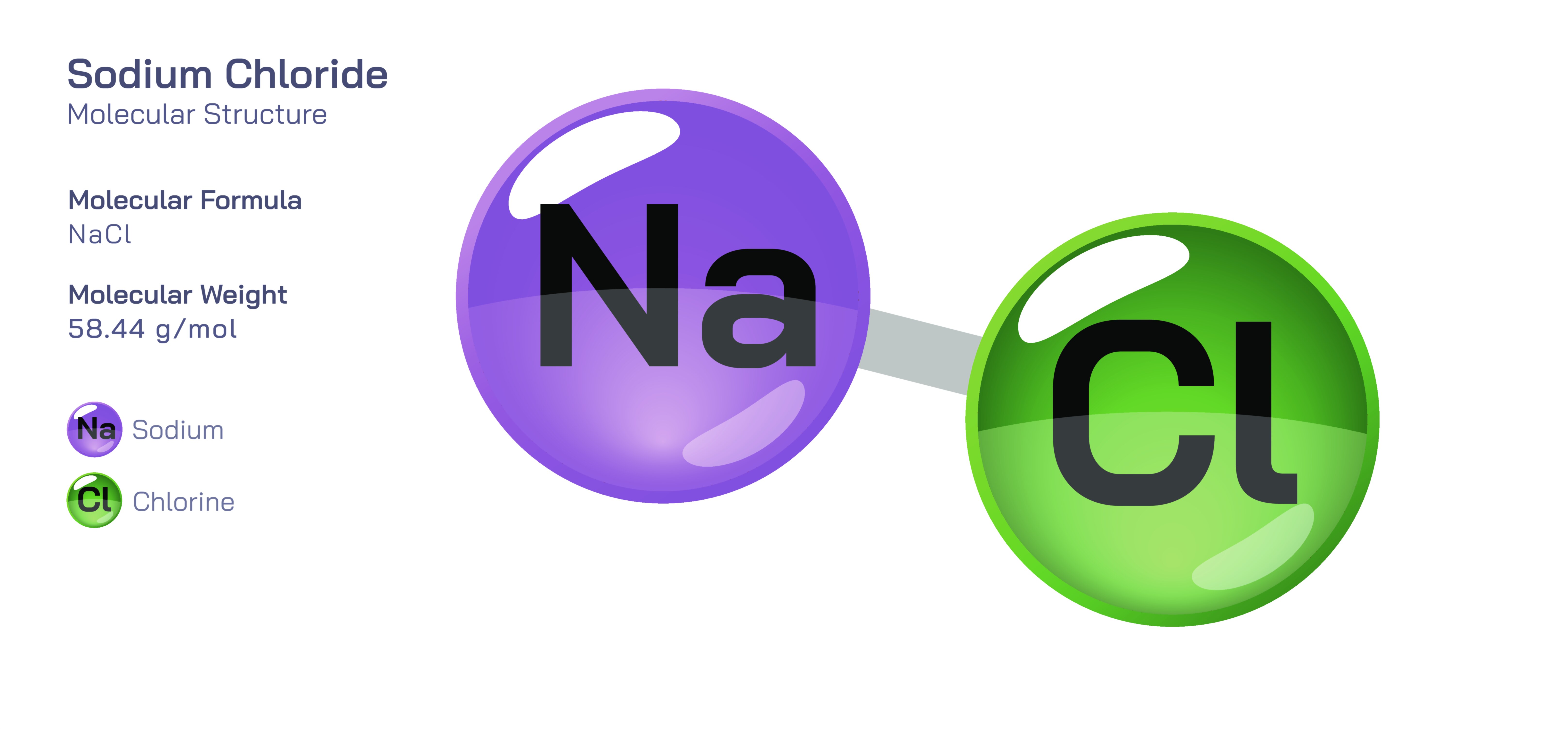
Sodium chloride, commonly known as table salt and expressed chemically as NaCl, is one of the simplest and most familiar inorganic compounds, yet beneath its ordinary appearance lies a powerful demonstration of atomic structure, ionic bonding and solution chemistry that makes it foundational in the study of chemistry. Sodium chloride demonstrates how the transfer of electrons between atoms drives chemical stability, how ions assemble into extended crystal lattices, how solids behave differently from solutions and how the microscopic world of atoms governs the macroscopic properties of matter. Because of these relationships, NaCl serves as a doorway into deeper chemical understanding not only in laboratories but throughout daily life.
At the atomic level, sodium chloride is formed when a sodium atom and a chlorine atom interact. Sodium belongs to Group 1 of the periodic table and has one valence electron in its outermost shell. This single electron is loosely held and easily lost because removing it allows sodium to achieve the stable electron configuration of neon. Chlorine, a halogen in Group 17, has seven valence electrons and is one electron short of a full octet. When sodium and chlorine encounter each other under reactive conditions, sodium transfers its outer electron to chlorine. This transfer is not a sharing of electrons, as occurs in covalent bonds, but a complete exchange that produces two ions: a positively charged sodium ion (Na⁺) and a negatively charged chloride ion (Cl⁻). This electron transfer demonstrates one of the most important principles in chemistry—atoms change into ions when doing so gives them greater electronic stability.
Once Na⁺ and Cl⁻ ions form, an electrostatic attraction arises between them. Unlike covalent molecules, sodium chloride does not exist as small, independent NaCl units. Instead, in the solid state, each sodium ion is surrounded by six chloride ions and each chloride ion is surrounded by six sodium ions in a symmetrical three-dimensional repeating array. This arrangement is called a face-centred cubic lattice. The ions pack in a way that maximizes attraction between opposite charges and minimizes repulsion between like charges. The result is a stable crystalline solid in which no single NaCl “molecule” exists; rather, the entire structure is one interconnected ionic lattice. This lattice structure explains many physical properties—high melting point, brittleness, rigidity and crystalline appearance—because breaking the solid requires overcoming strong ionic attractions throughout the entire network.
Because sodium chloride is such a strong ionic solid, its behaviour changes dramatically when placed in water. Water molecules disrupt the ionic lattice by surrounding individual ions during dissolution. Oxygen atoms of water, carrying partial negative charge, orient themselves around sodium ions, while hydrogen atoms of water, carrying partial positive charge, surround chloride ions. This hydration process pulls ions away from the crystal lattice and keeps them separated in solution. Because ions become freely mobile in this state, aqueous NaCl solutions conduct electricity, whereas solid NaCl does not. This clear difference between solid and dissolved salt illustrates the concept of electrolytes—substances that release ions in solution and enable electrical conduction. It is a powerful example of how chemical structure defines phase-dependent behaviour.
The chloride ion plays a leading role in many reactions, while the sodium ion plays a much more passive role. Sodium ions tend to remain spectators in chemical reactions because they have already achieved a highly stable electron configuration and show little tendency to gain or lose electrons. Chloride ions, however, are electrophilic and nucleophilic depending on conditions. In precipitation reactions, chloride readily forms insoluble salts such as silver chloride (AgCl) when treated with solutions of silver ions, generating a white curdy precipitate that is used as a qualitative test for chloride. This behaviour reflects a hierarchy of ionic lattice stability, where certain combinations—like Ag⁺ and Cl⁻—create stronger ionic assemblies than Na⁺ and Cl⁻. Chloride also participates in substitution reactions in organic chemistry and interacts biologically with proteins and enzymes, showing that the reactivity of NaCl in many contexts depends on chloride rather than sodium.
Sodium chloride is not only a chemical substance but a biological necessity. Both Na⁺ and Cl⁻ play vital roles in the physiology of living organisms. Sodium ions regulate nerve impulse conduction, muscle contraction and water balance in cells, while chloride ions are crucial for maintaining osmotic pressure and producing hydrochloric acid in the stomach for digestion. These biological functions arise from the behaviour of ions in solution, once again showing that the microscopic ability of sodium chloride to dissociate in water has enormous macroscopic consequences for life. The narrow range in which sodium and chloride concentrations must be maintained in the bloodstream demonstrates that chemistry does not exist only in laboratory settings—human survival depends on ion balance.
In industrial and environmental contexts, sodium chloride is equally important. It is used to de-ice roads, preserve food, soften water, manufacture chemicals and transport heat in salt-based molten systems. The role of sodium chloride in water softening illustrates ionic exchange: hard-water minerals such as calcium and magnesium replace sodium ions on ion-exchange resins, removing hardness from the water supply. In the chlor-alkali industry, sodium chloride is the starting material for producing chlorine gas, sodium hydroxide and hydrogen through electrolysis. During this process, chloride ions are oxidized at the anode to release chlorine gas, while sodium ions migrate to the cathode region to form sodium hydroxide after reaction with water. This process marks one of the largest chemical industrial systems in the world and once again shows how the behaviour of ions—particularly the chloride ion—drives major technological applications.
Thermally, sodium chloride is extremely stable because the ionic lattice requires high temperatures to disrupt. Unlike many compounds that decompose chemically upon heating, NaCl melts without changing composition. When molten, sodium chloride still contains Na⁺ and Cl⁻ ions, but they are now mobile rather than locked in place. This molten ionic state conducts electricity even more strongly than aqueous solution and serves as an electrolyte in metallurgy, including the extraction of reactive metals such as sodium and magnesium.
Although sodium chloride is safe in moderation, its effects depend on concentration and context. Excessive consumption may contribute to hypertension in humans not because sodium chloride is chemically harmful but because ionic balance influences fluid retention and vascular pressure. Similarly, high concentrations in soils or water sources can damage plant and aquatic life because osmotic imbalance affects cells. These effects are physiological rather than chemical hazards and reinforce the principle that chemistry interacts with biological systems through ion concentration.
In its broadest educational value, sodium chloride teaches several core ideas of chemistry simultaneously: ionic bonding through electron transfer, lattice formation in solids, dissociation in water, electrolyte physics, spectator and active ion behaviour, biological regulation of ions and large-scale industrial electrochemistry. Every property of NaCl—from crystal formation to biological necessity to industrial relevance—originates from the atomic structure of sodium and chlorine and their transformation into ions.
Thus, sodium chloride is not merely a household seasoning or a laboratory reagent. It is a model compound that illustrates how the microscopic world of electrons and ions dictates the visible behaviour of materials. By studying NaCl, one learns that chemistry is not only about substances but about the deeper connections between atomic structure, bonding and the properties that shape matter, life and technology across the world.