𝐏𝐨𝐥𝐲𝐬𝐭𝐲𝐫𝐞𝐧𝐞 𝐌𝐚𝐭𝐞𝐫𝐢𝐚𝐥 𝐒𝐭𝐫𝐮𝐜𝐭𝐮𝐫𝐞 𝐚𝐧𝐝 𝐔𝐬𝐞𝐬
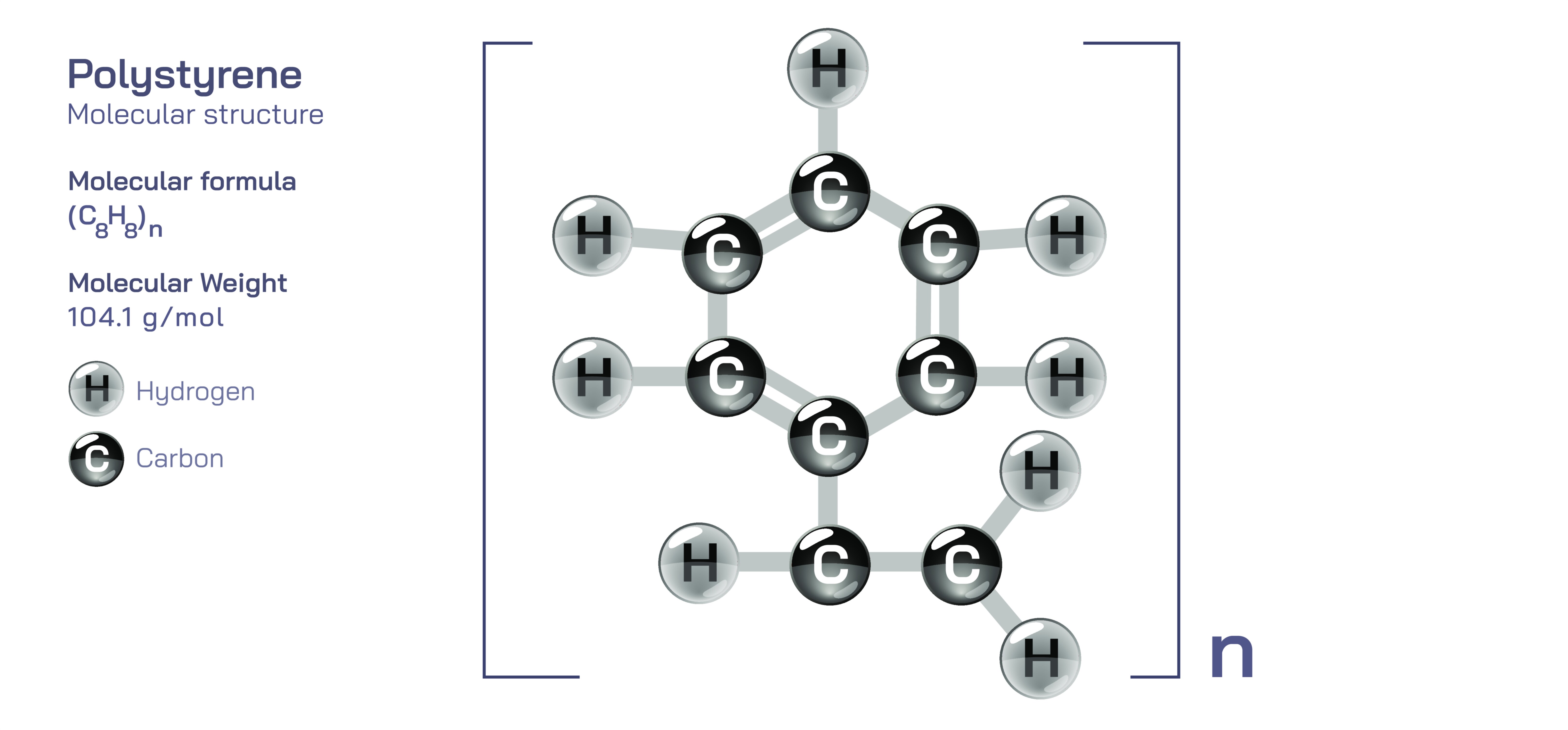
Polystyrene is one of the most recognizable and widely used synthetic polymer materials in the modern world, and its popularity is rooted in its versatile structure, its ability to take multiple forms, its ease of manufacturing, and its wide range of mechanical and thermal properties. At the molecular level, polystyrene belongs to the class of thermoplastic polymers, meaning that it softens and melts when heated and solidifies when cooled, allowing it to be reshaped during processing. The fundamental structure of polystyrene is based on long repeating chains of styrene monomers, which link together through a process called polymerization. Each styrene unit consists of a hydrocarbon backbone with a phenyl (benzene ring) group attached to it, and this structural feature strongly influences the material’s behaviour. The benzene ring makes the polymer chains stiff and highly rigid while also giving polystyrene its characteristic transparency and resistance to moisture. Although chemically simple in structure, polystyrene can exist in multiple forms, including solid, expanded, and extruded versions, each tailored to specific industrial and consumer applications. The adaptability of its structure is the reason polystyrene occupies such an important place in packaging, electronics, construction, medical sectors, and everyday products.
When discussing polystyrene at a structural level, it becomes clear that its properties depend heavily on how the polymer chains are arranged. The simplest and most common form is general-purpose polystyrene, known for its clarity, hardness, and brittleness. Because the chains remain rigid instead of sliding smoothly past each other, general-purpose polystyrene does not offer high impact strength but provides excellent dimensional stability. Increasing the toughness of this material led to the development of high-impact polystyrene, a modified version strengthened by adding rubber particles that absorb energy and prevent brittle cracking. The rubber particles become embedded throughout the polymer matrix like small cushions that distribute mechanical stress, transforming an originally fragile material into one suitable for physical handling and demanding applications. Another structural transformation involves the expansion of polystyrene using blowing agents that trap gas within the polymer, creating a lightweight foam filled with tiny sealed cells. Expanded polystyrene is known for its exceptional thermal insulation, cushioning properties, and resistance to water absorption, making it especially valuable for packaging and building applications. Extruded polystyrene forms when the foamed material is manufactured under pressure to produce a denser, more uniform structure with higher moisture resistance and compressive strength. These variations illustrate how tuning the internal structure of polystyrene results in dramatically different behaviours without needing a completely new chemical formula.
The widespread use of polystyrene stems from the flexibility offered by its multiple structural forms. In its solid transparent state, polystyrene is commonly used in laboratory equipment, cosmetic packaging, CD and DVD cases, disposable cutlery, refrigerator components, toys, and various household goods. Its ability to take a high-quality glossy finish and maintain tight dimensional tolerances allows it to be moulded into precise, attractive designs. High-impact polystyrene appears in products that require additional toughness such as appliance housings, packaging inserts, food trays, computer casings, printer bodies, educational models, and display units. Its durable yet low-cost nature makes it a preferred material for mass manufacturing in the consumer goods sector. Expanded polystyrene is indispensable in cushioning applications because it absorbs impact and protects fragile objects during transport, leading to its dominant use in packaging electronics, home appliances, glass products, and sensitive instruments. The same thermal insulation qualities also make expanded polystyrene essential for cold storage boxes, refrigeration panels, transportation of vaccines and perishable food items, and even architectural insulation in walls and roofs. Extruded polystyrene, being stronger and more moisture resistant than expanded foam, is widely used in construction as insulation boards, underfloor protection, foundation insulation, and structural insulation panels. The diversity of uses across industries highlights polystyrene’s role not simply as a plastic but as a strategic engineering material.
One of the most unique strengths of polystyrene lies in its ability to balance lightweight nature with structural functionality. Foam forms of polystyrene provide shock absorption and insulation through air trapped inside the polymer matrix, rather than relying purely on bulk material. This makes it highly efficient in providing strength without added weight, a vital advantage in logistics, building materials, and thermal management. In the medical field, polystyrene supports sterile and disposable applications, where contamination risks must be minimized. Test tubes, culture dishes, Petri plates, pipette reservoirs, and microplates are often made of polystyrene due to its exceptional clarity, biological compatibility, and ease of sterilization through radiation. Polystyrene also plays an important role in food industry packaging through containers, trays, cups, and lids that are lightweight, cost-efficient, and resistant to moisture and bacterial growth. Even though foam cups and containers have faced scrutiny in environmental discussions, they remain widely used in temperature-sensitive applications due to their excellent insulating capability compared to many alternatives.
Beyond consumer products and packaging, polystyrene has significance in science, technology, and construction. In physics and optical experiments, crystal-clear polystyrene provides an excellent medium for light transmission and spectroscopy. In civil engineering, polystyrene blocks are increasingly used for geotechnical lightweight fill, especially in roads and embankments where weight reduction is crucial. Large prefabricated blocks serve to stabilize soil and reduce settlement, offering long-term structural integrity without burdening the foundation. In the creative and design industries, polystyrene foam is easy to cut, carve, and shape, allowing artists and set designers to create sculptures, architectural models, exhibition displays, and theatre props. Its compatibility with adhesives, fillers, and surface coatings enables smooth finishing and painting, making it an economical material for prototyping. Even aquaculture and marine industries use polystyrene foam for flotation devices, life buoys, fish boxes, and floating structures because of its buoyancy and long-lasting water resistance.
Despite all these advantages, awareness of environmental responsibility has become an important aspect of using polystyrene. Being lightweight and durable means polystyrene persists in the environment if not collected or recycled properly. While the material is technically recyclable, not every region has the infrastructure to handle foam forms due to the volume they occupy relative to their mass. This has led to continued innovation to address environmental concerns, including the development of biodegradable additives, improved recycling methods, densification technologies, chemical depolymerization back to styrene monomer, and alternative packaging systems that maintain performance while supporting sustainability. Awareness of responsible handling and disposal complements its industrial importance, ensuring that a material with immense value continues to contribute positively without causing unnecessary ecological burden.
The structural simplicity of polystyrene—long repeating styrene chains with aromatic rings—has given rise to a material that can appear solid and transparent, tough and impact resistant, airy and foam-like, or dense and rigid depending on how it is processed. Its usefulness is a direct consequence of how polymer science transforms fundamental molecular structure into practical engineering properties. From laboratories to supermarkets, from foam packaging to insulation panels, from medical trays to electronics housings, polystyrene surrounds daily life in many subtle and obvious ways. Its evolution continues as manufacturers explore ways to improve performance, reduce environmental impact, and expand applications through advanced composites and recycling technologies. The story of polystyrene is therefore not simply one of a plastic material but one of how chemistry, engineering, design, and sustainability intersect to shape modern lifestyles and industrial progress.