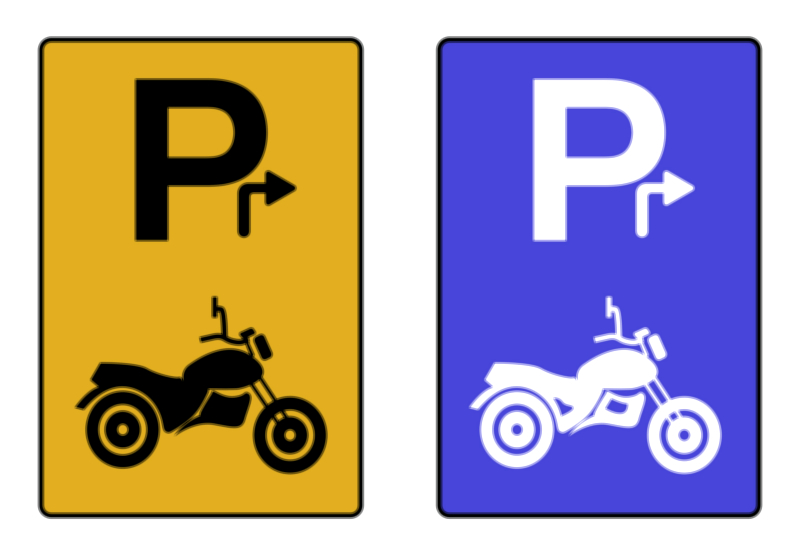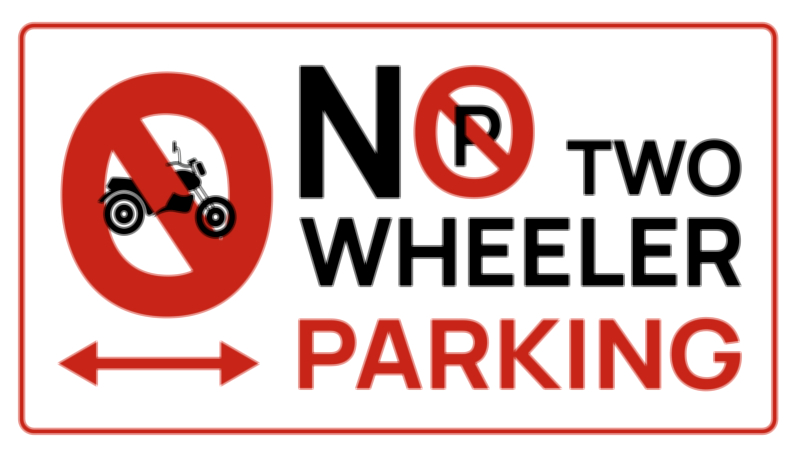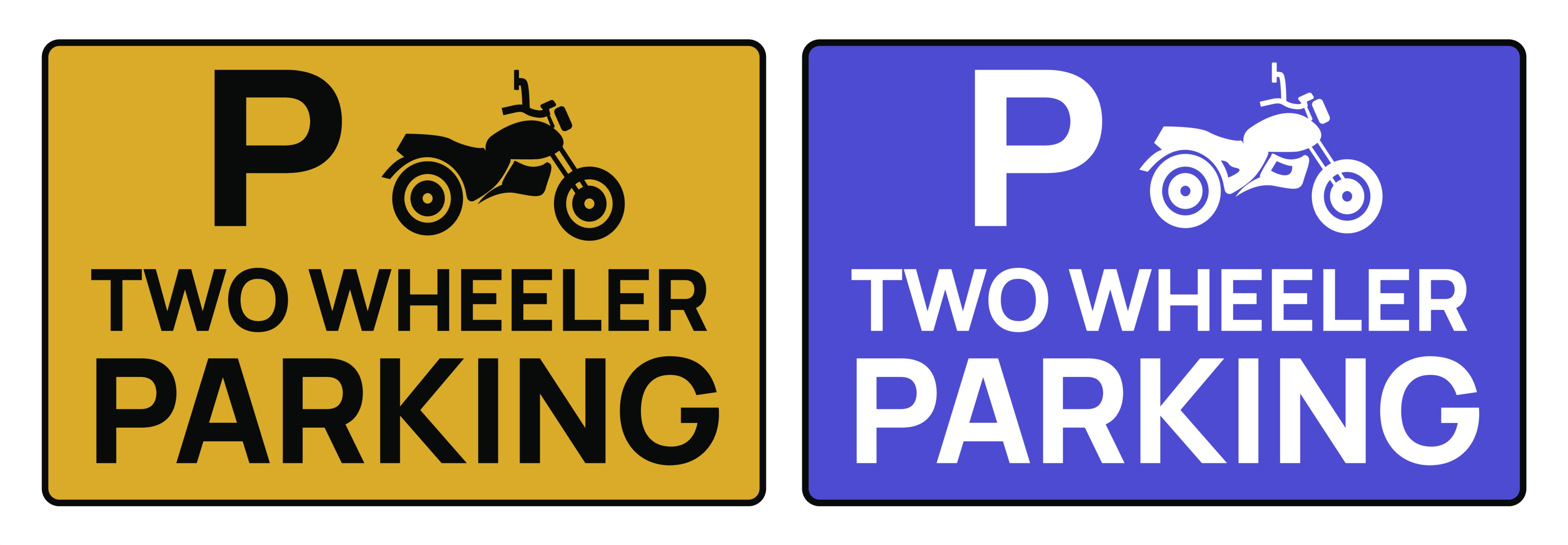
Two Wheeler Parking Lot — Bike and Scooter Parking Area Sign
A Two Wheeler Parking Lot sign may appear visually simple in a vector illustration, typically showing a bold “P” symbol alongside the clear silhouette of a bike or scooter, but its purpose reaches deep into the organization of traffic movement, pedestrian safety, accessibility, commercial flow, and everyday urban convenience. In cities where motorcycles and scooters make up a significant share of daily transportation, the need to cluster them into dedicated, well-planned parking areas is essential. Without that clarity, riders tend to choose parking based on personal convenience rather than environmental suitability, leading to congestion around building entrances, sidewalks, shop fronts, school gates, transit hubs, and hospital access points. A properly designed Two Wheeler Parking Lot sign ensures that riders do not have to guess where parking is permitted; the symbol communicates instantly that this specific zone has been intentionally allocated to two-wheelers and can fully accommodate their presence without obstructing movement or compromising comfort or safety for other users.
The sign gains even more importance when considered in terms of pedestrian experience. Although two-wheelers occupy less space than cars, their compact size can make them more invasive when parked at the edges of footpaths, ramps, building doorways, or narrow roads because pedestrians are forced into vehicle lanes to bypass the block. Children crossing the street from behind parked scooters become harder for drivers to see. Senior citizens and pregnant women lose the protected boundaries designed for their safe passage. People carrying bags, pushing strollers, or walking with limited balance are forced into uncomfortable and risky detours just to get around motorcycles left too close to entrances. A two-wheeler parking lot sign eliminates this hazard by drawing bikes and scooters away from these walking-priority spaces and into controlled parking areas. This not only restores safety for those on foot, but also preserves the stress-free, welcoming experience that building entrances are designed to provide.
Commercial environments also depend heavily on the placement of this sign. Businesses rely on foot traffic and entrance visibility, yet many storefronts become partially blocked when bikes and scooters cluster directly outside doors—an understandable but harmful consequence of riders seeking quick access. Customers are discouraged when they must step around vehicles to enter a shop, and businesses lose valuable display frontage when two-wheelers block the view of products or signage. A clearly marked Two Wheeler Parking Lot supports both commerce and rider convenience: vehicles remain close enough for quick shopping access, while entrances remain unobstructed for customers on foot. Delivery workers can also locate a predictable parking space without disrupting store operations or blocking loading zones, improving overall business efficiency.
Accessibility adds another crucial dimension to why this sign matters. Inclusive design principles ensure that ramps, tactile pathways, wide approach areas, and curb-cut entries support the dignity and independence of wheelchair users, visually impaired pedestrians, elderly individuals, and others who rely on barrier-free movement. A bike parked even briefly across a ramp or tactile line can make an access point totally unusable for someone with mobility challenges. A Two Wheeler Parking Lot sign prevents such intrusions, not by limiting convenience for riders, but by providing a designated alternative that removes the temptation to occupy sensitive access points. The sign thus becomes a passive but powerful defender of equal access.
Emergency readiness is another invisible function supported by this sign. Hospital entrances, fire hydrant access, ambulance bays, disaster-evacuation routes, and rescue access points must remain unobstructed at all times. Though two-wheelers are smaller than cars, their presence across these zones can delay critical equipment, oxygen cylinders, stretchers, and emergency responders. Every second lost because a vehicle is blocking a medical entrance carries serious consequences. A Two Wheeler Parking Lot sign reduces the likelihood that riders will gather in locations that interfere with life-saving operations. It nudges parking into safer zones so that essential spaces stay clear even during heavy public activity.
On a broader urban-planning scale, the sign improves the predictability of how vehicles behave on the road. Riders searching for unmarked parking create abrupt lane shifts, sudden stops, and unpredictable weaving—conditions that increase crash risk. Clearly designated parking lots absorb this uncertainty, guiding two-wheelers toward a known stopping point long before the rider reaches their destination. As a result, road behavior becomes calmer, more consistent, and more fuel-efficient, reducing idling, circling, congestion, and noise pollution. A single sign can therefore shape the tone of entire street segments, turning disordered movement into structure.
Today’s smart-mobility systems also rely on such signage. Navigation apps, delivery platforms, and mobility-service tools now map dedicated two-wheeler parking zones so riders can be guided in advance to legal stopping locations. Shared scooter services and electric-fleet operators use these zones to store, charge, and arrange vehicles without spilling into pedestrian walkways. Digital enforcement systems recognize the vector version of the symbol when monitoring compliance. The clean, scalable geometry of the illustration ensures that both humans and software interpret the sign instantly, transforming it into a visual and functional bridge between physical and digital mobility.
On a social and cultural level, the Two Wheeler Parking Lot sign represents a shared agreement that public space works best when everyone respects each other’s needs. When a rider chooses to follow the sign rather than stop at the nearest convenient corner, they contribute to a system that protects children, elderly pedestrians, emergency workers, shoppers, business owners, transit users, and fellow motorists. They help maintain a comfortable and safe environment for strangers who may never know that their well-being depended on the responsibility of one person who decided to park where the sign indicated rather than where it was easiest.
Ultimately, the vector illustration of the Two Wheeler Parking Lot — Bike and Scooter Parking Area Sign contains within its clean lines a complete philosophy of urban life. It guides riders toward a space that has been curated for them while safeguarding the visibility of storefronts, the walkability of sidewalks, the accessibility of ramps, the efficiency of deliveries, the readiness of emergency teams, and the safety of every person who moves through public space. Though the sign may contain nothing more than a “P” and a scooter silhouette, it plays a powerful role in transforming busy streets from chaotic improvisation into predictable structure—ensuring that mobility benefits everyone, not just the person parking the vehicle.