Three Wheeler or Auto Parking Lot — Designated Vehicle Parking Area Sign
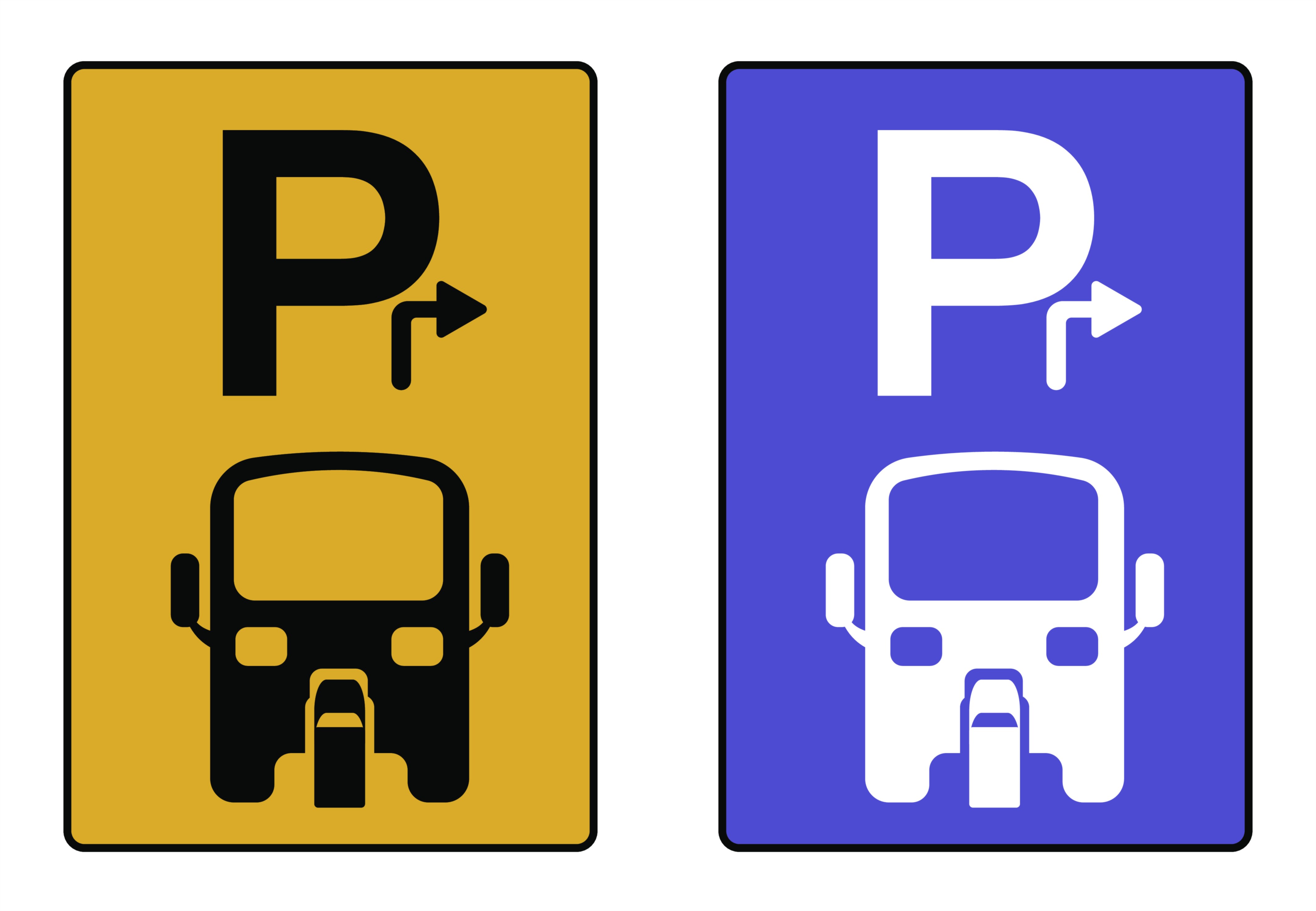
A Three Wheeler or Auto Parking Lot sign represents far more than a simple instructional marker directing drivers of auto-rickshaws, tuk-tuks, and three-wheel cargo or passenger vehicles where to leave their vehicles. In the language of organized public space, this sign is a powerful and intentional component of traffic planning, access management, and urban mobility design. In a vector illustration format, the symbol typically features a clean and recognizable icon of a three-wheeler enclosed within a defined parking graphic, often accompanied by a bold “P” or a framed space that visually identifies the area as reserved for this specific type of vehicle. While the icon looks straightforward, the placement and purpose of this sign come from detailed study of how clustered informal parking behaviors affect safety, walkability, logistics, and city flow. Its primary message is that three-wheelers are not merely allowed to park at this location, but that this location is specifically designed to accommodate their size, maneuvering characteristics, boarding behavior, commercial function, and load-carrying needs in a way that protects surrounding traffic and pedestrian zones from disruption.
The importance of this sign becomes clear when one considers how three-wheelers operate in urban environments. Auto-rickshaws and tuk-tuks are highly mobile, frequently used for short-distance transport, quick drop-offs, pickup services near markets, railway stations, schools, hospitals, bus stops, and busy commercial clusters. Their operational behavior naturally encourages short waiting periods between trips, which can turn into informal parking when multiple drivers congregate at strategic boarding centers. Without designated parking spaces, three-wheelers tend to occupy entrances, sidewalks, curb edges, building fronts, and circulation spaces that were never meant to serve as casual holding areas. This causes disruptions that ripple quickly into neighboring traffic: pedestrian pathways become blocked, crossing visibility weakens, bus stops become cluttered, building entrances fill with waiting vehicles, and cyclists are pushed unpredictably into moving lanes. The Three Wheeler or Auto Parking Lot sign prevents these problems not by discouraging the parking of three-wheelers but by guiding them to a planned parking cluster where their presence adds order instead of disarray, and where their commercial convenience does not come at the cost of public safety or traffic flow.
The placement of this sign is the result of traffic engineering rather than convenience. Authorities identify specific locations where a three-wheeler parking lot supports safety and movement rather than obstructing it. That location might be adjacent to a market exit but away from the primary pedestrian corridor, close to a transit station but off the main approach road, near a school but positioned so that children are not placed between vehicles and active traffic, or near a hospital but separated from ambulance landing zones. In all such cases, the parking lot sign clarifies the spatial balance between allowing three-wheelers to operate efficiently and keeping pedestrian zones, emergency pathways, and travel lanes free from friction. When drivers follow this signage, passengers get consistent pickup points, pedestrians regain safe sidewalks and building entrances, and three-wheeler traffic no longer spills unpredictably into areas where visibility and safety depend on open space. The sign therefore becomes a foundation of harmonious coexistence between commercial mobility and public comfort.
Another essential feature of the Three Wheeler or Auto Parking Lot sign lies in how it supports public transportation integration. In many cities, auto-rickshaws serve as first-mile and last-mile connectors for commuters who transition from trains or buses to their homes or workplaces. Without a clearly marked parking and waiting area, three-wheelers crowd around transit hubs in an unorganized cluster, forming bottlenecks that slow the movement of passengers arriving from public transit systems. Designated signs help transform what could become chaotic queues into orderly and predictable rider-boarding zones. Passengers benefit from safe, comfortable, and intuitive access to rides; drivers get equal turn opportunities without conflict; bus drivers gain clear entrance and exit lanes; and station operations remain smooth rather than congested. Even touristic and recreational zones rely heavily on such parking signage because it prevents high-footfall areas from becoming visually cluttered, congested, and unsafe for slow-moving visitors unfamiliar with the environment.
This sign also promotes better business and economic flow for both drivers and local commercial ecosystems. Three-wheeler drivers make their livelihood by locating passengers, and passengers look for auto stands in predictable places. When parking areas are clearly marked, business becomes orderly rather than competitive chaos. Drivers do not need to circle endlessly for potential passengers, creating unnecessary fuel consumption and road congestion. Passengers do not have to stand in unsafe areas hoping to flag a ride. Shops and restaurants do not lose frontage because drivers have blocked entrances or sidewalks. Workers delivering goods do not need to navigate around clusters of vehicles that should not be parked in commercial access lanes. Simply by guiding three-wheelers to a dedicated space, the sign supports fair opportunity for drivers, smooth accessibility for customers, and economic efficiency for surrounding businesses.
The sign also plays a crucial role in protecting pedestrian accessibility and dignity, particularly for vulnerable groups. When three-wheelers occupy ramps, footpaths, or doorway approaches, those who already face mobility challenges—visually impaired individuals, wheelchair users, senior citizens, pregnant women, children, and people carrying heavy items—lose their safe passage. A blocked curb ramp is not a minor inconvenience for someone in a wheelchair; it is a barrier that forces them into unsafe traffic. A congested footpath becomes a hazard when parents with strollers or elderly individuals are forced to weave between idling vehicles. A three-wheeler parking lot sign prevents such conflicts by drawing waiting vehicles away from pedestrian priority zones, keeping sidewalks and entrances free for the people who depend on them the most. The vector illustration thereby becomes a signal of social respect as much as a regulation—an affirmation that pedestrians retain their right to space even in crowded urban areas.
From an emergency and safety perspective, the sign supports a protected environment because it reduces the likelihood that three-wheelers will gather around entrances where emergency responders require transparency and instant access. Ambulances, fire engines, and rescue teams often depend on uninterrupted curb frontage, and the existence of a designated parking lot for autos makes it far less probable that parking will spill into critical access nodes. Orderly clustering decreases random roadside waiting, lowering the risk of blocking hydrants, evacuation gates, emergency ramps, or medical transport lanes. The sign thus becomes part of a life-safety network by preventing avoidable obstructions before they occur.
Another benefit that arises from properly placed three-wheeler parking lot signage is noise and pollution management. When drivers compete for space in inappropriate locations, engines idle for long periods, horns increase, and exhaust accumulates around pedestrian walkways, commercial entrances, and sensitive public spaces such as schools and hospitals. A designated parking lot sign moves this idling activity to a designed holding zone where noise and emissions are managed away from vulnerable areas. Even in busy markets and transit centers, noise distribution becomes more controlled when parking is standardized rather than scattered.
As cities evolve into smart mobility ecosystems, the significance of the sign extends into digital navigation and automation. Ride-hailing platforms for auto-rickshaws now integrate dedicated parking locations into their pickup algorithms, assigning passengers to meet vehicles exactly where this signage indicates. Goods-delivery operations map loading/unloading efficiency around such marked lots. Computer-vision enforcement systems recognize these signs to determine whether vehicles are parked in or outside regulated boundaries. Autonomous three-wheel taxis being developed in several countries will rely on the vector iconography of such signage to determine where they are permitted to wait for passengers. The clarity of the vector illustration therefore becomes not only a visual tool but a digital asset within emerging transportation networks.
At a social level, the Three Wheeler or Auto Parking Lot sign communicates the idea that shared city spaces succeed only when shared responsibility is practiced. When three-wheel drivers respect the sign and park only in the designated lot, they participate in a collective commitment that protects safety, accessibility, emergency preparedness, commercial vitality, and neighborhood harmony. When the sign is ignored and informal parking spreads across sidewalks, entrances, and curbs, conflict multiplies: residents become frustrated, business owners lose walk-in access, pedestrians are endangered, and fellow drivers are pushed into aggressive or competitive behaviors. Thus, the sign stands as a mediator between the convenience of one individual and the comfort and safety of many.
Ultimately, the vector illustration of the Three Wheeler or Auto Parking Lot sign condenses into a single graphic the complex needs of transportation science, urban planning, commercial flow, accessibility design, public safety strategy, and social cooperation. The symbol supports the smooth integration of three-wheelers into the city without allowing their convenience to become an obstacle to others. It turns what could become disorganized crowding into a coordinated system and transforms a potential point of friction into a dependable resource for movement. Beneath the simple lines of a parking icon lies a layered infrastructure of comfort for pedestrians, fairness for drivers, efficiency for businesses, and safety for communities.