No Four Wheeler Parking Anytime — Traffic Safety and Vehicle Restriction Sign
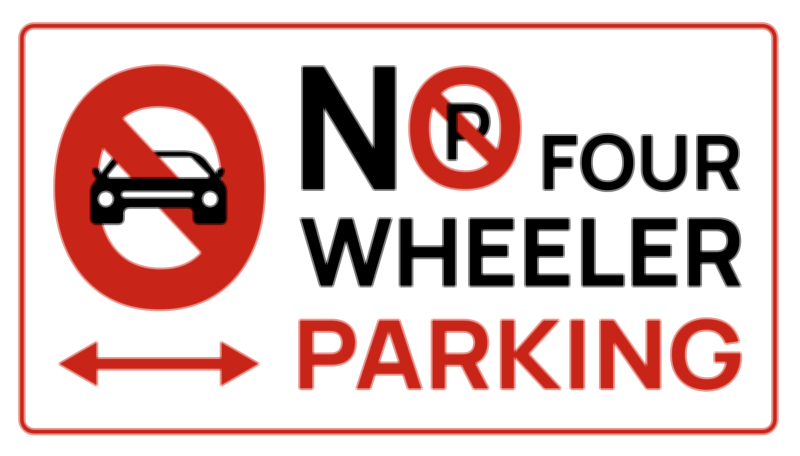
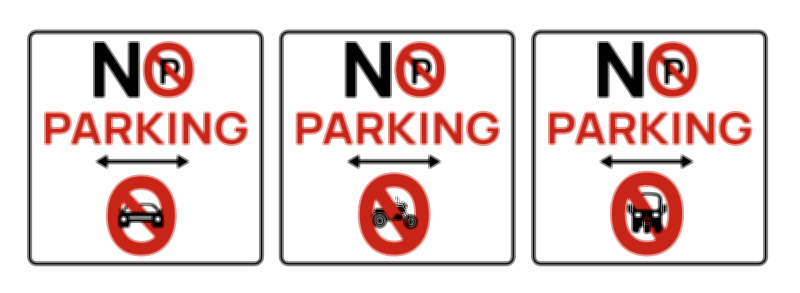
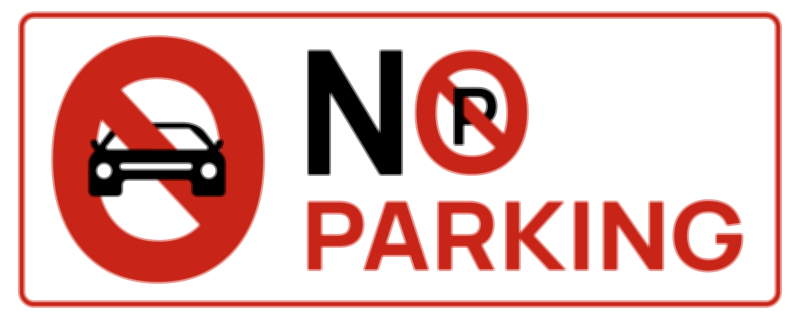
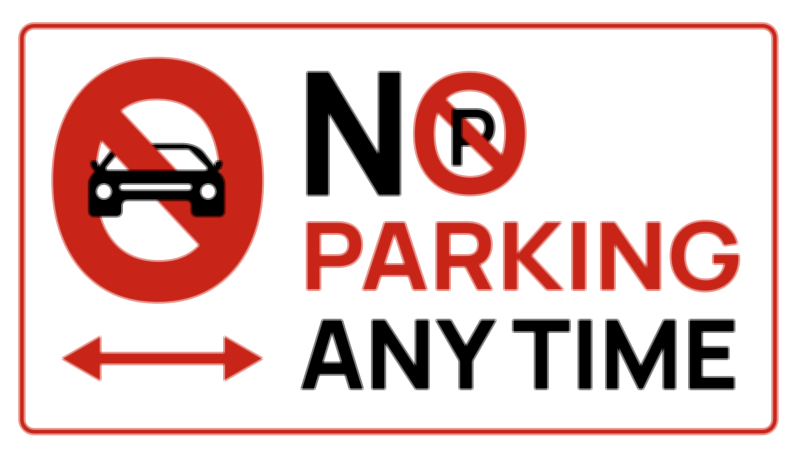
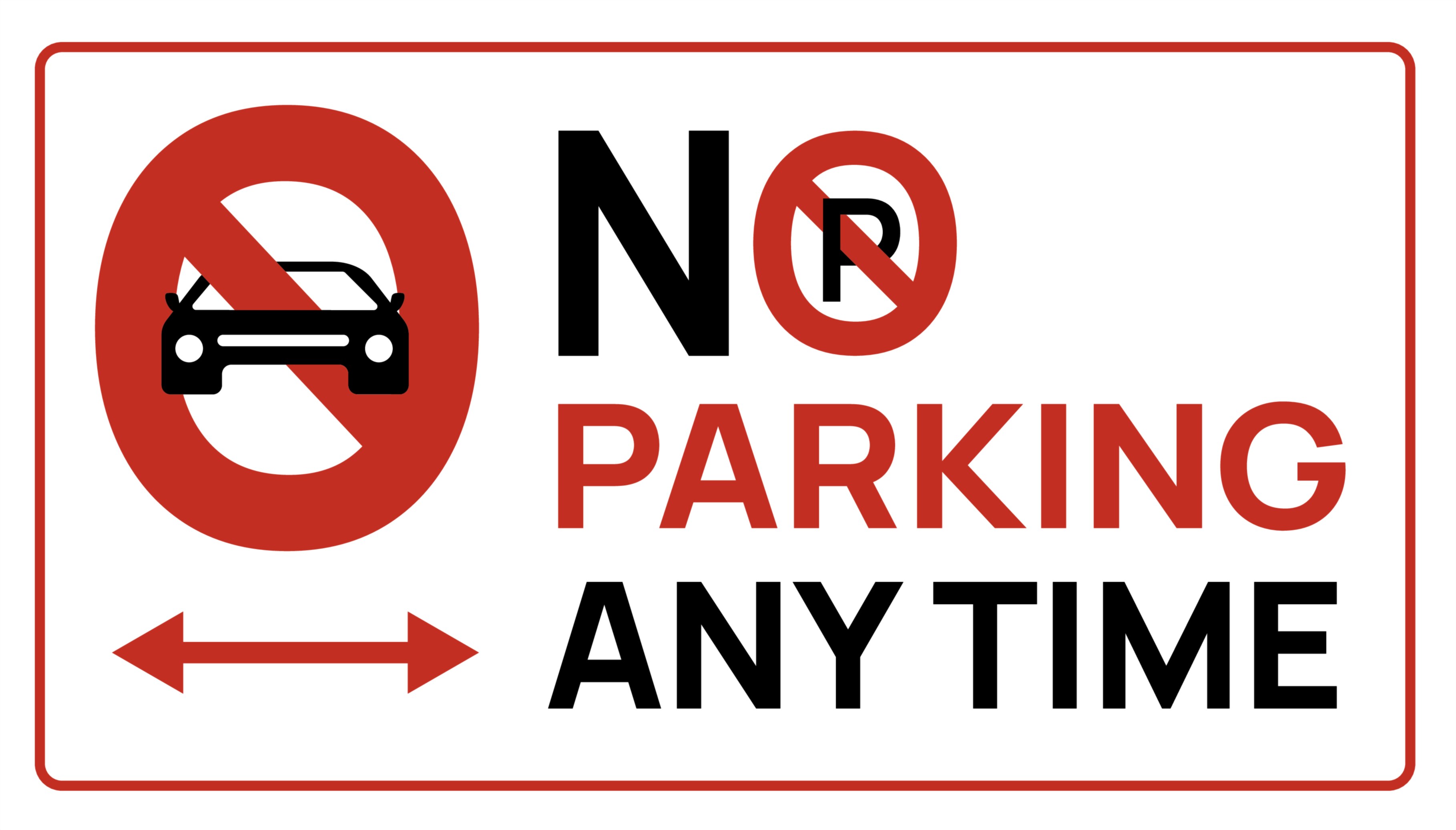
A No Four Wheeler Parking Anytime sign is one of the clearest and most uncompromising traffic restriction symbols used to protect safety, accessibility, and mobility in spaces where the presence of a parked four-wheeler would create unacceptable levels of risk or disruption. Although the sign is visually simple in a vector illustration format, usually combining a bold red prohibition symbol with the silhouette of a car or SUV, its meaning reaches far beyond that graphic. The red circle communicates prohibition and authority within the universal language of road signage, the diagonal slash represents restriction of a specific action, and the car silhouette makes explicit that the rule applies to four-wheeled motor vehicles. The words “No Four Wheeler Parking Anytime,” when present, reinforce that the restriction is in effect continuously, without exception and without a permissible time window. The precision of a vector version ensures that the sign can be rendered cleanly for roadside boards, gate signage, digital parking systems, GPS applications, or mapping interfaces without distortion of meaning. To understand why the symbol is designed this way, and why it is placed where it is, one must look deeper into the safety and operational challenges that emerge when a four-wheeler occupies space in areas that are not meant for parking.
Four-wheelers take up significantly more space than two-wheelers, bicycles, or pedestrian loads, and the effects of that larger footprint become dramatically clear when one is left in a high-risk zone. In markets, narrow lanes, school entrances, hospital approaches, transit hubs, and commercial complexes, the movement of people and vehicles depends on predictable visibility and unobstructed pathways. When a car parks even briefly where it should not, it narrows the carriageway immediately, forcing buses and trucks into the path of opposite-direction traffic or compelling motorcycles to weave unpredictably around the obstruction. Pedestrians lose their safe walking corridor and are pushed closer to moving traffic. Children emerging from behind a parked four-wheeler become invisible to approaching drivers until the last moment, increasing collision risk sharply. A simple parking stop becomes the trigger for a sequence of split-second hazards in which drivers, cyclists, and pedestrians must adjust rapidly to conditions that should not have existed. The No Four Wheeler Parking Anytime sign prevents these cascading risks by communicating that four-wheelers, because of their size and potential to obstruct movement, may not stop here under any circumstances.
The absolute nature of the sign also reflects emergency access needs that leave no room for negotiation. Fire trucks, ambulances, rescue vehicles, hospital transport vans, security patrol cars, and disaster response teams require immediate access to certain spaces twenty-four hours a day. A gate, driveway, service entrance, fire lane, hydrant approach, or ambulance docking area must remain empty at all times, not just during business hours. The difference between unobstructed emergency access and a blocked path often determines whether response time is swift enough to protect life and property. When a car is parked illegally in a zone protected by a No Four Wheeler Parking Anytime sign, even short delays can become devastating. Firefighters may waste irreplaceable seconds navigating hoses around a parked vehicle. Paramedics may be forced to unload a stretcher farther from the entrance, slowing the transfer of a critical patient. Residents trying to evacuate during a crisis may struggle to exit quickly if a vehicle blocks the only safe gate. The sign therefore becomes an anchor in the hidden architecture of emergency preparedness: it ensures that the physical spaces required for life-saving action are always ready, not only when danger is obvious.
The sign also protects the logistical integrity of spaces that depend on smooth and predictable flow. In commercial zones, a four-wheeler in the wrong place can derail an entire supply chain by blocking a loading dock or a delivery corridor. Trucks may double-park, forcing delivery workers into moving traffic while carrying heavy loads. Service technicians may have to haul equipment over long distances rather than directly into the building. In hospitality spaces like hotels, restaurants, and event venues, a blocked frontage disrupts guest pick-ups and drop-offs and creates unnecessary congestion that degrades the visitor experience. In residential buildings, a car left across an entrance prevents residents from moving their own vehicles in or out, creating frustration that escalates quickly into community disputes. The presence of the No Four Wheeler Parking Anytime sign establishes clear boundaries that streamline the rhythm of everyday movement, making building entrances, loading zones, and facility approaches usable for their actual purpose rather than turning them into points of conflict or delay.
Equally important is the role this sign plays in accessibility for vulnerable users. Many entrances are designed with features that support individuals with disabilities: wheelchair ramps, wider curb cuts, tactile guidance surfaces, reserved boarding points, and gentle slopes designed for people with limited mobility. If a four-wheeler parks in front of these, even for a moment, access becomes blocked entirely. A wheelchair cannot squeeze past the obstruction. A visually impaired person may lose the tactile path that guides their movement. A senior citizen with limited walking strength may be forced toward dangerous vehicle lanes rather than the safe entrance they rely on. Parents pushing strollers, people carrying heavy bags, and individuals recovering from medical conditions all depend on entrance routes that remain consistently open. The No Four Wheeler Parking Anytime sign reinforces the idea that accessibility is not a feature that can function only when convenient; it must be protected at every moment. Respecting the sign therefore becomes a form of respect for the dignity and independence of others who share the built environment.
City planning and traffic science also underline why this sign is indispensable. Roads do not function well simply because they are wide or well-maintained; they function because every user follows rules that prevent chaos. A single four-wheeler parked illegally in a high-density corridor can reduce road capacity, trigger shockwave slowdowns, and cause congestion that ripples far beyond the original location. Peak-hour efficiency in urban zones depends heavily on curb discipline, and the No Four Wheeler Parking Anytime sign ensures that forbidden parking spots do not erode the delicate timing of city traffic flow. When the sign is ignored, buses and commercial vehicles lose their movement priority, intersections jam, and frustration spreads among drivers — which in turn encourages aggressive maneuvers that put vulnerable road users at heightened risk. The sign provides visible structure in environments where structure is essential to prevent breakdown of order.
In the age of smart mobility, the relevance of this symbol has expanded beyond painted metal boards. Digital navigation platforms warn drivers when they approach a No Four Wheeler Parking Anytime zone, preventing unintentional violations. Ride-hailing and logistics apps integrate these zones into route planning to avoid stopping where parking is unsafe or illegal. Businesses receiving shipments depend on mapping systems to show available access points that have not been blocked. Autonomous and semi-autonomous vehicles rely on recognition of this visual symbol to determine where stopping is prohibited. Cities with smart parking enforcement use license-plate recognition cameras to monitor restricted areas continuously, ensuring compliance without waiting for on-ground personnel. A high-resolution vector illustration of the sign makes visual consistency possible across all of these systems, carrying the identical meaning in both physical and digital mobility networks.
Behind all these layers of function sits the social meaning of the sign — the expectation that drivers consider the safety and movement needs of others, not just their own convenience. Parking in a restricted spot may seem insignificant to the person leaving the vehicle, yet the consequences of that momentary comfort are transferred to strangers who may be endangered, delayed, or blocked from entering their own homes or workplaces. A driver who obeys the No Four Wheeler Parking Anytime sign may never see the benefits of their choice directly, but their cooperation protects children crossing the road, residents trying to enter their gates, suppliers delivering goods, emergency responders trying to save lives, and pedestrians seeking a safe and uninterrupted passage. The sign represents a compact of shared responsibility: the road and the entranceway belong not to one individual but to everyone who uses them.
The symbol itself — a red prohibition frame over a car silhouette, sometimes paired with the words “No Four Wheeler Parking Anytime” — may appear visually simple, but embedded within it is an entire philosophy of safe mobility, respect for accessibility, emergency readiness, logistical continuity, and civic cooperation. Through its constant presence and uncompromising clarity, the sign keeps spaces that should never be blocked open every hour of the day. It is a guardian of smooth movement, a protector of vulnerable road users, a safeguard for emergency response, and a stabilizer of daily life in congested environments. The design may be minimal, but the impact is immense: by preventing the parking of four-wheelers anytime in critical areas, the sign plays a silent yet essential role in building safer, healthier, and more harmonious communities.