Building Entrance No Parking Sign — Access Control and Traffic Management
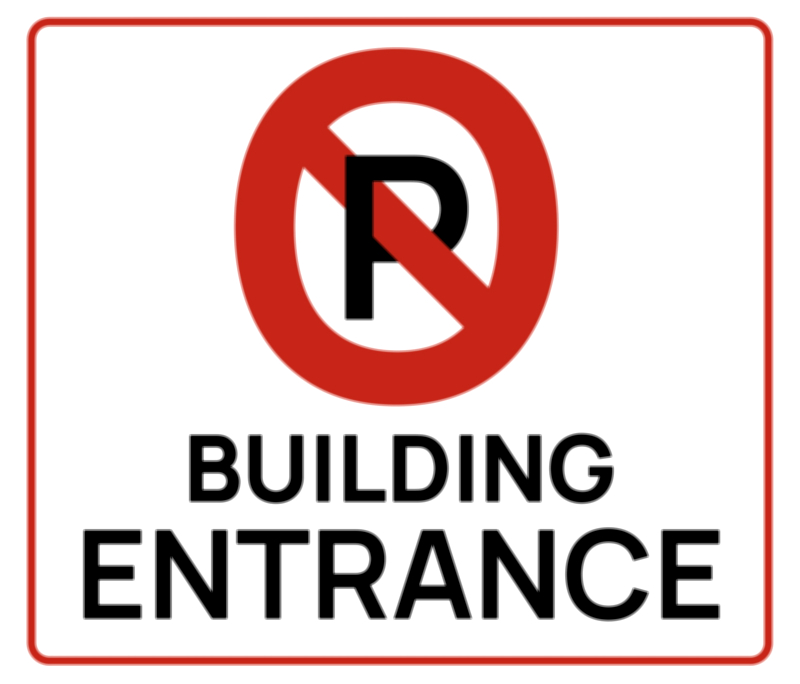
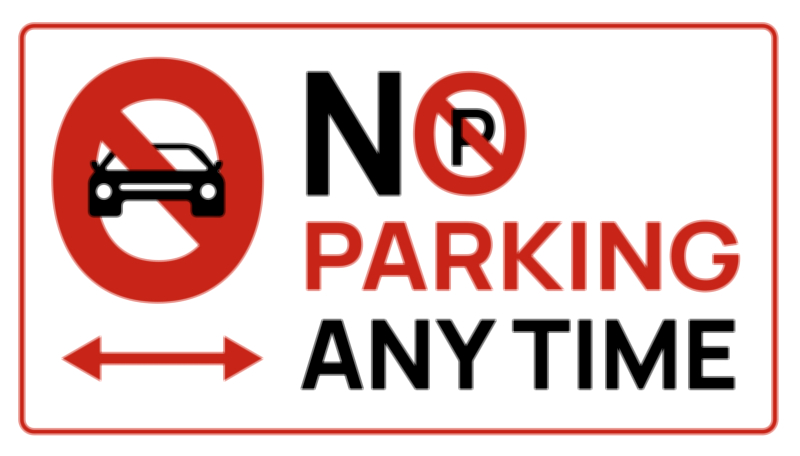
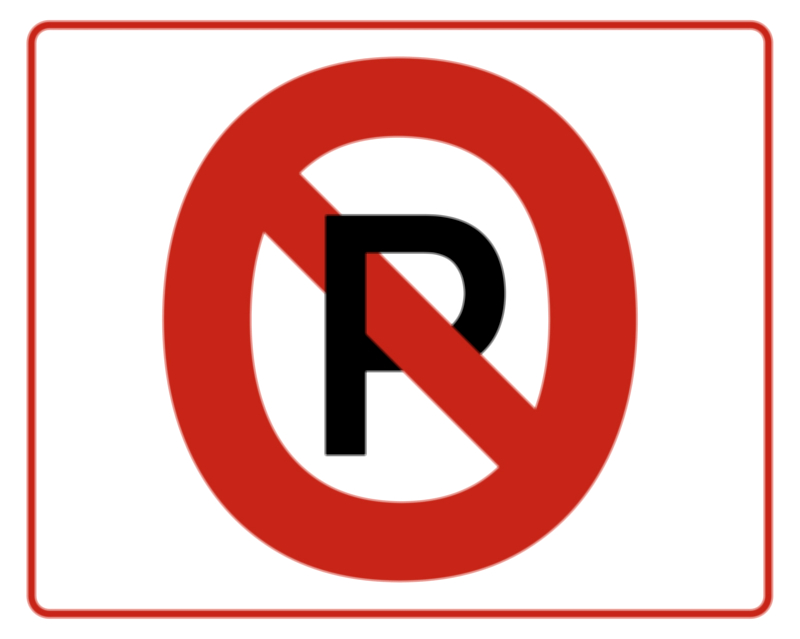
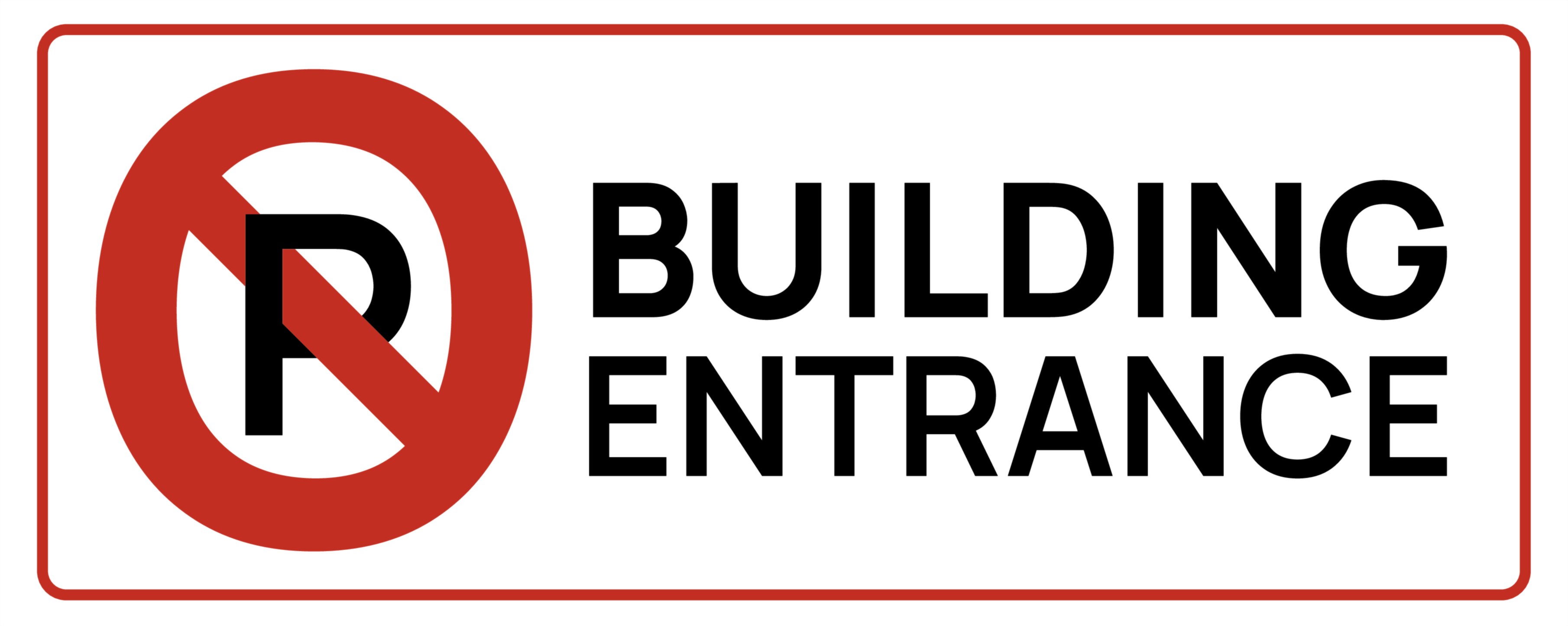
A Building Entrance No Parking sign is far more than a simple visual discouraging drivers from leaving their vehicles near a doorway. It is a carefully engineered traffic control symbol developed to protect mobility, safety, and accessibility at the threshold of a structure, ensuring that building entry points remain functional for the wide range of people and services that depend on them. In a clean vector illustration, the sign is typically shown as a red-bordered circle containing a large diagonal slash across the letter “P,” or as a bold red prohibition symbol placed over a simplified icon of a door, gate, or building façade. The design is intentional: the circular shape communicates a regulatory command, the red border signals a restriction, and the diagonal slash represents prohibition without requiring written language. The clarity of a vector layout — precise lines, crisp curves, standardized colors, and geometric balance — is essential because the sign must be immediately legible both in physical form on metal signboards and in digital form on parking maps, navigation screens, and architectural traffic plans. The symbol delivers a universal message at a glance: parking is forbidden at the building entrance because the space must remain unobstructed for safe and orderly access.
The reason this sign exists is grounded in the mechanics of travel and pedestrian flow rather than in regulation alone. A building entrance is not simply a structural feature but a high-exposure zone where people converge and disperse continuously. Pedestrians crossing driveways, residents carrying belongings, visitors stepping out of vehicles, schoolchildren entering and exiting grounds, office workers gathering at opening and closing times, and individuals pushing mobility aids all interact in the space immediately in front of an entrance. If this space is allowed to be blocked by parked vehicles, the natural flow of movement deteriorates. People are forced off sidewalks or pedestrian lanes into moving traffic; children become hidden behind parked cars and risk stepping into the road unseen; wheelchairs and strollers lose the smooth path intended for them; and visibility for approaching drivers is compromised at the very moment when anticipation and reaction time are most critical. In this sense, the Building Entrance No Parking sign is not merely a symbol of control but a protective measure that prevents predictable dangers from arising by maintaining a clear, uninterrupted route for every person arriving or leaving.
Emergency safety is an equally powerful justification for this signage. Fire exits, paramedic approaches, evacuation routes, and emergency assembly zones are designed around the assumption that the entrance remains clear at all times. When a vehicle stops and remains parked in front of a building entrance — even for a few minutes — the impact can be devastating in a crisis. A blocked doorway can delay stretchers, prevent firefighters from deploying hoses, force evacuees to reroute through a more dangerous exit, or stop first responders from gaining rapid access during life-threatening situations. Codes requiring that entrances remain unobstructed are built into architectural planning and emergency response strategy; the No Parking sign marks that requirement visually and enforceably. For the same reason, these signs are often reinforced with tow-away warnings or painted curbs to emphasize that noncompliance brings immediate consequences not because of legal rigidity but because lives could depend on instant access in the future. The symbol therefore protects more than building comfort — it secures the safety infrastructure that surrounds every modern structure.
Commercial continuity and logistical operations also depend heavily on this type of signage. Many buildings — particularly those used for business, hospitality, residential complexes, hospitals, or public services — require frequent deliveries, equipment movement, garbage collection, and maintenance tasks. When private vehicles monopolize curb space in front of entrances, delivery personnel are forced to park farther away, pushing heavy cargo across long distances and through pedestrian pathways. Service technicians must transport equipment from remote parking areas, slowing repair timelines. In hotels and event venues, blocked entrances disrupt check-in, luggage handling, and passenger drop-offs. Businesses suffer when traffic to their entrance becomes inconvenient, and visitors feel unwelcome or unsafe when they must weave around vehicles that should never have been parked there. A Building Entrance No Parking sign reduces these conflicts by guaranteeing that the entry frontage remains reserved for the building’s operational needs and not for improvised private parking.
Accessibility considerations add another essential layer of meaning to the sign. Modern building design includes ramps for wheelchair users, handrails, widened doorways, tactile paving, and automatic opening systems — all of which depend on unhindered access. When a vehicle blocks an entrance, accessibility features become unusable, preventing disabled individuals from moving independently and safely. The No Parking sign at an entrance thus stands not simply as a regulation but as a statement of social equity, signaling that public and private buildings must remain physically accessible to everyone, not only to those who are able-bodied or mobile. It protects the dignity and rights of those who need barrier-free access and ensures that infrastructure investments in accessibility are not undone by careless parking.
Traffic management is yet another function of this signage that shapes the rhythm of public mobility. Roads, lanes, and curbside areas form a shared canvas of movement, and even one parked car in a restricted entrance zone can create a ripple effect that congests adjacent streets, forces pedestrian detours, obstructs driveway exits, or compels buses and delivery vans into unsafe maneuvers. When drivers feel free to stop wherever it is personally convenient rather than where it is designated, disorder spreads quickly. The No Parking sign prevents such friction by establishing a predictable and widely understood boundary that keeps roads fluid, entrances clear, and transportation networks synchronized. It becomes a quiet traffic controller that protects the flow of movement without requiring verbal instructions, barriers, or checkpoints.
The digital era increases the relevance of this sign beyond roadside metal posts. Navigation apps now display No Parking icons to prevent drivers from being misled into stopping at building entrances. Smart parking software integrates building entrance restrictions into automated parking suggestions. Security systems and camera networks use the location of these zones to trigger alerts or enforcement actions. Autonomous and semi-autonomous vehicles rely on digital versions of this very symbol to understand where they are not permitted to stop. In all of these contexts, the clean and precise vector illustration of the sign becomes the communication bridge between infrastructure and intelligent mobility systems. A symbol that once served only human eyes now also informs machines, reinforcing the responsibility held by its design.
The social dimension of the sign is equally significant. Respecting a Building Entrance No Parking symbol demonstrates regard for the safety and needs of others, while ignoring it prioritizes personal convenience at the expense of the collective. Penalties for violation — fines, towing, or legal action — are not intended as punitive measures but as deterrents to prevent dangerous and disruptive behavior. When people obey the sign, building entrances remain free for those who need them most: children, elderly residents, disabled individuals, emergency responders, guests, and service personnel. When they are ignored, tensions arise, risks increase, and the harmony of shared public space breaks down. The sign is therefore both a physical communication tool and an ethical reminder that civic responsibility begins with simple everyday decisions, such as where one chooses to park.
A vector illustration of the Building Entrance No Parking sign visually compresses all of this complexity into a symbol that is instantly recognized and consistently respected. Its dimensions, contrasting colors, diagonal slash, and precise proportions create a universal message that transcends language barriers and cultural differences, ensuring that every driver understands that the entrance ahead must remain accessible without exception. Behind the clean lines and high-contrast colors lives a deeper purpose — to preserve safety, mobility, accessibility, and efficiency for everyone who depends on the doorway it protects. Through its silent presence, the sign supports the smooth functioning of buildings and roadways and reinforces the idea that the safe use of shared urban space is not the responsibility of traffic authorities alone, but a collective commitment made visible through thoughtful symbols and responsible behavior.