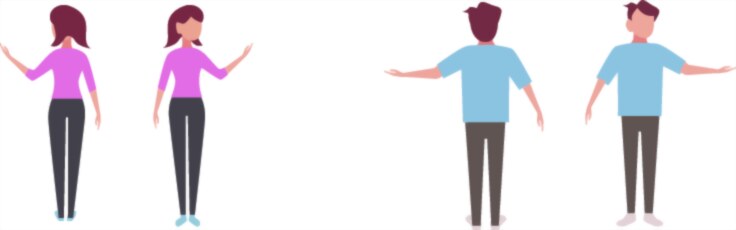
Man and Lady Front and Back Vector Illustration
Vector illustrations of a man and a lady shown from both the front and back are far more than simple drawings; they serve as foundational visual assets in design, fashion, education, animation, digital media, UX/UI development, workplace communication, health and fitness visualization, and commercial branding. To understand their full value, one must look not only at the visible artistic representation but also at the structure, intentionality, symbolism, and usability built into the illustration. When designers create a front–back character pair, they do so with the goal of presenting the human form in a way that is universally readable, proportionally consistent, and suitable for a wide variety of professional applications. These illustrations become a universal language that communicates identity, shape, posture, clothing, symmetry, and orientation without relying on words. Their strength lies in simplicity and adaptability, making them a staple in instructional manuals, character modeling guides, garment industry layouts, 3D reference sheets, game character design, anatomy training tools, and commercial signage. In the world of vector art, the value of such illustrations increases because vectors can be infinitely scaled, recolored, modified, and repurposed without losing quality, allowing them to remain relevant across countless sizes, print materials, and digital formats.
At the core of a front and back human illustration is the intentional continuity of posture and proportion. The figures are typically drawn standing upright, often with arms slightly apart from the body to ensure that the silhouette remains clear on all sides. When a man and a lady are illustrated together, subtle anatomical differences are preserved without exaggeration so that they remain realistic and respectful in representation. Designers give attention to shoulder width, torso curvature, waist definition, hip shape, leg proportion, and facial orientation, yet aim to maintain neutrality so the figures do not reflect bias, inappropriate expression, or stereotypical exaggeration. The front view highlights the alignment of chest, abdomen, knees, and foot positioning, while the back view emphasizes the shoulder blades, spine alignment, and the natural shape of the legs and waist from behind. What seems like simple artwork is the result of careful anatomical calibration intended to provide a clean base that can support clothing overlays, pose adjustments, animation rigs, body measurements, or gesture mapping.
One of the most important practical uses of a man and lady front–back illustration occurs in the fashion and garment industry. Designers require precise human templates on which to draft clothing patterns, test garment proportions, plan print placements, and visualize how fabrics drape on the human form. Front and back representations help in designing shirts, dresses, pants, jackets, uniforms, activewear, and accessories because both sides of the body are visible and usable for measurement. The illustrations act as mannequin surfaces that allow designers to draw seam lines, stitching details, brand elements, color blocks, and logo placements with technical accuracy. Because the figures are vector-based, digital tailors and fashion CAD specialists can import the artwork into software systems to simulate textile fitting, eliminate manual tracing, automate pattern scaling, and accelerate production workflows. In the embroidery and printing industry, these illustrations serve as guides to plan alignment on the chest, back, collar, shoulders, and sleeves, ensuring professional placement and reducing errors.
Another powerful area in which these illustrations play a defining role is education and professional training. Whether it is for workplace safety posters, emergency response infographics, physical education guides, medical instructions, or personal grooming manuals, showing the human body from both front and back makes instructions universally understandable. For example, a poster teaching correct posture in weightlifting needs to display spine curvature from the back as well as knee and shoulder positioning from the front. A first-aid manual may need to show where to place hands during the Heimlich maneuver from the front and where to support the person from the back. Fitness training diagrams illustrate muscle groups activated by certain exercises, requiring anterior and posterior visual references. Even in school-level art classes, front and back vector illustrations help students understand balance, symmetry, and proportion as they learn to draw or paint the human form.
In the digital world of character creation, 3D modeling, and animation, front and back illustrations serve as reference sheets that guide artists in sculpting rigs, adjusting meshes, and developing avatar templates. Game developers, storyboard writers, and motion graphic artists utilize these illustrations to maintain consistent character design from every angle. Without a front–back template, it becomes difficult to preserve proportion across different scenes, positions, and animations. Vectors are especially valuable because they maintain crisp lines and controllable anchor points that can match rigging grids and orthographic views in 3D software. This compatibility speeds up the modeling process, reduces mismatches in character geometry, and ensures that the digital character follows realistic anatomical structure. Even in simple 2D animation, front and back views allow smooth transitions within walking cycles, rotations, and perspective changes when animators construct scenes that require believable movement.
Beyond technical fields, these vector illustrations also play a major role in branding, signage, and communication. Public facilities—such as malls, airports, gyms, hospitals, workplaces, and parks—often require universally understandable signage that guides crowds without language barriers. A simple front–back human outline can indicate changing rooms, locker rooms, spa areas, massage services, salon and grooming spaces, and body measurement zones. Graphic designers prefer vector illustrations because they can quickly recolor, stylize, and integrate them into broader design systems such as modern icons, minimal line drawings, flat graphics, or dimensional gradients. Businesses also use human front–back illustrations in advertising campaigns, where clothing brands show design elements; fitness brands show before-and-after transformations or body posture; and wellness centers show body balancing, physiotherapy, or massage zones. Because vectors are customizable, brands can adjust skin tone, hairstyle, clothing style, accessories, and body shape to match diverse audiences and promote inclusivity.
An interesting aspect of using front and back illustrations together is the psychological sense of completeness they communicate. The viewer subconsciously perceives the figures as whole, approachable, and fully presented, making the illustration feel balanced. This dual representation reflects the idea that human identity is multi-directional; no one is defined by a single perspective. Designers and viewers alike benefit from this visual openness because it supports clarity, transparency, and realism in communication. Whether the image is used for professional or creative purposes, the dual-view format signals that the subject has been observed with full dimensional honesty, leaving no ambiguity about structure, design, or physical interaction.
In modern design culture, these illustrations are also vital foundations for customization. Many creative tools, from children’s educational apps to adult avatar builders, rely on editable human outlines. Using a neutral front–back illustration as a base, users can add clothing, facial features, hairstyling, accessories, tattoos, color themes, or body modifications. This is why designers prefer simplified and balanced proportions in the base illustration—it ensures that any customization aligns properly and remains visually stable. For motion capture or body tracking applications, these illustrations support orientation mapping so sensors can annotate which part of the body is rotating, moving, or stretching. Even ergonomic designers use them in seating and furniture development to determine where the back touches surfaces, where weight is applied, and how posture varies between individuals.
Because the illustrations are vector-based, they also align with the long-term sustainability and scalability needs of digital and print production. The same artwork can be scaled down for icon size or enlarged for billboard size without pixelation. Every stroke, curve, and node remains editable, meaning designers can adapt the artwork across thousands of uses without degradation. Whether printed in monochrome for a safety card, rendered in colorful gradients for website banners, animated in advertising videos, or applied to garment mockups for production, the vector format remains consistently efficient.
Ultimately, a man and lady front and back vector illustration represents much more than just a pair of drawings. It is a practical design tool, a technical reference, a communication medium, and a universal visual language. It supports teaching, branding, manufacturing, healthcare communication, athletic training, garment design, character creation, and architectural signage. It invites both precision and creativity: precision when used as a template for realistic measurements and technical work, creativity when adapted into expressive design systems and visual storytelling. What begins as a simple human outline becomes a multi-industry asset—scalable, modifiable, and endlessly reusable—proving once again that the most essential visual tools often emerge from clarity, balance, and intentional simplicity rather than complexity.