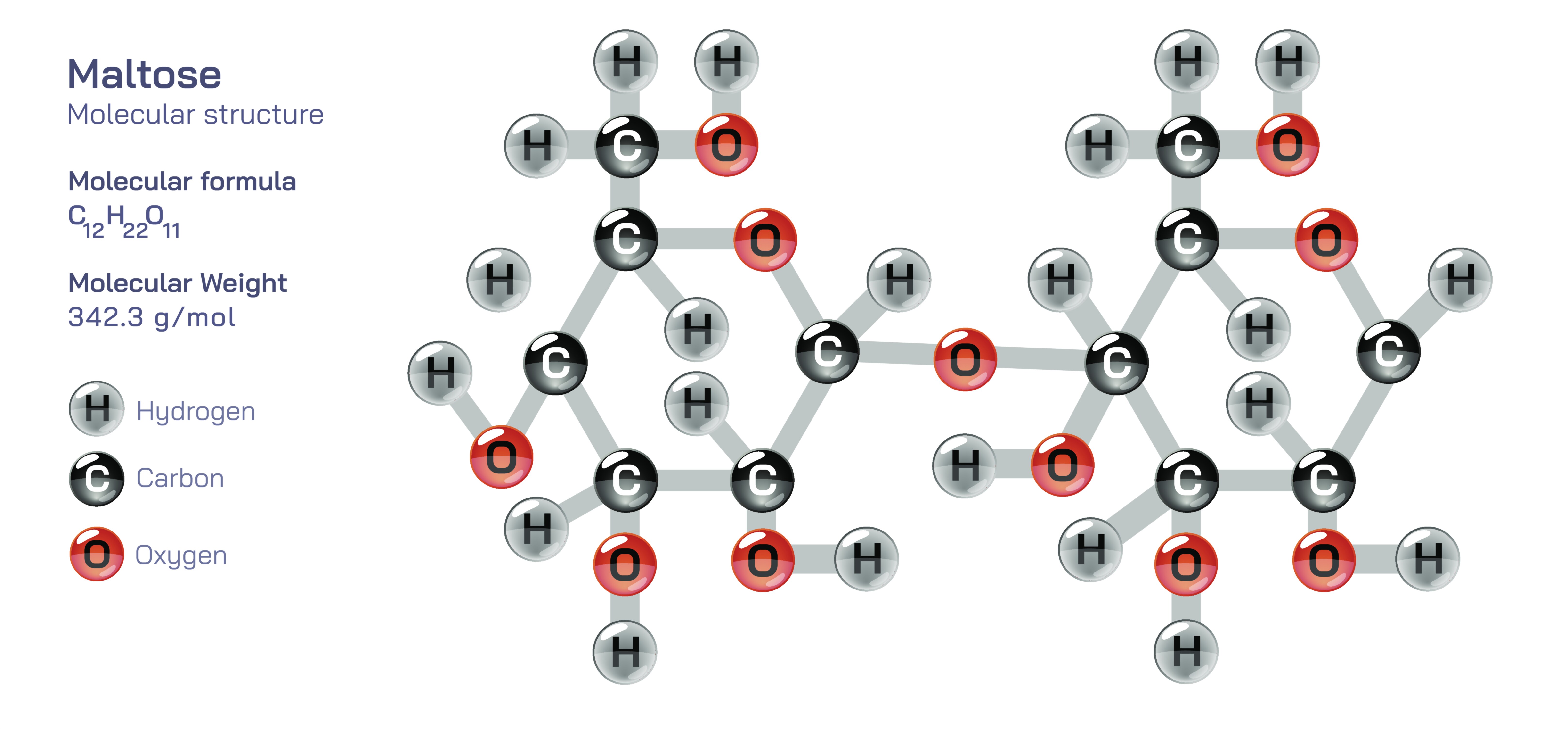
Maltose — Molecular Structure and Composition
Maltose is a biologically and nutritionally significant carbohydrate whose relevance extends from cellular metabolism and digestive physiology to food chemistry, fermentation science, and industrial biotechnology, and its importance is rooted directly in its molecular architecture. Structurally, maltose is a disaccharide composed of two glucose units joined together through a specific type of glycosidic bond known as an α-1,4 linkage, meaning that the alpha configuration of the first glucose molecule at carbon-1 is chemically connected to carbon-4 of the second glucose molecule. Although this arrangement might appear subtle, it has far-reaching consequences for how the molecule behaves and how the human body, plants, microorganisms, and food systems interact with it. Because the bond between the two glucose monomers retains a free anomeric carbon on the second glucose residue, maltose is classified as a reducing sugar, which means it can participate in a range of chemical reactions capable of altering protein structure, influencing flavor and aroma development in cooked foods, and supporting biological energy conversion. At the molecular level, maltose exists in a dynamic equilibrium among several structural forms, switching between alpha and beta anomers and transitioning between open-chain and cyclic conformations in aqueous solutions, which not only contributes to its reactivity but also reveals the complex motion and flexibility that carbohydrates exhibit despite their seemingly simple appearance.
Biochemical and metabolic significance of maltose in living systems
The metabolic relevance of maltose begins with digestion and energy production, where the breakdown and transformation of carbohydrates fuel virtually every physiological function. Maltose is generated naturally during the enzymatic degradation of starch, a long polymer of glucose found abundantly in plant-based foods such as grains, potatoes, legumes, and seeds. When organisms ingest starchy foods, enzymes in the saliva and pancreas—such as amylase and maltase—sequentially cleave the α-1,4 glycosidic bonds of starch, producing maltose as an intermediate before complete conversion to glucose. Once maltose is hydrolyzed into its constituent glucose molecules, the glucose enters glycolysis, the citric acid cycle, and oxidative phosphorylation, contributing directly to ATP production, which is essential for muscle function, nerve signaling, protein synthesis, immune processes, and cell maintenance. In infants and young mammals, maltose metabolism is especially important because digestive enzymes for disaccharides develop early in life, making maltose one of the manageable carbohydrate sources during the transition from milk to starch-containing foods. In muscle cells, liver tissues, and brain cells, glucose derived from maltose can be stored temporarily as glycogen or immediately oxidized, demonstrating how maltose operates at the crossroads between dietary intake and cellular bioenergetics.
Structural identity and its role in food chemistry and sensory properties
The molecular composition of maltose also strongly influences food behavior, especially in products that undergo heat or fermentation. Because maltose is a reducing sugar, it participates in the Maillard reaction, a complex series of chemical transformations between sugars and amino acids that give rise to the browning, aromas, and flavors of baked bread, roasted grains, toasted nuts, cooked cereals, and malted beverages. In brewing science, maltose plays a defining role in shaping alcohol production because it is one of the principal sugars produced when barley grains are malted—soaked, germinated, and dried to activate enzymes that convert storage starch into fermentable sugars. Yeasts readily metabolize maltose during fermentation, turning it into ethanol and carbon dioxide while simultaneously producing secondary flavor compounds that characterize beers, malted drinks, and certain spirits. Even outside of alcoholic beverages, maltose contributes to the sweetness and mouthfeel of products such as malt syrups, confectionery glazes, cereal bars, and infant foods. Interestingly, maltose is less sweet than sucrose because of differences in receptor binding on the human tongue, yet it provides a smooth and rounded sweetness profile that food formulators deliberately use to enhance flavor without overwhelming the palate.
Functional properties in industry, biotechnology, and fermentation
Beyond its nutritional and sensory importance, maltose is embedded deeply in industrial and biotechnological processes because of how microorganisms interact with it. Bacteria, yeasts, and fungi each possess specialized enzymes that transport and metabolize maltose, and the rate of maltose utilization can determine fermentation efficiency, microbial growth characteristics, and biochemical product yields. Maltose serves as a controlled carbon source in laboratory media because it supports cell growth without the rapid metabolic spikes caused by simpler sugars like glucose. In enzyme research and pharmaceutical manufacturing, maltose can stabilize proteins due to its ability to form hydration shells that protect delicate molecular structures from denaturation during freeze-drying, storage, or reconstitution. Maltose-binding proteins, which naturally recognize and transport maltose inside cells, have been adapted for bioengineering applications where scientists exploit their selective binding capabilities to purify proteins or regulate biochemical pathways. The interplay between maltose and biological systems therefore demonstrates not only the energy-providing function of carbohydrates but also their ability to shape molecular stability and industrial productivity.
Influence of maltose in physiology, health, and dietary considerations
Although maltose is metabolized efficiently in healthy individuals, understanding its physiological effect is essential to nutritional science. Because maltose consists solely of glucose units, its digestion leads to a rapid rise in blood glucose when consumed in concentrated form, and this response is particularly relevant for individuals managing diabetes, metabolic syndrome, or insulin resistance. However, the impact of maltose varies with context; when it appears naturally within whole grains, paired with fiber, protein, and fats, glucose absorption slows and supports sustained energy release. In contrast, purified maltose syrups used in processed foods can elevate blood sugar more quickly, prompting careful formulation in health-oriented food products. The biology of maltose also intertwines with the gut microbiome: beneficial bacteria in the intestinal tract ferment maltose into short-chain fatty acids, which contribute to colon health, immune balance, inflammation regulation, and gut barrier integrity. Thus, maltose is not simply a sweetener but a mediator of complex metabolic processes that differ depending on how it is delivered and paired with other nutrients.
Environmental and agricultural relevance emerging from maltose formation and metabolism
Although maltose is best known in food and physiology, its presence in plant biology is equally fundamental. During seed germination, plants activate amylase enzymes that mobilize energy reserves stored in starch, generating maltose as a major product that fuels early root and shoot development before photosynthesis becomes self-sustaining. The rate at which maltose is produced and consumed influences germination timing, stress resistance, and seedling vigor. In agricultural biotechnology, maltose metabolism is studied closely because modifying starch-to-maltose conversion pathways offers ways to improve crop yield, enhance sprouting energy, influence grain quality, and optimize raw material for malting, brewing, and livestock feed. Maltose also appears in nectar and plant secretions that interact with insects and pollinators, suggesting that even outside of human consumption, maltose plays a role in ecological nutrient exchange and plant–animal symbiosis.
A molecule where structure predicts function across disciplines
Taken as a whole, maltose illustrates how the spatial arrangement of atoms determines not only chemical identity but also biological, nutritional, and industrial function. Two glucose molecules alone do not guarantee any particular behavior—it is the α-1,4 glycosidic linkage, the retained reducing end, the conformational mobility in solution, and the balance between cyclic and open-chain forms that collectively create the maltose identity. These structural details determine how rapidly maltose reacts in browning chemistry, how readily it ferments, how it influences sweetness, how it interacts with proteins, how the digestive system metabolizes it, and how living organisms use it for energy. Whether one observes maltose as the fuel powering the early growth of a germinating seed, the fermentable substrate in a brewery, the stabilizing ingredient in a pharmaceutical formulation, the browning agent in a bakery, or the biochemical link between dietary starches and cellular ATP, the molecule remains the same—yet its function adapts depending on the system around it.
By connecting molecular structure to real-world behavior, maltose stands as a clear example of how chemistry underlies biology, gastronomy, medicine, ecology, and industry all at once. Its simplicity makes it elegant, and its versatility makes it indispensable. From human metabolism to microbial fermentation, from food formulation to agricultural development, maltose demonstrates how even small molecular variations can ripple outward to influence flavor, health, technology, and life itself.