Types of Lenses — Optical Components and Light Refraction
Lenses represent one of the most essential optical components ever developed, forming the foundation of vision correction, imaging systems, scientific instruments, digital technologies, and countless everyday applications. When we talk about the types of lenses and their role in manipulating light through refraction, we enter a domain where physics, geometry, perception, and engineering intersect. A lens is far more than a transparent curved object; it is a precisely engineered device that bends light in controlled ways to form images, magnify objects, correct refractive errors, and manipulate how we perceive the world. Understanding the different types of lenses requires exploring how the curvature of their surfaces determines how incoming light rays bend, focus, diverge, or transform. This interaction between shape and light behavior forms the conceptual basis for applications ranging from eyeglasses and microscopes to cameras, telescopes, projectors, and advanced optical systems. The study of lenses reveals how simple physical principles can be harnessed to create technological marvels and enhance human capability.
At the heart of lens behavior lies the principle of refraction—the bending of light as it passes from one medium to another with a different optical density. When a light ray enters a lens, its speed changes, causing it to alter its direction. The specific path that light takes depends on how the surfaces of the lens are curved. A convex surface, curving outward, pushes incoming light rays inward toward a point. A concave surface, curving inward, spreads light rays outward. By controlling the curvature and thickness of a lens, designers can dictate how images are formed, whether magnified or reduced, upright or inverted, real or virtual. These fundamental principles differentiate the two major categories of lenses: converging lenses and diverging lenses. Converging lenses bring parallel rays of light to a focal point, forming real images on screens or sensors. Diverging lenses push parallel rays apart, creating virtual images that the eye perceives but cannot be projected onto a surface. From these two foundational types arise various specialized lens forms used in optical systems across the world.
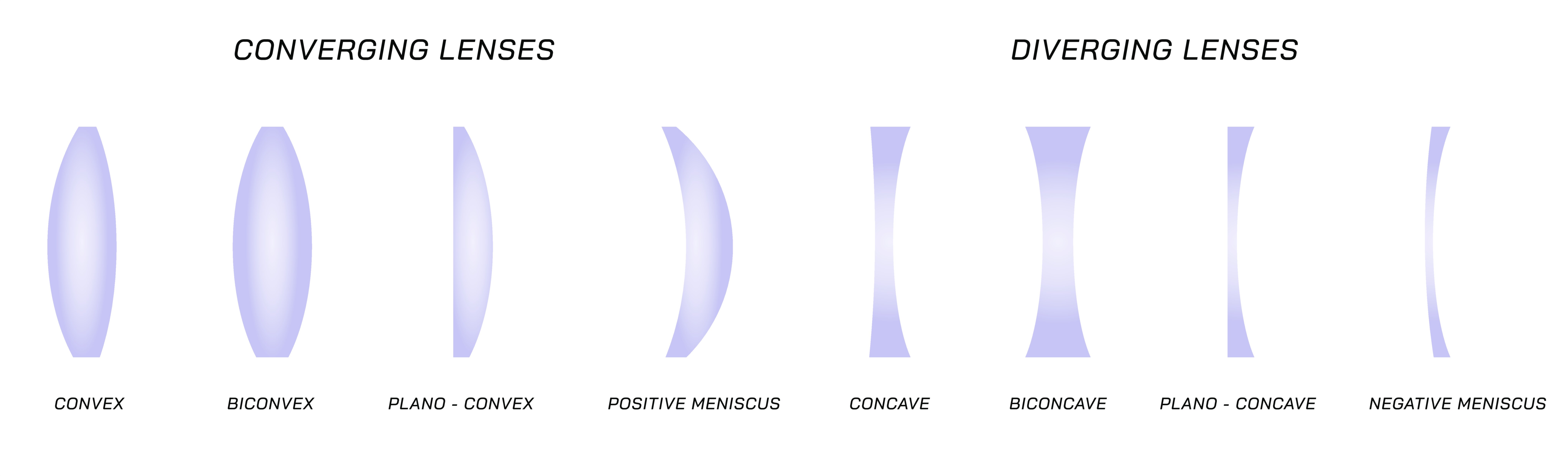
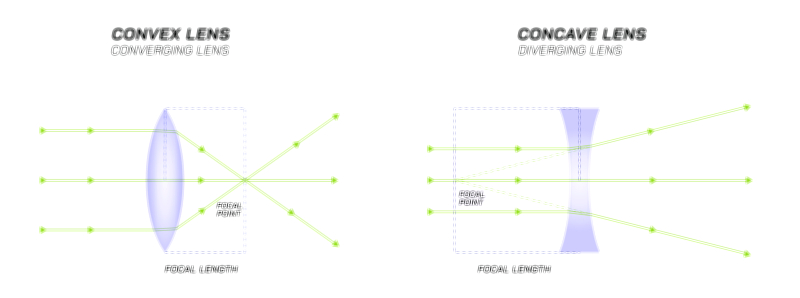
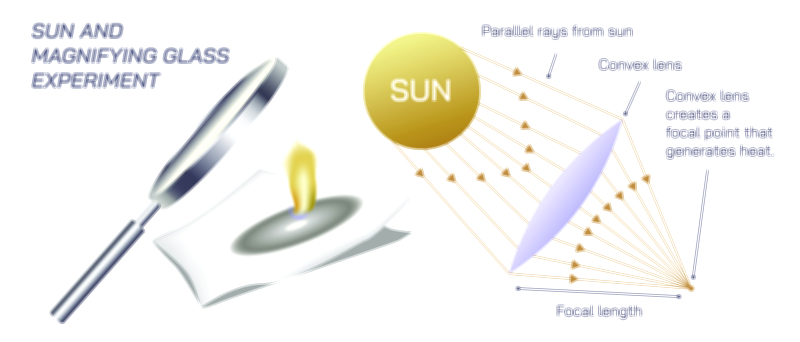
Convex lenses, also known as converging lenses, are thicker at the center and thinner at the edges. Their outward curvature causes parallel light rays to bend inward, meeting at a focal point on the opposite side of the lens. This ability to concentrate light makes convex lenses indispensable in devices that rely on focused images. In cameras, convex lenses gather light from scenes and project a sharp inverted image onto the sensor or film. In magnifying glasses, the lens creates an enlarged virtual image by bringing the focal point inside the viewing distance, making small objects appear larger when observed through it. Eyeglasses designed for farsightedness use convex lenses to correct the inability of the eye to converge light onto the retina. The natural crystalline lens of the human eye itself functions as a type of variable convex lens, adjusting its curvature to focus on near or distant objects. Convex lenses also appear in projectors, telescopes, microscopes, and binoculars, where precise control of image formation is essential.
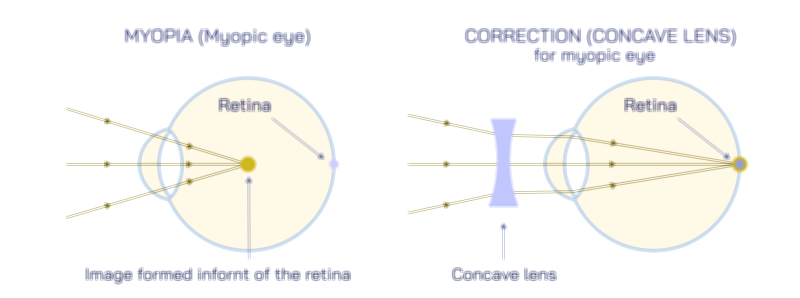
Concave lenses, or diverging lenses, are thinner at the center and thicker at the edges. Their inward curvature spreads incoming parallel rays outward as if they originated from a single focal point on the same side as the light source. This divergence is useful in applications requiring expansion or correction of light paths. Eyeglasses for nearsightedness use concave lenses to counteract the excessive focusing power of the eye, helping light rays focus correctly on the retina. Laser systems often incorporate concave lenses to widen narrow beams, preventing damage or distortion in downstream components. In optical instruments, concave lenses are sometimes paired with convex lenses to form compound lens systems that reduce aberrations, control magnification, or improve clarity. Although concave lenses do not form real images on screens, they play a critical role in shaping virtual images essential to vision correction and beam manipulation.
Beyond the simple categories of convex and concave, many specialized lens types emerge from variations in curvature and design. Biconvex lenses have outward curvatures on both sides, offering strong focusing power and symmetry ideal for general-purpose imaging. Plano-convex lenses combine one flat surface and one convex surface, controlling aberrations while efficiently converging light, making them common in collimation, laser systems, and illumination optics. Similarly, biconcave lenses possess inward curvature on both surfaces, dispersing light efficiently and often appearing in beam expansion systems. Plano-concave lenses offer precise control over divergence, with one flat face ensuring predictable beam shaping.
Meniscus lenses—curved in opposite directions on each surface—offer a balance of converging or diverging capabilities depending on the dominant curvature. Positive meniscus lenses converge light while minimizing spherical aberration, making them valuable in high-quality imaging systems that require reduced distortion. Negative meniscus lenses diverge light while controlling unwanted optical artifacts, contributing to refined lens assemblies in cameras, telescopes, and advanced optical equipment. These more complex lens shapes demonstrate how slight modifications to curvature profoundly influence light behavior, enabling lenses to match specific technical requirements.
Cylindrical lenses represent another specialized category. Unlike traditional spherical lenses, they curve in only one direction, affecting light in a single axis. This unique property allows cylindrical lenses to form lines instead of points, correct astigmatism in eyeglasses, and modify laser beams by shaping them into sheets or lines for industrial scanning, bar-code readers, and scientific applications. Cylindrical lenses exemplify how optical engineering adapts lens design to address highly specific refractive challenges.
Progressive lenses, widely used in modern eyewear, demonstrate how lens technologies integrate multiple refractive powers in a single device. These lenses gradually shift from one prescription strength to another, allowing seamless vision correction across near, intermediate, and far distances without visible segment boundaries. The complexity of progressive lens design reflects advanced mathematical modeling and precise manufacturing techniques, showing how modern optics tailor light manipulation to human needs. Similarly, bifocal and trifocal lenses incorporate discrete zones of different focusing powers, providing clarity at varying viewing distances and supporting individuals with presbyopia. Although these lenses are designed primarily for biological rather than purely optical systems, they exemplify the intricate relationship between lens geometry and functional vision.
Aspheric lenses introduce another level of sophistication by incorporating non-spherical surface profiles. Standard spherical lenses often introduce distortions, such as spherical aberration, where light rays at different points on the lens focus at slightly different positions. Aspheric lenses correct this imperfection by designing surface curves that vary gradually from center to edge. These refined surfaces create sharper images, thinner lens profiles, and improved performance in cameras, eyeglasses, telescopes, and optical sensors. Aspheric lenses demonstrate how innovations in lens geometry push optical engineering toward greater accuracy and versatility.
In advanced optical systems, compound lenses—assemblies of multiple single lenses—combine different shapes, materials, and refractive powers to achieve precise imaging results. Cameras use compound lens systems to correct distortions, control zoom levels, enhance sharpness, and manage light across wide fields of view. Microscopes gather and concentrate light through layered lenses that magnify samples many times. Telescopes integrate objective lenses with eyepiece lenses to capture distant light and present it clearly to the human eye. These compound systems show how individual lens types collaborate, each correcting for the limitations or aberrations of the others. Even basic binoculars rely on a carefully arranged sequence of convex and concave elements working in harmony to produce clear, enlarged, upright images.
The materials used in lens construction also influence their performance. Glass lenses offer excellent clarity and scratch resistance, making them ideal for scientific instruments and high-end optics. Plastic lenses, lighter and more impact-resistant, dominate the eyewear industry and many consumer devices. Specialized materials such as quartz, polycarbonate, and crown glass extend lens functionality into ultraviolet, infrared, and high-energy optical systems. Anti-reflective coatings, UV filters, polarization treatments, and scratch-resistant layers enhance lens durability, reduce glare, and protect vision. These additional technologies demonstrate how lens performance depends not only on shape but also on material science and surface design.
Understanding the various types of lenses also requires an appreciation of how images are formed. Converging lenses can produce real images—those that can be projected onto screens—when objects lie beyond the focal point. They can also create magnified virtual images when objects lie within the focal point. Diverging lenses produce only virtual images, always smaller and upright relative to the object. The distance between object, lens, and focal point fundamentally affects image characteristics such as size, orientation, and clarity. These conceptual relationships form the basis for optical calculations, instrument design, and the integration of lenses into technological systems.
The significance of lenses extends far beyond scientific and medical use. Everyday life is filled with lenses that subtly shape perception. Eyeglasses correct refractive errors by adjusting how light enters the eye. Smartphone cameras capture memories through meticulously engineered lens modules. Projectors display images through focused beams of refracted light. Vehicle headlights use lenses to direct illumination efficiently. Even simple toys like magnifying glasses introduce children to the wonder of optical magnification. Through these applications, lenses enhance human capability, enabling us to see farther, read clearer, observe the microscopic, and explore the vastness of space.
Ultimately, the types of lenses used across optical systems reveal how fundamental principles of light refraction can be harnessed in complex and compelling ways. From simple convex and concave forms to advanced aspheric, cylindrical, progressive, and compound assemblies, lenses embody the union of physics, engineering, and visual science. They demonstrate how manipulating the path of light allows us to perceive the world more clearly, explore realms previously invisible, and build devices that rely on precise optical control. Whether correcting vision, amplifying distant galaxies, or enabling digital imaging technologies, lenses continue to illuminate the profound connection between light, geometry, and human innovation.
Types of Lenses — Optical Components and Light Refraction Vector Illustration
Types of lenses vector illustration showing convex and concave lenses with light refraction patterns for physics, optics, and educational study.
Summary
Related Images






File Details
File Type
-
EPS
File Size
-
5.53 MB
File Dimension
-
Scalable vector file
Your contribution helps us create more resources, but please support only if it's comfortable and affordable for you.❤️️
