Lenz’s Law — Electromagnetic Induction, Opposing Current Direction, and Conservation of Energy in Changing Magnetic Fields
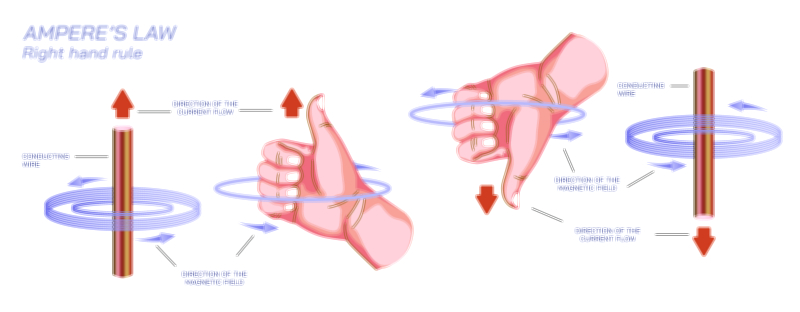
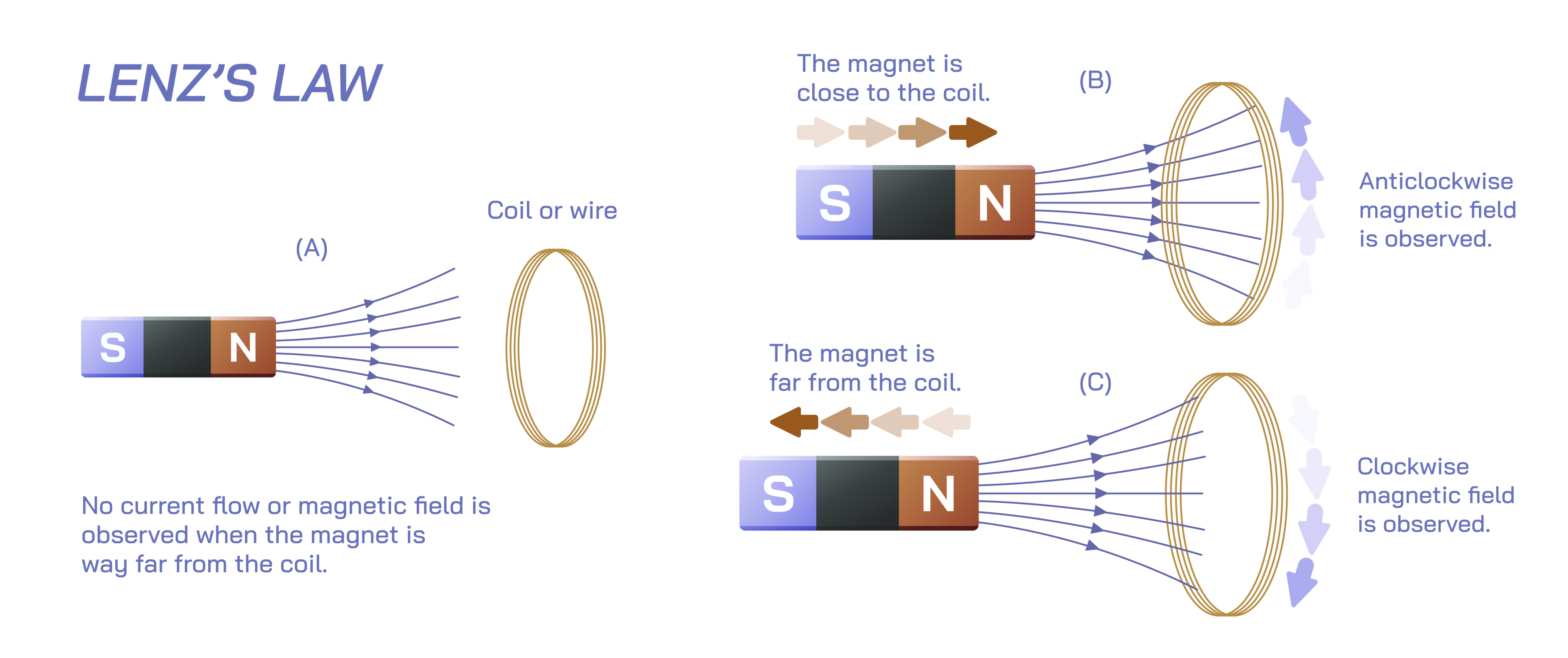
Lenz’s Law describes one of the most fundamental behaviours of electricity and magnetism: whenever a changing magnetic field induces an electric current in a conductor, that current flows in such a direction that its own magnetic field opposes the change that produced it. Although the idea appears simple on the surface, it reflects a deep principle of nature—electromagnetic systems always resist changes in magnetic flux, ensuring that energy is neither created nor destroyed but simply converted from one form to another. Lenz’s Law is therefore not just a rule about the direction of induced currents; it is a bridge connecting classical electromagnetism with the universal law of conservation of energy. The law is expressed visually in vector illustrations that show magnetic field lines, induced currents, and the circulating magnetic responses that oppose the original change. Understanding the law provides insight into how electric generators work, why induction produces resistance to motion, how electrical braking systems function, and why electromagnetic induction can both generate and oppose useful forces in mechanical and electrical devices.
Lenz’s Law applies whenever the magnetic flux through a conductor changes. Magnetic flux refers to how many magnetic field lines pass through a loop or surface, and it can change if the magnetic field strength varies, if the area of the loop changes, or if the orientation of the loop shifts relative to the magnetic field. According to Faraday’s discovery of electromagnetic induction, a changing flux creates an induced electromotive force (EMF) that generates current in the loop if it is a closed circuit. Lenz clarified the direction of that induced current, declaring that the induced current always acts in a way that opposes the flux change that caused it. If the magnetic field passing through a loop increases, the induced current produces a magnetic field pointing in the opposite direction to reduce the increase. If the magnetic field decreases, the induced current produces a field in the same direction to resist that loss. This opposition is not accidental—it is required for conservation of energy. If the induced current helped rather than opposed the change, the system would amplify energy from nowhere, violating physical laws.
The behaviour described by Lenz’s Law becomes especially clear in dynamic systems. Imagine bringing a bar magnet toward a conducting loop. As the magnet approaches, the magnetic field passing through the loop increases. Lenz’s Law states that the loop produces an induced current whose magnetic field points outward, pushing back against the approaching magnet. The closer the magnet gets, the stronger the induced current becomes, and the harder the loop pushes against the motion. This observable resistance to motion demonstrates that induction converts mechanical energy into electrical energy. If the magnet is pulled away instead, the opposite change occurs—the magnetic field inside the loop decreases, so the induced current produces a magnetic field that tries to keep the magnet close. Again the motion is resisted, showing that energy must be supplied to separate the magnet and loop. What appears as a “force of opposition” is in fact a transfer of energy: mechanical work is transformed into electrical energy inside the conductor.
Lenz’s Law is not only directional but quantitative. The induced EMF and current adjust to exactly the magnitude necessary to oppose the rate of magnetic flux change. Fast changes induce stronger responses; slow changes induce weaker responses. This relationship governs the behaviour of countless electromagnetic devices. In an electric generator, for instance, mechanical rotation forces coils to cut through magnetic fields, inducing currents that exert opposing electromagnetic torque. The greater the electrical load connected to the generator, the stronger the induced current becomes, and the harder the mechanical system must work to maintain rotation. In this way, Lenz’s Law regulates the balance between electrical output and mechanical input, ensuring that the energy extracted from motion equals the electrical energy delivered to the circuit.
An equally powerful demonstration of Lenz’s Law occurs in eddy currents, which are circulating currents generated in bulk conductive materials rather than in wire loops. When a conductor moves through a magnetic field—such as an aluminium plate sliding between magnets—whirling currents form within the metal. These eddy currents generate magnetic fields that oppose the plate’s motion, producing strong resistive drag without physical contact. This effect makes possible magnetic braking systems used in roller coasters, trains, and industrial equipment, where eddy currents slow moving parts safely and smoothly without friction. The same principle explains the unusual behaviour of a magnet falling slowly through a copper pipe: eddy currents induced in the pipe create a magnetic field that resists the magnet’s fall, converting gravitational energy into electrical resistance heating. The dramatic slowing of the magnet appears almost magical, yet it is a direct and predictable result of Lenz’s Law.
Lenz’s Law also plays a vital role in electrical self-induction, which occurs when a changing current inside a coil influences its own magnetic field. When a circuit suddenly tries to increase current through a coil, the changing flux generates an induced EMF that pushes against the increase, slowing the current rise. When the circuit tries to decrease the current, the induced EMF pushes to keep it flowing, slowing the decay. Self-induction protects circuits against sudden current changes and forms the foundation for inductors, transformers, chokes, and power supplies. In transformers, Lenz’s Law ensures that the magnetic flux linking the primary and secondary coils remains balanced—if the secondary current increases, the opposing magnetic field forces the primary coil to draw more current from the source, matching energy transfer. This self-balancing electromagnetic response enables stable voltage conversion and electrical power distribution across continents.
Everyday devices reflect the consequences of Lenz’s Law. Induction cooktops heat metal pots not by direct temperature application but by inducing eddy currents inside the cookware; the metal resists the change, converting electrical energy into heat. Metal detectors rely on induced current changes to detect conductive objects hidden below the surface. Induction power-transfer systems—such as wireless phone chargers and electric vehicle charging pads—operate through changing magnetic fields that create induced currents in receiving coils. Even guitar pickups use the principle: vibrating metal strings disturb a magnetic field near a coil, inducing tiny currents that become amplified into sound.
Fundamentally, Lenz’s Law embodies nature’s opposition to spontaneous increases or decreases in electromagnetic energy. Systems always react to maintain balance: they fight increases in magnetic flux and resist decreases. This reactive opposition ensures that induced currents cannot build energy for free and that all forms of electromagnetic work are paid for by an input of mechanical or electrical energy. In every generator, every transformer, every induction motor, and every electromagnetic braking system, Lenz’s Law is operating silently and continuously.
Therefore, Lenz’s Law is not just about the direction of induced current in a conductor. It expresses a universal rule that safeguards the conservation of energy by guaranteeing that electromagnetic induction always resists the change that causes it. Whether represented in a vector illustration showing magnetic fields and induced current loops or observed in the slowing of a falling magnet, Lenz’s Law forms the cornerstone of practical electrodynamics—ensuring that energy flows logically, predictably, and consistently across the physical world.